NEW VIDEO: Tip Atrophy—Triggers & Solutions
Something some of you might struggle with early in production is tip atrophy, often called tip abortion. In fact, weeks 10 through 12 are when the Tech On Demand team usually starts getting calls from growers—just a little more than a month away!
Tip atrophy is when you see symptoms during propagation, often on calibrachoa or petunia, where it looks like the cuttings were accidentally pinched—but you know they weren’t. Poor rooting, stunted growth and strappy foliage can also cause you to wonder what the heck is going on?
To answer that question, we turn, as we often do, to Dr. Will Healy.

As Will explains, this issue can be triggered by a handful of different occurrences in propagation, and it doesn’t always affect the entire crop. He starts by explaining that tip atrophy occurs in a range of different greenhouse crops in every season but is most often experienced with petunia and calibrachoa in the spring and pansies in the fall. It can be pervasive across entire crops or random, making it especially frustrating. Usually considered a symptom of nutrient deficiency, Will explains that tip abortion or atrophy is nutritional ... but there are certain processes to understand.
Will runs through the need for micronutrients, especially boron, calcium and copper, in a tip atrophy prevention strategy and exactly what levels to aim for when supplementing.
The final piece to this puzzle is being aware of potential trigger events. High relative humidity, low light, poor root growth, wet growing points, high soil pH, low transpiration, nutrient leaching and more can lead to tip atrophy.
By the end of Will's presentation, you and your team will be in a much better position to avoid tip atrophy and tip abortion in your greenhouse production.
-
WATCH THE VIDEO PRESENTATION ON YOUTUBE.
-
LISTEN TO THE AUDIO VERSION VIA THE TECH ON DEMAND PODCAST, BROUGHT TO YOU BY GROWERTALKS. It can be found on Spotify (click the link), APPLE PODCASTS and just about any other podcast app you use. Be sure to subscribe to Tech On Demand, brought to you by GrowerTalks so you never miss an episode.

Nick’s Tip of the Week: Greenhouse Light Levels
Each week, I’ll work with my buddy Nick Flax, a technical services expert at Ball, to share a concern that’s come up during one of his numerous calls with growers across North America. This week, he’s talking light—one of the five factors of plant growth and one that can be impacted (positively and negatively) in many different ways.
PROBLEM: So far in this year’s Get Ready for Spring series, I’ve covered most of the “5 factors of plant growth” in different contexts. Now that we’ve reviewed crop culture concepts that relate to water, gas exchange and mineral nutrition, let’s talk about the importance of light levels. Plants cannot grow and develop properly if one of the five factors is absent or lacking (water, gas exchange, mineral nutrients, proper temperatures and light). However, in early spring, light is often the most limiting factor for many North American growers in this five-variable equation.
NICK’S TIP: Here are a few basic ways to think about the importance of light in bedding plant production—particularly in early spring:
-
Plants accumulate light energy in the photosynthetically active radiation (PAR) spectrum to grow. This includes light from the blue to red (about 400 to 700 nm, respectively) range.
-
Think of PAR accumulation in plants like a “rain gauge for light energy.” The harder it rains and the longer it rains, the more total inches of water a rain gauge collects. In the same way, the more intense light levels are in the greenhouse and the longer the daylength is, the more light energy plants can soak up to drive additional growth.
-
The more light energy your crops can absorb, the more nodes they can form. More nodes mean more places for axillary shoots and/or flower buds to develop. This results in larger, bushier plants and more color on crops at finish.
Check out the MSU Extension article Know Your Light Levels for more info on how to quantify and measure light intensity and energy accumulation in your greenhouse.
Maximize Light Whenever Possible
In early spring, your geography has everything to do with maximum potential light intensity and daylength. In the northern hemisphere, the further north you are, the further you are from the sun and shorter your daylength is in winter and early spring (due to Earth’s axial tilt). This means sunlight is less intense and your plants have a shorter window to soak up PAR energy during the day. Light intensity increases and days get longer as spring progresses, but plants need optimal light now to grow vigorously (and remain compact and aesthetically pleasing.)
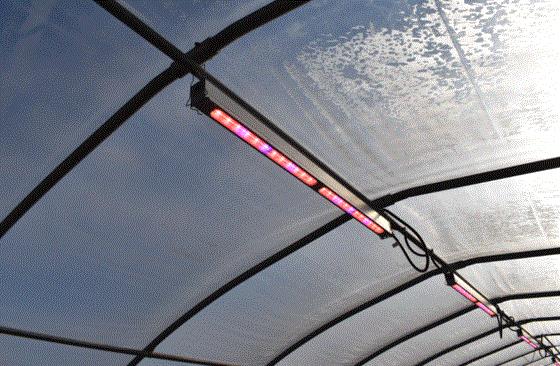
The addition of high-intensity discharge (HID) lights is a logical solution to address low light. Fixtures like LEDs (light-emitting diodes) and HPS (high-pressure sodium) lamps are commonly used in the greenhouse to supplement natural light levels. However, buying and installing these fixtures isn’t cheap, so it’s not always economically feasible to add lights, so consider the following to help maximize light levels in your greenhouses in other ways early in the season.
Glazing material age: If your greenhouse is covered with polyethylene film or rigid polycarbonate, the age of your glazing material has a big impact on light levels at crop height. As the sun degrades plastics, they darken in color and/or become somewhat opaque, which reflects (or absorbs) light energy from the sun and keeps it from reaching your crops. Follow manufacturer recommendations on when you should replace your glazing material and avoid the temptation to “get another couple of years out of it” if your spring crops have tended to get leggier or grow slower in recent years.
Glazing material cleanliness: Dirt, dust and algae on your roof and sidewalls all block light. Wash both the inside and outside of your greenhouse glazing and sidewalls each year. Pressure-washing with clear water is often sufficient, but be careful not to damage your glazing material. Also, if you include a detergent of some kind, check your glazing manufacturer’s specifications and care instructions to ensure it is safe to use. Many companies offer specific cleaning recommendations, so reach out to your suppliers when in doubt.
Change your shading strategy: Many of you apply a liquid shading compound to the outside of your roofs or sidewalls in summertime to keep the greenhouse cooler and block excess light. However, if you do not fully remove this before winter, shading compounds can accumulate and block the light your crops need in the early season. While the old white latex paint dilution works and is still used by many to “whitewash” their structures, it can sometimes be hard to remove completely. Consider use of products like ReduSol that have “release” agents to enable quick and easy removal of the shading compound when you want to take it off.
Manage crop spacing: If weather and glazing conditions cannot be remedied right now, consider how closely your plants are spaced on the bench/floor. The tendency to stretch is often a response to low light intensity, so adjust space between your crops to help light penetrate lower into the canopy and reduce competition for light among plants that are next to each other.
Also, wait for as long as possible before you hang your basket crops above plants on the bench/floor. Until natural light intensity and daylength increase, placement of crops above your main growing surfaces will only reduce light levels at crop height and diminish their ability to accumulate light energy.

Spring Production: Botrytis Preparation
When you ask growers about challenges in spring production, the greenhouse issue encountered most often and without much discussion or debate is Botrytis. I’m sure you’ll agree, and no doubt you’ve encountered gray mold in the past, as it impacts a very wide range of environments (indoors and outdoors) and crops (from ornamentals and cut flowers to vegetables.)

Our friends at e-GRO released an alert on botrytis written by Tom Ford, an extension educator at Penn State Extension. Tom gave a detailed rundown on botrytis, complete with photos of various impacted crops (the photo above is courtesy of Tom), information of how to create environmental conditions to prevent gray mold and sanitation tips. Here are some scouting tips that he shared in the alert. Before spring finished plant production kicks off for 2024, it might be a good idea to print out THIS e-GRO ALERT and share it with your team.
Some quick tips from the alert:
-
Examine all cuttings for blighted leaves and/or decaying tissues upon their receipt from the propagator.
-
Examine mature plants weekly and look for brown lesions on the leaves or for the presence of blighted foliage. Also examine the stems and look for brown, sunken cankers (especially where blighted leaves have been observed). Scout for signs of Botrytis cinerea infection in areas of the greenhouse where plants are overcrowded, where air circulation is poor, or where condensation appears to accumulate and drip.
-
If you cannot confirm botrytis infection through visual inspection, consider placing the blighted plant parts in a sealed plastic bag with a damp paper towel. Light gray to tan cobweb-like mold will develop on the infected plants parts if Botrytis cinerea is present. If you still are unsure, consider submitting a sample to the Plant Disease or Diagnostic Clinic located in your state. Sample submission guidelines and forms can vary state to state, so work through your local Cooperative Extension Office when needing assistance.

Upcoming FREE Webinars: Irrigation & Perennials
There are four upcoming webinars I want to share with you—all brought to you by GrowerTalks and hosted by Chris Beytes. Conveniently, all the info can be found HERE and all of the live presentations start at 1 p.m. Eastern/Noon Central.

February 7: Your Guide to Easy Perennial Production
Perennial production doesn't have to be tough. Join Jim Kennedy, Ball Seed Sales Director, and Darren Barshaw, Darwin Perennials Product Representative, to get a pulse on best practices for building or expanding your perennial program. In this webinar, you’ll learn about perennial scheduling, crop culture, and tips for handling different product forms. Other topics include supply chain flexibility and genetic breakthroughs that will optimize your best perennial crop yet. Expect an informative discussion about the top new perennial varieties, along with plenty of production tips.
February 21: The Benefits of Dissolved Oxygen in Irrigation Water
Optimizing the level of dissolved oxygen (DO) in your irrigation water can have huge impacts on plant growth. Too little DO can cause slower plant growth and crop problems. Super-saturated levels of oxygen can improve plant health and speed plant growth. Dramm's Les Evans will discuss the benefits, the systems and the procedures to optimizing the dissolved oxygen in your irrigation water.
March 7: New Perennials at 2024 Retail & 2025’s Must-Watch Perennials
Get to know and learn to grow the top new Proven Winners Perennials. Walters Gardens Regional Product Manager Laura Robles will review 15 of the top new perennials available at retail for 2024, as well as previewing 15 of the top upcoming varieties for 2025. If you want to know what’s hot in perennials, this is the webinar for you.
March 13: Common Water Problems and How to Solve Them
Growing plants is the conversion of water into plant tissue. Water is the most important input used in horticulture. Optimizing your water can have huge impacts on your crop. Often, growers experience problems with their water source or water quality. Dramm's Kurt Becker will discuss the various common water issues that affect growers and the solutions to each problem.
Again, you can sign up for these at www.growertalks.com/webinars. And check out all of GrowerTalks past webinars under the "Available Now" section.

Growing FYF Perennials from Vernalized Liners
Crops produced from VERNALIZED LINERS are perhaps the quickest, easiest and most predictable way to bring first-year-flowering (FYF) perennials to market. Darwin Perennials and Kieft Seeds tech expert Chris Fifo calls these “no brainers” and explains that almost every perennial class is FYF from vernalized liner.
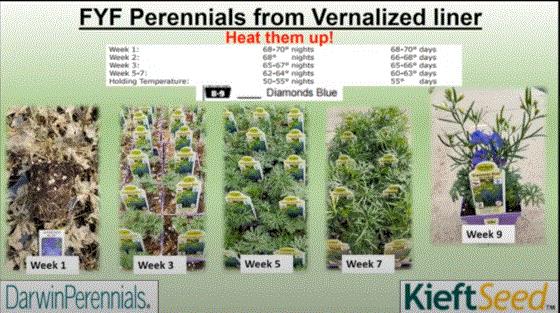
These mature young plants have been cold treated, creating more flower power right out of the gate. Chris recommends using 50-cell inputs or larger and transplanting them according to established “weeks to bloom” calendars. But remember, as soon as you receive these liners, the clock is ticking. Chris offers week-by-week advice to help you and your team bring crops to market in blooming color so they jump off the retail bench into shoppers’ carts as quickly as they are restocked.
This video is part of a miniseries on FYF perennials that also includes seed-raised plugs for spring and fall, as well as vegetative perennial production and is organized into one PLAYLIST to make them easy to access and share.

Reminder: Impatiens Downy Mildew Prevention
It’s that time of year again when I see emails going out from tech experts reminding growers to be vigilant when growing Impatiens walleriana for spring sales. Of course, most of you have moved your impatiens numbers to the new series bred for Impatiens Downy Mildew (IDM) resistance, but vigilance is still critical, because susceptible varieties are not going away just yet.

As our resident jack-of-all trades Tech On Demand expert Nick Flax once wrote, “As a group, DM-causing pathogens are difficult to detect, they strike fast, they develop resistance to fungicides very easily, and managing outbreaks can be costly for you and your customers. Downy mildews are systemic (spread throughout infected hosts) and decline and eventual death of infected plants is almost always the result. By the time symptoms and signs appear, it’s too late, so preventative management is critical.”
I thought it would be a good idea to share some resources this week to help you and your team stay on your front foot when it comes to IDM as we progress further into the spring 2024 season. A lot of research has been done and protocols for managing risk are pretty solid. And we’ve produced quite a bit of content in the past few years to help. Here’s the list:

Finish Line ...
This issue of the newsletter has been packed with timely technical information and ideas to help your team prepare for the weeks ahead. That’s my goal each week, and thanks to your feedback and ideas, improvement is continuous and the Tech On Demand team is better for it.
One source we use quite a bit when talking to growers with cultural and technical challenges related to seed-raised crops is the Ball Culture Guide.

The Ball Culture Guide: The Encyclopedia of Seed Germination has been a mainstay resource for growers since its introduction in 1989. That first volume was the culmination of a decade’s worth of research and development in seed germination knowledge and experience, thanks to the new technology of plug production.
Now in its fourth edition, the guide provides detailed information on germination, scheduling, production temperatures, lighting requirements, propagation and growing-on tips, final garden height and much more. The chart format makes it an easy-to-use guide for producing a multitude of seed-grown crops in all categories—annuals, perennials, potted crops, cut flowers, foliage plants, vegetables, herbs and ornamental grasses.
If you (and your production team) don’t have a copy on hand, NOW’S THE TIME TO ORDER! Trust me, it’s well worth the money, and I assure you it’ll be used plenty in 2024.
Talk to ya’ next week!


Please feel free to send your comments, constructive criticism and topic ideas to me at bcalkins@ballhort.com.

Bill Calkins
Editor - Tech On Demand
This email was received by you and 25,988 other fine subscribers!
If you're interested in advertising in Tech On Demand, contact Kim Brown ASAP and she'll hook you up.