What's Happening Here?
The days are getting shorter, schools are back in session and summer is nearly over. Before fall arrives, I thought I’d share a diagnostic challenge that's typically most problematic during the summer months. Take a look:
Look at this hedera. There are two things you’ll likely notice. First, you’ll notice a small piece of vermiculite resting on the center of the leaf. This is the carrier for the biologicals being applied to manage spider mites and is NOT what I want you to focus on. What I am hoping you’ll see is the presence of the small purple splotches on the leaf.
I already provided one clue: “Typically most problematic during the summer months” and the second hint I’ll offer is the shape of the splotches. I think I’ve said enough and likely helped many of you secure your final answer. With that, the time has come for me to ask, “What’s happening here?”
Take a few minutes to ponder the possibilities and I’ll reveal the answer at the end of this newsletter.
A New Multi-virus Test Kit
When perusing through my inbox this weekend, I came across a pretty cool virus testing product in JC Chong’s PestTalks newsletter. Rather than regurgitate the contents of his article, I thought I’d share the article straight from last week’s PestTalks.
Agdia has added a new virus test strip to its extensive offering of diagnostic tools and tests. Called the Thrips Spot Viruses ImmunoComb, this new test kit combines all immunostrips used to detect and confirm three viruses in a single, easy-to-use kit.
The target viruses are impatiens necrotic spot virus (INSV), tobacco streak virus (TSV) and tomato spotted wilt virus (TSWV), which are the most common thrips-transmitted viruses we find on greenhouse-grown ornamental plants, herbs and vegetables. These viruses cause similar symptoms, so scouts and diagnosticians often have to test for all three viruses at the same time.
Instead of testing for these viruses with individual immunostrips, you can now test for all of them at the same time using a single kit. The way to use this new test kit is the same as an individual strip—put the leaves (symptomatic or asymptomatic) in the buffer-filled extraction bag that comes with the kit, macerate the leaves and dip the test stripes in the solution. Wait for a few minutes and voilà! You know whether you have viruses and which one it is. Best of all, you can use the test kit in the field and get identification within minutes.
Click HERE for more information on the new test strip for multiple thrips-transmitted viruses.
Thank you, JC, for allowing me to share this information with my subscribers. This is just a taste of the great content JC puts out there. The latest issue contains a diagnostic challenge similar to the ones I do here and articles about different colored sticky cards, a new murder hornet and an invasive species tour. Go
HERE to view this newsletter in its entirety.

Impressive Perennials
Here are a couple perennials that have been catching my eye this year:
Buddleia Chrysalis Cranberry
Cranberry is a recent addition to the Chrysalis series of Buddleia from
Darwin Perennials. There are currently five cultivars in the series: Blue, Cranberry, Pink, Purple and White. They're all compact, forming attractive 2-ft. mounds of fragrant flowers from late spring to late summer. The cranberry color really pops in the landscape and rightfully earns numerous compliments. Hardy to Zone 5.
Nepeta Nova Blue
Nova Blue is likley under your radar, but I encourage you to take a closer look at one of
Terra Nova Nurseries' recent introductions. I first mentioned Nova Blue last year, and in my opinion, it still has untapped potential to become a perennial superstar.
It produces lots of bright lavender-purple flowers, blooms weeks ahead of its peers and flowers repeatedly from spring until fall keeping a clean and tidy appearance throughout the growing season. Nova Blue only reaches 4-in. tall and spreads 24 in. across. This great new nepeta introduction is cold hardy to Zone 5.

The Answer is ...
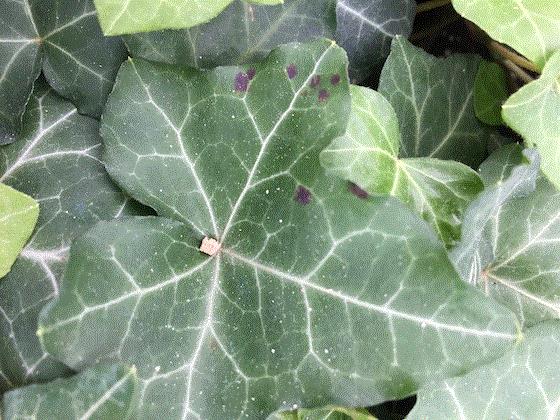
At the top of the newsletter, I showed this image and asked if you could identify what’s happening with this hedera. Were you able to figure it out?
I really hope you heeded my words above and weren’t misled about the vermiculite used to deliver biologicals for managing spider mites because the leaf spots weren't caused by spider mites. This problem can occur any time of the year, but is more prevalent during the heat of summer. Look at the spots once more—do you see what I see? If you answered the purple splotches appear to be angular, then you saw what I was hoping you would.
There are only a few things that cause angular spots to develop on leaf surfaces—they're bacterial leaf spots, downy mildew and foliar nematodes. If your final answer to this week’s challenge was bacterial leaf spots, you correctly diagnosed the problem on this hedera. Congrats! I knew you could do it.
Managing This Issue
Bacterial leaf spots on hedera are caused by Xanthomonas. Early infections typically appear as those shown above, but more advanced infections will appear as small circular, dark green to nearly black water-soaked (oily appearing) spots with yellow halos surrounding them (below). The leaves may eventually turn yellow, die and fall off.
The onset of bacterial leaf spots is greatly increased when the leaves are allowed to remain wet for several hours at a time. Once an infection occurs, it's spread from leaf to leaf with splashing water from overhead irrigation or rainfall. Therefore, to prevent the spread of bacterial leaf spots, it’s important to minimize wet leaves and splashing water from plant to plant. I know that's easier said than done, right? Consider watering in the mid-morning versus the early morning hours to allow the leaves to dry quicker during the brighter conditions of the late morning to early afternoon.
Bacterial leaf spots can be tough to control once the plants are infected. For this reason, the best strategy for reducing bacterial infections is through preventative spray programs. Biofungicides containing various strains of Bacillus, such as Cease and Triathlon BA, have been shown to provide good control of bacterial leaf spots when they're applied preventatively. Bactericides containing copper—such as Camelot O, Kalmor and Phyton 27—are great go-to products for minimizing bacterial infections. One additional option is the use of the disinfectant/fungicide/bactericide KleenGrow; it has shown just as much efficacy against bacterial diseases as the other options I’ve shared here. I like to alternate between a copper-based fungicide or a Bacillus product and KleenGrow, or rotate between each of these three options.
Preventative spray programs should be applied at seven- to 14-day intervals. Be sure to apply at the shortest intervals when disease pressure is present or the conditions are favorable (namely wet) for bacterial diseases.


Thanks for reading this edition of Perennial Pulse. My email is paul@opelgrowers.com if you have any comments, article suggestions or if you'd just like to say hello.
Best regards,

Paul Pilon
Editor-at-Large—Perennial Pulse
Director of Growing—Opel Growers
This email was received by you and 34,842 other fine subscribers!
If you're interested in advertising in Perennial Pulse, contact Kim Brown ASAP and she'll hook you up.