Poinsettias Are About to Hit the Shelves
I chuckled a little when I read Chris Beytes’s Acres Online from last Friday.
Not because Chris said something funny in the newsletter, although he’s always funny. Chris was wondering if mum sales were down this year. Some said yes and some said no. As folks take stock of what happened to this year’s mum crop, many are about to ship poinsettias out the same door. (My local Lowe's said poinsettias will be available starting November 12.)
We’ll have to talk about how well this year’s poinsettia crop does at the end of the year. I was amused by how incessant our crop production processes are and how much of our emotional and financial wellbeing is tied up with the performance of these processes.
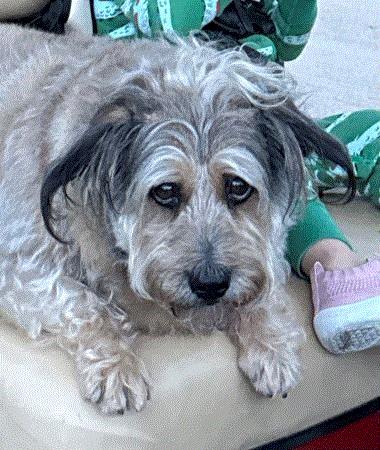
Where am I going with that thought? I’m not sure if I even make sense to myself sometimes. No wonder my wife’s dog often looks at her as if to say, “I’m sorry you’re married to this piece of work.”
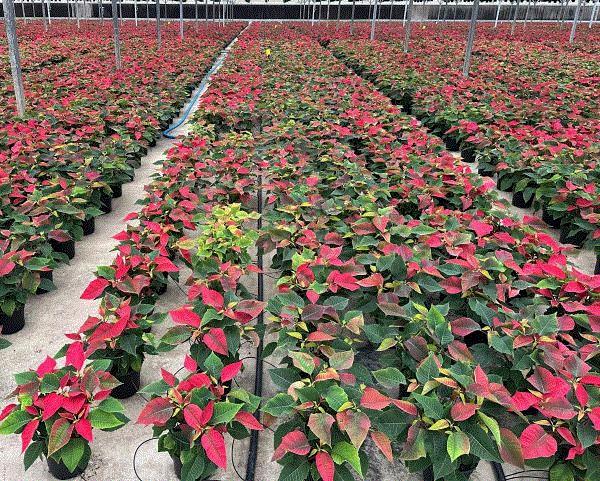
Ah, yes, what I was trying to say is, it’s only been a few days since we’ve been done shipping mums, but we now need to work on shipping poinsettias. They have color and are ready to go! In fact, I already found them on the shelves at my local stores.
Bugs and crud don’t care if the poinsettias are ready for sales or not; they infest and infect as opportunities present themselves. Pest management doesn’t end until the customers pay for and bring the poinsettias home. You take your eye off the ball at your own peril.
Today’s newsletter will focus on some last-minute pest management tasks before the poinsettias are out the door, just in case some bugs and crud show up.

Always Test for Bract Safety
Before we get to the bugs and crud, I want to first address the question of which insecticides, miticides and fungicides are safe for bracts. Bracts are the money-making parts of poinsettias—you certainly don’t want them to become spotted or burned before selling them.
I don’t really have a good answer to that question. Yes, I could list products that have clear label prohibitions on uses on poinsettias with colored bracts or not. But I also know there are a few problems with relying solely on labels. First, pesticide manufacturers can’t test for all plant species or cultivars, so label languages aren’t always comprehensive. Secondly, phytotoxic responses may be different among cultivars of the same plant species. And, lastly, how, when and where we use or apply pesticides also influence phytotoxicity.
I’ve experienced or heard about too many incidences of plant injuries, even when one follows label precautions. I’d seen a product cause injury when sprayed a bit too heavily. There are also differences between formulations: I observed damage from BotaniGard ES in a trial, but BotaniGard WP was perfectly fine in the same trial. I also tested a product that’s supposedly unsafe (Hachi-Hachi SC) on Freedom Red bracts and had no problem. A safe product can also turn bad when tank-mixed with another product or adjuvant or applied when it’s too hot, too cold or too something else.
I always recommend doing a phytotoxicity test whenever one uses a new product or a familiar product on a new crop. For poinsettias, I would even go so far as suggesting you test bract safety of every product you use. It'd be even better if you conduct tests on as many of the cultivars as you're growing, all application rates you plan to use and under the environmental conditions when the products are likely to be applied. If you can’t trust information from other sources, then get the information yourself!

A List of No-No Insecticides & Fungicides According to the Labels
Although I don’t put a whole lot of weight on label statements of a product’s bract safety, that’s just about the only place where I can get bract safety information relatively easily, so that’s where I’ll start.
You can also talk to representatives of the pesticide manufacturers and cutting suppliers and see what additional information or precautions they can provide. Of course, also talk to your trusted fellow growers and managers. If y’all are willing to share some of your experience on which products are safe or not on bracts with me and all of the readers of this newsletter, please email me.
Here are some of the insecticides and fungicides with precautions about use on poinsettias:
-
Adept (diflubenzuron): Do not apply to poinsettias.
-
BotaniGard ES (Beauveria bassiana): Do not apply to poinsettias after bract formation.
-
Distance IGR (pyriproxyfen): Do not apply to poinsettias after bract formation. Malformation of roots and newly expanded leaves after drench application have been observed on some cultivars (Freedom Bright, Freedom Bright Red, Winter Rose and Jingle Bells).
-
Endeavor (pymetrozine): Do not make foliar application to poinsettias after bract formation.
-
Hachi-Hachi SC (tolfenpyrad): Do not apply to poinsettias with colored bracts.
-
Nufarm Chlorpyrifos SPC 4 (chlorpyrifos): Phytotoxicity caution on some varieties is noted.
-
Milstop SP (potassium bicarbonate): Weekly application of 0.5 lb. per 4,350 sq. ft. may cause marginal burn to young leaves during vegetative growth. Biweekly applications don’t injure developing bracts.
-
Pedestal (novaluron): Cannot be used on poinsettias.
-
Pillar SC Intrinsic (triticonazole + pyraclostrobin): Potential stunting or discoloration.
-
Pipron (piperalin): Label noted reports of spotting on mature bracts.
-
Pylon (chlorfenapyr): Cannot be used on poinsettias.
-
Tame 2.4EC (fenpropathrin): Tank mix with Orthene (acephate) cannot be used on poinsettias after bract formation.
-
TetraSan (etoxazole): Do not apply to poinsettias after bract formation.
-
Triact 70 (neem oil): Do not use on poinsettias.
-
Trinity (triticonazole) (discontinued): Potential stunting or discoloration.
-
Ventigra (afidopyropen): Poinsettia, particularly at bract formation, is not tolerant.
Residues of 26/36 Fungicide (thiophanate methyl + iprodione) and Palladium (cyprodinil + fludioxonil) may be visible after frequent applications or high application rates.
Check out the April and May 2026 issues of this newsletter for phytotoxicity of insecticides and fungicides on other plant species. Email me if I missed some products that shouldn’t be used on poinsettias in the list.

Insects & Mites on Pre-Sale Poinsettias
Among the bugs of poinsettias, I often think of thrips and broad mites as pests that are more impactful in the earlier stage of growth. Every bit of distortion caused by thrips and broad mites can become serious blemishes as plants grow and leaves expand. These two pests should be managed from the start of a crop.
That’s not to say that the other major pests—whiteflies, fungus gnats, shore flies and Lewis mites—could just be left unattended. These pests become a problem during bract formation because their management aren’t particularly successful during the growing phase. That brings us to one of the facts about pest management in poinsettia: If you don’t want to deal with any pest when bracts are showing color, then deal with them when the poinsettias are still green.
I always tout whitefly management on poinsettias as a prime example of successful biological control. The combined use of multiple biological control agents (predatory mites, parasitoids and entomopathogenic fungi), systemic insecticide drench and insect growth regulator treatments have basically rendered whiteflies a manageable pest. Folks who can't use neonicotinoids have several good systemic and translaminar alternatives (see this GrowerTalks article I wrote a few years ago).
I think insecticide selection depends on how many days I have until shipment. If bracts are showing color, but I have a week or two to spare, then I’ll choose a neonicotinoid or another systemic insecticide (spray or drench), insect growth regulators (such as buprofezin or Talus and s-kinoprene or Enstar) or one of the insecticides mentioned below.
These insecticides have great efficacy in reducing nymph numbers and, consequently, the adult numbers (which are more noticeable by clients). If I’m only a few days from shipping, I would use abamectin (Avid, Barracuda, Minx, etc.), acetamiprid (TriStar), dinotefuran (Safari), flonicamid (Aria), pyridaben (Sanmite), pyrifluquinazon (Rycar) and thiamethoxam (Flagship) to quickly knock down adults and reduce nymphs.
I think of fungus gnats and shore flies as leftover problems from the growing stage. Similar to whiteflies, sprenching the media with neonicotinoids, azadirachtin, cyromazine (Citation), Steinernema feltiae, Isaria and Beauveria can still help reduce larva and adult numbers if you still have a week or two before shipping. If it’s only a few days to shipping, management should be to sprench the media with a neonicotinoid or pyrethroid to reduce adult numbers.
You can often pick out Lewis mite-infested poinsettias by their lighter color.
Lewis mite has become a real pain in the past few years. In my experience, miticides that work well against the twospotted spider mite also work well against the Lewis mite. That means there are several options.
In the finishing stage, the success of a mite management program depends on how well you can achieve spray coverage when canopies are dense and plants are packed tight. Miticides that have translaminar activity—such as abamectin (Avid, Barracuda, Minx, etc.) and spiromesifen (Savate)—have some advantages in this situation. (Etoxazole and chlorfenapyr are also good translaminar miticides, but they can’t be used on poinsettias in bract formation.)
Effective contact miticides—such as acequinocyl (Shuttle), bifenazate (Floramite, etc.), cyflumetofen (Sultan), fenpyroximate (Akari) and hexythiazox (Hexygen)—can also be used if application volume can be increased or an adjuvant can be added to increase coverage. Note that Sultan label suggests that the addition of an adjuvant can reduce visible residue on poinsettias.

Diseases on Pre-Sale Poinsettias
I mentioned that the best way to avoid having to deal with bugs on pre-sale poinsettias is to control them effectively before bract formation. This is doubly, triply true for diseases because the symptoms of and damage by diseases won’t simply disappear with the successful control of pathogens. Charles Krasnow of the University of Connecticut has a great article on preventing Botrytis on poinsettia in the May 2026 issue of GrowerTalks.
The most common diseases on pre-sale poinsettias (at least based on what I saw) are Pythium root rot, Rhizoctonia stem rot and web blight, Botrytis, and powdery mildew. The best way to manage symptomatic poinsettias isn’t treatment followed by more treatment; the best way is to haul them all to the dumpster because whatever we spray won't reverse the decline the plants have already suffered.
Environment manipulation (heat, airflow, irrigation, etc.) can help prevent infections on asymptomatic plants. (Remember the disease triangle?) Fungicide applications can also help slow down or stop the spread. Every pathologist has his or her Tier 1 and Tier 2 (or String 1 or String 2) products (so do "fake" pathologists like me).
Late-season management of Pythium and Rhizoctonia has to be very aggressive. You also need to have a higher tolerance for losing more plants over time as more infected plants become symptomatic.
My go-tos for Pythium are etridiazole (Terrazole), cyazofamid (Segway), fluopicolide (Adorn), fenamidone (Fenstop), fosetyl-Al (Teclera) and propamocarb (Banol). I might also throw in a FRAC 11 or 7 + 11 fungicide (such as Empress, Heritage and Pageant Intrinsic) or mefenoxam (if you don’t already see some reduction in efficacy) if additional options are needed.
For Rhizoctonia, I would go with a fungicide that contains a FRAC 3 (Avelyo, BattleLine, Tourney, etc.), FRAC 11 (Heritage, Empress, etc.), FRAC 7 + 11 combo (Broadform, Mural, Orkestra Intrinsic, Pageant Intrinsic, etc.), fludioxonil (such as Medallion), polyoxin D (such as Affirm) or thiophanate methyl (such as 3336).
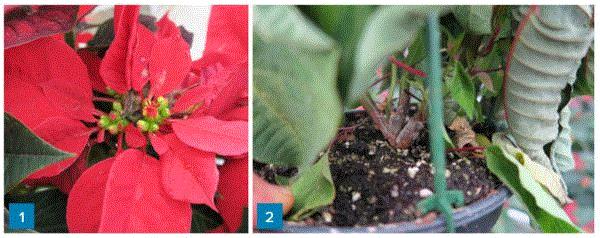
Botrytis infections on bracts and stems. (Photo credit: Charles Krasnow, University of Connecticut.)
I think you’ll get decent efficacy against Botrytis by using a FRAC 7 + 11 (Broadform, Mural, Orkestra Intrinsic, etc.), a FRAC 7 (such as Astun and Postiva) and a FRAC 11 (such as Heritage and Empress) fungicide, as well as fehexamid (Decree) or fludioxonil (Medallion). Palladium (cyprodinil + fludioxonil) is also a good option, but test to see if these products would leave noticeable residue on the bracts as warned on the labels.
For powdery mildew, a product that contains a FRAC 3 fungicide (such as Avelyo, BattleLine and Postiva), a 7 + 11 combo (such as Broadform, Mural and Orkestra Intrinsic) or pyriofenone (Seido) is an effective option. Pipron (piperalin) is very effective against powdery mildew, but you need to test it on a small group of poinsettias with colored bracts to see if you see the spotting damage noted on the label. Palladium is also a good option, but test to see if the application can leave behind noticeable residue.


Have a great 2026 poinsettia season. See y'all later!
JC Chong
Editor-at-Large
PestTalks
This e-mail received by 27,847 subscribers like you!
If you're interested in advertising on PestTalks contact Kim Brown ASAP!