NEW PODCAST: 4 Questions for Marcus, a Landscape Business Manager
For the latest “Pick 4” edition of my Tech On Demand podcast (EPISODE 279) in which we get to know cool people in the hort industry, I was joined by my friend Marcus Jansen, the new Landscape Business Manager for Ball Seed and a fascinating guy with deep roots in horticulture—from 4-H and FFA to Iowa State hort degrees and multiple internships with leading green industry businesses. Eventually his path led him to Ball, where he spent five years with PanAmerican Seed and is now leading a major, strategic initiative with Landscape.

But the corporate side of Marcus is just one facet of his industry life. He’s also active in many organizations—he even leads “plants and pints” events at his local brewery. Marcus brings tons of passion to his roles in our industry, and you can’t help but get inspired when he talks plants. Listen all the way to the end because one of his favorite perennials is one I hadn’t even heard of—but now I want a bunch for my yard!
Here are the four questions Marcus chose to answer:
Q: What was your first exposure to “horticulture” and how did you feel, react, respond?
Q: If you won the lottery and could start a horticulture business from scratch, what would it be and what would it look like?
Q: What are your top three favorite annuals? And perennials?
Q: What advice would you give to a young person considering pursuit of a career in horticulture?
Huge shout out to episode sponsor Prospiant—leaders in greenhouse design, manufacture and build. Learn more and connect with the expert team at prospiant.com.
There are now more than 275 Tech On Demand podcast episodes in the archive covering a huge range of topics related to the professional greenhouse, garden center, landscape, nursery and CEA markets. Jump back in to get caught up or take a minute to subscribe—that way you’ll never miss an episode!

James’ Tip of the Week: Don’t Chase Poinsettia Height
Usually, I work with my buddy Nick Flax, a technical services expert at Ball Seed, to share a concern that’s come up during one of his numerous calls with growers across North America. This week, Selecta One and Ball FloraPlant technical manager James Doukas is hijacking this section to share some advice he has used in his past life as a grower and now shares with growers across the continent who are producing millions of top-quality poinsettias. Next month (November) can really be a make-or-break time for your crop.
PROBLEM: November is on the horizon, which means that across the North American continent, poinsettias—no matter their response timing—are putting their energy toward bract development vs. height growth. Unless your operation is located on the most southern latitudes, natural growth will tail off to about one-half to three-quarters of an inch per week (or less).

JAMES’ TIP: Last week's tips from Josh Henry focused on maintaining good-quality bracts through the last few weeks of finish prior to ship. This week's tip is to NOT go chasing height specs in November. Even with some chemical GA tricks, making up 2 to 3 inches this late is unrealistic. Instead, focus on accepting the crop as it currently is and spend your time finding alternative buyers (if needed) for the portion of the crop coming up short of spec.
Don't shoot from the hip and apply chemicals that you are unsure of their response. November is when poinsettia plant quality is maintained or lost, not made up. And every chemical application, whether applied overhead or as a drench) comes with risk.
This does NOT mean never try something new. Minimize your risk by testing new chemical applications on a small group of poinsettias prior to crop-wide application. If you desire to apply a chemical across the crop, make sure every individual variety you plan to treat is represented in your test group. Poinsettias, even from the same breeding company, are individuals; an application that is safe on one variety does not ensure safety on another variety. These response differences can be minor during growing, but with bract color the response difference can range from minor spotting to total bract destruction. Still, there is value in experimenting to see if you have a tool for next year.
Temperature strategies are the best for throttling bract color development and growth. Use morning dips and negative DIF to control height on varieties that have a history of late-season stretch. Maybe apply a paclobutrazol micro-drench if you are nearing the top of your height specs. Bring up your night temperatures for quicker color development. Positive DIF can help on sunny days to eke out that additional quarter inch of height, but on overcast days the artificial warm day can produce soft growth prone to handling damage during shipping.

Corteva’s Solutions + Controls: Managing Against Insect Resistance
This week, I connected with technical experts at Corteva to learn more about why attention to insecticide resistance management protocols will help preserve our most effective chemistries. Thank you to Corteva for providing this critical information.
While some of the most significant agricultural developments have been technological, others have been more attitudinal; among these is our deepening understanding of insect life cycles and physiology. It’s this understanding that led to the framework we now call integrated pest management (IPM). One of the chief goals of IPM is prevention of insecticide resistance.

Resistance occurs when various factors—biological, genetic or operational—increase pressure on an insect population, resulting in reduced susceptibility to those factors. Use too much of a specific insecticide, active ingredient or mode of action, and future generations can develop resistance to that control measure. Greenhouses and other enclosed spaces are particularly susceptible due to their relatively constant environment, low beneficial insect or predator populations, and robust spray programs. But when used within a larger IPM program, insecticide resistance management (IRM) principles can help preserve the effectiveness of valuable insecticides.
Insecticide Resistance: Prevention Is the Best Cure
One of the most effective recommendations for preventing resistance is avoiding the continual use of a single active ingredient or mode of action. Instead, opt for an insecticide rotation or mixing products with multiple active ingredients.
XXpire insecticide from Corteva Agriscience, for example, uses two active ingredients with two different modes of action to control more than 39 common greenhouse and nursery pests, making XXpire insecticide an effective option for your IPM program.
That said, IRM isn’t exclusively about the choice of chemistry. Regular scouting, identification of population or damage thresholds, and applications targeting insects at the most vulnerable stage are equally important and can help boost the effectiveness of an insect control program.
Fine-tuning the Mix
In the last 10 to 15 years, new classes of chemistry have been developed, each with different modes of action. These products are more selective and more effective at specific developmental stages. As a result, it’s critical that nursery and greenhouse managers and consultants understand the targeted pests, the effects of their insecticide or mix, and the downstream impacts of the various insecticide classes.
While insecticide mixtures can provide an increased spectrum and level of control, the products used should be chosen for their efficacy against specific pests. Avoid combining products with similar modes of action and choose products that minimize the risk of cross-resistance. And when possible, use products that have similar residual activity.
Sound resistance management practices can help prolong the effectiveness of insecticides and should be considered a shared responsibility. A programmatic approach to pest control should be part of everyone’s strategy when choosing insecticides and other control measures in greenhouses and nurseries.
Connect with the expert team at Corteva and learn more about their product lineup HERE.

OSU Conference Notes: Can Biostimulants Help Optimize Fertilizer?
Biostimulants continue to generate buzz in our industry and just about every conference I attend includes at least one presentation on their potential benefits. In fact, I made sure to include them in our 2026 BIOSOLUTIONS GUIDE (and will again in 2027), but it definitely seems like determining when and where to use them in production can be challenging.
At the Ohio Floriculture & Nursery Conference, Dr. Michelle Jones from The Ohio State University discussed research into microbial biostimulants and their potential to improve fertilizer use efficiency.
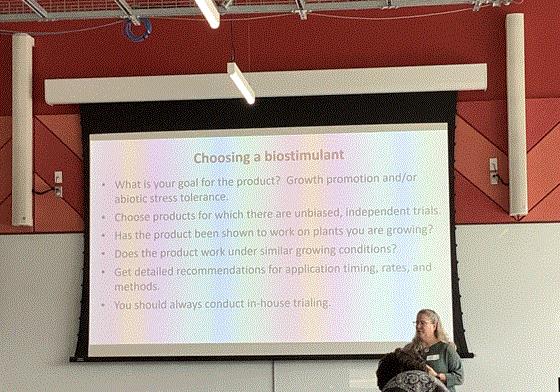
Based on her presentation, it seems biostimulants can improve plant health and quality while helping plants tolerate stresses such as drought and temperature extremes. Here’s a summary of the notes I took during her excellent talk:
Microbial biostimulants contain beneficial organisms including Bacillus, Pseudomonas and Azospirillum bacteria, mycorrhizal fungi and Trichoderma. Potential benefits include improved rooting and plant growth, as well as flowering, overall appearance and “greenness.” Additional benefits seen during research include nutrient uptake and drought tolerance. But … results aren’t always consistent.
Of course, the growing conditions and greenhouse environment matter because these products contain living organisms. In addition, nutrition, substrate, pH, application methods, plant species and other crop protection products can all influence performance. And that’s a LOT of factors! Differences among plant varieties and biostimulant formulations add even more variability.
In terms of biostimulant impact on crop nutrition, fertilizer levels are especially important. If plants already receive all the nutrition they need, the benefit from a biostimulant may be limited. High fertilizer rates, particularly phosphorus, can also suppress microbial colonization.
That creates an interesting opportunity. Rather than adding biostimulants to an already high fertility program, growers might use them to improve nutrient availability and plant performance at normal or lower fertility levels.
Dr. Jones discussed research showing healthier, greener plants and increased nutrients in leaf tissue following applications of microbial products. Some beneficial bacteria can also produce auxins that encourage rooting. Better root systems could ultimately help plants make better use of available fertilizer. All of these research findings are super encouraging!
But, as always, there are limitations. Mycorrhizae can take about four weeks to colonize and produce a plant response, and different microbes may perform better with particular crops.
The takeaway is really to treat biostimulants as another production tool, not a cure-all. Consider where they might reduce inputs, improve crop quality or provide some added protection when plants encounter unexpected stress. Keep an ongoing dialogue with your biostimulant suppliers, seek out good research to peruse—and, of course, watch for future articles in GrowerTalks and our grower guides, because this topic is exciting and one that we’ll be following closely!

Register Now: Biological Control Conference on November 12
If biological control is part of your IPM program and you can get to Connecticut next month, this event is definitely one that should be on your radar ... and NOW IS THE TIME TO REGISTER—before November 5!
The Biological Control Conference for Ornamental Growers takes place Thursday, November 12, at the Connecticut Agricultural Experiment Station in New Haven, Connecticut.
Hosted by UConn Extension’s Rosa Raudales and Charles Krasnow, the conference is designed specifically for commercial ornamental growers, with a strong focus on practical information you can take back and implement at your operation.

Photo: Suzanne Wainwright-Evans (Buglady Consulting)
The program covers microbial biopesticide applications, pest and beneficial identification, pesticide compatibility, and two newer BCAs/predators (brown lacewing and Crazee Mite). Attendees will also get hands-on experience evaluating the coverage and distribution of microbial products using spray-sensitive paper and selective media.
Here’s a session that caught my attention: Suzanne Wainwright-Evans (Buglady Consulting) will lead an interactive “Bug Battle” session focused on identifying pests and beneficials and using that information to make better biocontrol decisions. How cool does that sound?!
The day wraps up with attendees and peers sharing real-world IPM strategies, including in-house beneficial rearing, pest management trials, pest tracking and IPM maintenance programs.
Registration is $80 plus tax and includes lunch and five pesticide recertification credits. Space is limited to 70 attendees and registration closes November 5. Walk-ins will not be accepted.
Check out the FULL PROGRAM SCHEDULE and I think you’ll agree that it looks fantastic!

Finish Line ... CEAs
I want to take this opportunity to pass along a request from Inside Grower editor Jen Polanz—nominations are now open for the CEAs! Here’s what she wants you to know:
I am thrilled to announce we have launched the nominations page for the third annual CEAs—Cultivating Excellence Awards, presented by Indoor Ag-Con and Inside Grower magazine with award sponsor Premier Tech. Winners will be announced at the Gala Luncheon at Indoor Ag-Con March 24, 2007, at the Westgate in Las Vegas. Click here for the nomination forms and full award descriptions.

This is the third year Inside Grower magazine has partnered with Indoor Ag-Con to offer up awards that highlight the best in growing operations and product innovation. And last year, we introduced the Trailblazer Award to recognize the innovators who paved the way early on. As a refresher, our awards are:
-
Operational Excellence Award
-
The Product Innovation Award
-
Trailblazer Award
Full descriptions are available on the nominations home page. The deadline for entry is Friday, November 20, so don’t delay! Also, do you have a recommendation for a future Trailblazer? I’d love to hear it—shoot me an EMAIL!
Join us at Indoor Ag-Con March 24-25 at the Westgate in Las Vegas, where we will hold the CEAs Gala Luncheon on March 24 and announce our winners! REGISTER TODAY.
Talk to you next week!


Please feel free to send your comments, constructive criticism and topic ideas to me at bcalkins@ballhort.com.

Bill Calkins
Editor—Tech On Demand
This email was received by you and 25,397 other fine subscribers!
If you're interested in advertising in Tech On Demand, contact Kim Brown ASAP and she'll hook you up.