NEW PODCAST: 4 Questions for Tanya, a Territory Manager (AND BLOOM DIVA!)
For about the past month on the Tech On Demand podcast, I’ve been catching up with different people in the industry to find out a little bit about their careers, passions, journeys in the world of plants and more. I keep saying this is a great way for me to reconnect with friends and learn more about our industry’s most valuable assets—the people! It’s been fun, and I've lined up 10 more since CAST, which means you’ll hear plenty of these chats throughout the summer.
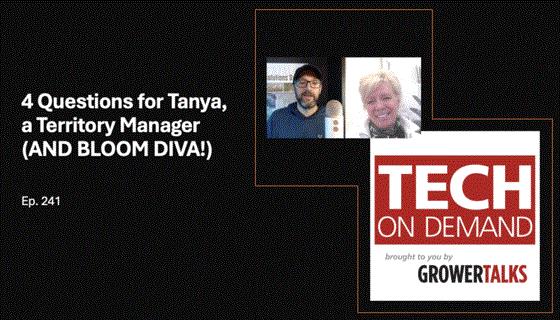
For EPISODE 241, I’m joined by Tanya Carvalho, territory manager for all of Canada at Ball FloraPlant and Selecta One. Tanya is also a social media influencer for the commercial side of our industry—you should follow her on Instagram! @tanyacbloomdiva
As I said in the intro, Tanya is one of our industry’s biggest advocates and a super passionate green industry representative who truly cares about the customers she serves. She’s amazing, and you can’t help but fall more in love with flowers and plants after interacting with Tanya.
Here are the four questions (from the 12 I sent her) that Tanya selected:
Q: How do you explain our industry to strangers, friends, family?
Q: If you won the lottery and could start a horticulture business from scratch, what would it be and what would it look like?
Q: What are your top 3 favorite annuals? And perennials?
Q: What advice would you give to a young person considering pursuit of a career in horticulture?
Oh yeah … This episode is sponsored by PROSPIANT—leaders in greenhouse design, manufacture and build. Shout out to the Prospiant team for supporting the podcast!
Guess what!? There are more than 240 Tech On Demand podcast episodes in the archive covering a huge range of topics related to the professional greenhouse, garden center, landscape, nursery and CEA markets. Take a minute to subscribe—that way you’ll never miss an episode.

Nick’s Tip of the Week: The Big Combo Balancing Act
Each week, I’ll work with my buddy Nick Flax, a technical services expert at Ball, to share a concern that’s come up during one of his numerous calls with growers across North America. This week, he’s discussing a particular issue he works with growers to manage each season—dealing with uneven combo growth.
PROBLEM: Looking back at the past few seasons of my activity reports for spring problems I run into when working with growers, I noticed more than a handful of back-and-forths about keeping mixed combo containers more-uniform. Whether you plant combo-liners (like MixMasters, Kwik Kombos, Confetti Gardens, etc.) or mix and match your own creative combinations, the way to achieve uniformity starts with your ability to find “happy mediums.”

NICK’S TIP: Keep the following in mind as you plan environmental and crop cultural strategies in your combos to identify factors that can lead to uneven growth and development.
Dial Your Temperature
Temperature fundamentally controls leaf unfolding rate, and all species have an optimal temperature where leaves unfold quickest. Above or below that optimum temperature, new leaves unfold at progressively slower rates. For most herbaceous ornamentals, if you plot leaf unfolding rate at different temperatures on a graph, each crop’s temperature response curve will look like an upside-down “U” when you connect the dots. The goal with combo planters is to grow at an air temperature where all (or most) of those curves intersect at close to the same point, or similar leaf unfolding rate. For example:
-
Combo planters with different cultivars of the same crop in a family/series are often the easiest to keep components on pace with each other. While some differences in optimum temperature may exist across varieties of the same plant, they are often minimal and those “temperature response curves” are almost identical. As such, no matter what you set your greenhouse temperature to, it’s rare for different components of these types of mono-crop combos to overgrow each other.
-
Combos with several different crops, however, present a much greater likelihood that one crop may overgrow the others if the temperature isn’t right. For example, I regularly see petunias dominate neighboring components in combos when they are grown cool right after transplant.
Petunias will establish quickly and thrive even at colder temperatures, but crops like calibrachoas and verbenas will take longer to root in.
A week or two head start is all a petunia needs to push out and start to overgrow its neighbor, so the solution here is to grow these types of combos at slightly warmer temperatures initially. Once all components in a mix start to actively grow, then you can start to reduce air temperatures to promote better tone.
Many growers reduce greenhouse temperature in late winter and early spring to reduce heating costs, but if savings on heating result in the need to rework baskets and patio pot combos by hand and increase use of plant growth regulators, are you really saving money?
Balance Your Fertilizer
The type of fertilizer you use can have a major impact on leaf shape and size or tendency to stretch. Many growers use ammonia- and/or urea-based fertilizers to keep low pH-loving crops like petunia and calibrachoa happy, but ammonia and urea forms of nitrogen often encourage lush growth and rapid leaf expansion. Nitrate-based fertilizers, on the other hand, tend to encourage tighter, more-toned growth and smaller leaf size. Be critical of the fertilizers you use early in the crop cycle, or you may inadvertently encourage one or two of your combo components to outgrow their neighbors.
A frequent trend when I discuss overgrown combo components with growers is the use of fertilizers like 20-10-20 or 20-20-20 at high concentrations right after transplant. In these cases, petunias tend to overtake other genera in the mix.
-
For those of you who use these types of fertilizers to reduce alkalinity instead of acid injection, this tendency is harder to avoid without driving the soil pH up rapidly. This is a reason why reliance on acidic fertilizers that encourage lush growth to manage alkalinity is ultimately not a very flexible strategy.
-
Consider watering combos in with a nitrate-based fertilizer or a more-balanced blend of ammonia/urea-form nitrogen and nitrate-based nitrogen sources. This will help jump-start your combos with a shot of feed but not spur petunias to balloon-up and outcompete the other genera for space right away.
Once all components are established and start to push out at a similar pace, you can lean more heavily on acidic fertilizer to manage soil pH. If iron deficiency symptoms start to appear on low-pH-loving crops in those first few weeks due to nitrate-based fertilizer use, an iron chelate drench will serve as a good temporary Band-Aid until you can switch back to 20-10-20 and lower the soil pH again.
Again, your operation’s water quality and alkalinity management strategy have a big influence on how heavily you can feed combos with nitrate-based fertilizers without causing soil pH issues. Monitor soil pH regularly any time you change fertilizer strategies and make proactive adjustments to avoid long-term challenges with crop growth and quality.

CAST 2026 Debrief: Ups/Downs
I’ve attended California Spring Trials for something like 20 years (since it was Pack Trials) and although for 10 of those years I was stationed in Santa Paula at the Ball site, whenever I return dozens of people immediately ask “so what did you see out there?” It’s a tough question to answer because I can go in a bunch of different directions.
First off, there’s the new varieties—and this is usually what the question asker wants to know about. But they’re also asking for trends … and the “vibe,” meaning how industry members’ attitudes are heading into spring. Some are probably wondering if there’s big industry news like acquisitions, bankruptcies or people changing roles. Big box growers always wonder what the IGC growers are looking at, and vice versa.
So, here’s what I’ll do—partially to organize my own thoughts—but also to try to cover most bases in my post-event debrief. First, I’ll cover trends in products. Next, big-picture industry trends I noticed. Lastly, how marketing strategies impacted what was shown and where breeding and introduction direction seems to be moving to meet retailer and consumer needs. Of course, please remember these are just my own takeaways. Don’t take this as gospel in any way shape or form.
In our industry, trends really don’t go away but they do shift in terms of importance at events like Spring Trials. Here are ups and downs.

Ups: Begonias and dahlias—so many new intros for these classes in the past three to five years and it continued this year. Begonia and dahlia breeders have been busy, and in both crops new dark-leaf varieties with bright blooms seemed to dominate the displays at CAST. For begonias, I particularly liked the new Whopper Rose Espresso from Benary, and Dragon Wing Bronze Leaf White from PanAm. In dahlias, I pretty much like them all, but the showstoppers for me were the LaBella four-color Chocolate series from Beekenkamp, I’conia Valencia Pink from Dümmen and Coffee Shop Lavender Latte from Syngenta.

Ups: Fresh new colors & patterns—orange petunias and vinca, black angelonias, water-color pattern blooms and speckles/stars/hearts have been emerging at CAST for a few years now and 2026 seemed to take it to another level. We saw a massive pinkish-white tradescantia called Pistachio Pink at Green Fuse, “blue” pentas at Benary and Green Fuse, chartreuse rosemary at PlantHaven, vivid yellow agastache at Dümmen and petunia colors I can’t even describe in the Amazonas series from Danziger. Of course, Westhoff had new Crazytunias and a standalone called Frogger White. They always seem to push the envelope with colors! I also really liked the vibrant, bright colors in petchoa from PanAm (Caliburst Nectarine) and Ball FloraPlant (CitraNova Lemon Zest and Limone).
Downs: Geraniums—when we were touring Syngenta’s trial on our final day, we saw a couple new geraniums. Both were sort of niche series for smaller-pot programs. Bossman Beytes commented that he thought they were the first geraniums we’d seen all week and as I thought back, he was right! Seriously—five days covering 30 trials and we saw two new geraniums ... it has to be a spring trials first! In years past, we’d always see new geraniums from five or more breeding companies. I know for a fact there were more new geraniums out there, but they were definitely not focus items breeders chose to show the media. Maybe there were supply chain messages for distribution reps, but from my perspective, geraniums are on the CAST “down” list.
Downs: Coleus—like geraniums, we saw VERY few. I’m digging through my notes and I think the only coleus we saw as standalone new introductions (not in combo programs) were three new ones in the TerraScape program from Kientzler. As I’ll share later, one trend I picked up on at CAST is breeding in shade crops … like coleus, traditionally. But all the new coleus seem to be positioned as sun plants (or sun and shade). Maybe there’s so much competition on the sun bench that coleus are getting squeezed out by big, new flowering plants? Just a thought. There are a lot of coleus on the market and they seem to sell well but maybe there’s no longer the big growth we saw in the past, which tends to lead to big breeding programs.
To see ALL of the products I mentioned above, check out videos from every CAST stop and every new variety exhibitor. THEY’RE ALL HERE IN THIS PLAYLIST.

CAST 2026 Debrief: From 30,000 Feet
I wanted to lead with varieties because they’re the lifeblood of the industry. And because most readers will stop there (glad you didn’t!) and here’s where I might get controversial. I doubt any of these comments will get me in trouble, but it’s good to slim down the audience a bit, LOL.
From a high level and because I do have a decently-long perspective on CAST, here are some thoughts.
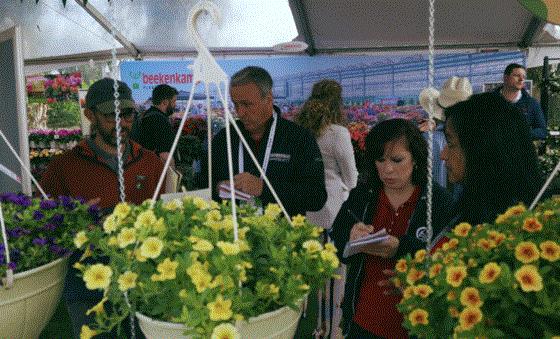
I felt like the event was very conservative this year. Most of the introductions were upgrades or line extensions—like a new red with a better habit or a few new colors added to an already-large series with good industry uptake. I get it, most of the new product dollars come from these products and they’re much easier to add to a customer’s existing order. And although these products always make up the bulk of new varieties from a percentage of intros, the feature displays at CAST tend to showcase the hottest new stuff and the secondary displays capture the extensions.
This year, I really felt there were more feature displays than usual (the ones tour guides take editors to) featuring upgrades and color extensions. While we did see all-new series or major breakthroughs, they seemed few and far between. I’ve been thinking about this for a few days and might have a reason brewing in my brain … there’s a lot of uncertainty floating around us all these days and this certainly impacts both how businesses operate and how shoppers consume.
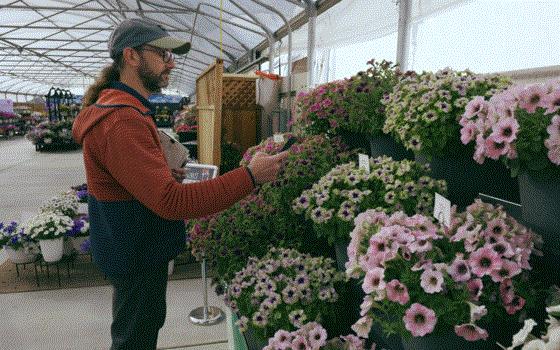
Maybe now is a good time to step back a bit on the huge innovation investments and focus on solidifying current offerings and maximizing what’s already in the portfolio. It could also be that with so many huge innovations in the past decade (it really feels like the entire plant world has taken a major step forward with amazing new breeding), we’re just in a bit of a lull or haven’t yet determined where the next big breakthroughs will come from.

CAST 2026 Debrief: Retail Influence Drives Innovation
Okay, this shouldn’t be controversial … as close as breeders, growers and retailers are these days, it’s no surprise that breeding direction and plant introductions are more and more aligned with retail sales and sell-through. Of course, I’m talking mostly about big box and mass market influence here. Independent garden centers have ALWAYS influenced breeding, because for most of our industry’s history, that’s all there was. And with half of garden centers being hybrid businesses growing their own product, local garden centers and nurseries have always been the (or a) focus of plant breeding.
But now, big box buyers and grower committees have a tremendous amount of influence on breeding programs and what products are brought to market. And I will go out on a limb and say this is now a good thing. “Now” is the important word there. I think modern consumer trend research, sales data and a deep understanding of today’s shopper is really improving the hit rate of new varieties. Basically, thanks to the information shared by retailers and the growers who supply them (plus the large consumer focus groups they conduct), breeding companies have much better intel into what consumers actually want and what they will buy.
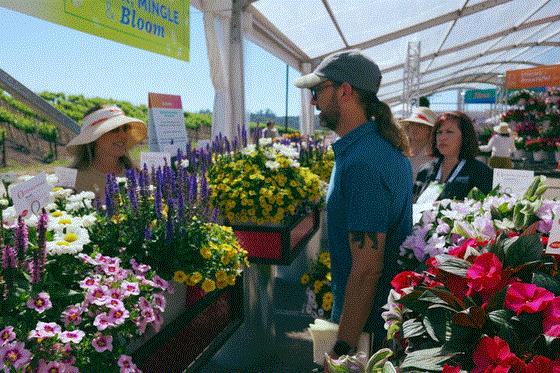
Here are two examples of this information sharing in action:
First is what I’ll call a rebirth in mixed containers. For years, we’ve all talked about combos, exhibitors at CAST have shown combos and although there was an uptick in combos available at retail, we rarely saw the extravagant recipes displayed at spring trials make their way to the retail bench (maybe a few high-end IGCs …). I’m talking about premium combos built at the grower level, not multi-liner programs.
But for the past few years, breeding companies who’ve either dabbled in combo programs or never been in the recipe game are releasing new programs that help growers select the best plants to build premium combos based on crops with proven track records and availability from the same rooting stations. The combos not only look great but have a grower-friendly supply chain and enough flexibility to withstands delivery interruptions or “cannot supply” issues. I also think we have enough data now to make solid educated guesses about designs and recipes that sell through at various price points, because no one in the supply chain can handle big shrink numbers on such high-end items.
Another spin off of this combo takeaway is an uptick in shade combinations. At least three stops showcased new mixes for shady spaces and all mentioned these have been directly requested by retail buyers. I'd have to look at my notes more closely, but I'd bet we've seen an increase in shade crop breeding over the past five years, which is opening up more and more options for shade combos.
I actually talked to a few growers I saw out in California, as well as breeding company product reps, who agreed with my thoughts on the combination program explosion topic, so hopefully I’m not crazy here. Let me know YOUR THOUGHTS.
Next is something I called out last year and heard again and again at this year’s CAST—season extension and the importance of “shoulders.” I do think this trend is driven by the mass market, but it really impacts and benefits every garden center and greenhouse. Breeders seem to be focusing a lot on new crops that can be sold before peak spring weekends and after the traditional garden shopping season ends. Long gone are the days of being okay with six big weeks in spring … Touring spring trials this year, I bet we heard the term “season extender” at just about every stop. Sometimes it was related to cool-season crops that can be sent to retail IN BLOOM in early spring. Other crops that fit the profile are summer-blooming perennials, fall combo components, crops bred for extra-long holdability during bad weather and “rain events,” or durability in the heat of summer. I even think the major industry trend toward first-year-flowering perennials reflects the retail need for longer sales windows.
If adding sales on the shoulders of your traditional sales calendar is a goal for your business, talk to your favorite breeders or sales reps, because there’s a huge palette of purpose-bred crops that you might not even be aware of … but your favorite broker rep can definitely help. Most of them probably went to CAST!

Finish Line ...
Wow. A 3,000-word newsletter. Either I was on a roll or maybe I just needed to offload a bunch of thoughts rattling around in my head after Spring Trials. Hopefully, some of my ideas will resonate or inspire some deeper thought as we head into the craziest time of year for most of us in the green industry.
I was going to spend more of this newsletter shouting out new varieties, because new saw hundreds in California last week. Although I commented above that the intros seemed a bit on the conservative side, that doesn’t mean there weren’t some seriously kick-butt new varieties at CAST. I mean seriously, there were FOUR NEW GLOW-IN-THE DARK PETUNIAS! I honestly can’t think of anything cooler than that in terms of innovation and wow factor.
For a company-by-company and variety-by-variety rundown of the entire CAST event, you can read the five-day ACRES OF BUZZ E-NEWSLETTER COVERAGE. Half of the commentary is from me, and the other half is from Chris Beytes, who has like 15 more years’ experience covering trials than I do! And of course, the VIDEOS. All 24 of them. And the FACEBOOK and INSTAGRAM coverage. Heck, I even shot video wearing Meta Glasses so you can see exactly what it looks like to walk through a trial—you can find that on FB and IG.
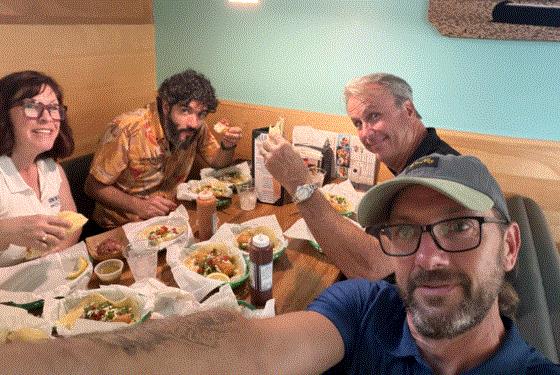
Spencer Makenzie's fish tacos—an annual tradition. IYKYK
Lastly, big shout out to my Ball Publishing Bobblehead buddies—Chris, Jen and Osvaldo. I can’t think of a better group of hooligans to spend 14+ hours a day with covering the trials! Love you guys!
Thanks for hanging with me through this long newsletter and I’ll be back in a week!


Please feel free to send your comments, constructive criticism and topic ideas to me at bcalkins@ballhort.com.

Bill Calkins
Editor—Tech On Demand
This email was received by you and 25,390 other fine subscribers!
If you're interested in advertising in Tech On Demand, contact Kim Brown ASAP and she'll hook you up.