What’s Happening Here?
Are you ready for a stumper? I know most of you will likely be unsuccessful with this week’s challenge. I can confidently say that because after several attempts, I didn’t get this one right, either. My friend Brent sent me this image of a dianthus crop and asked if I knew what was going on?
The white fungal growth across the soil surface seemed familiar, but after four attempts to solve this mystery, I failed to correctly identify what was happening. Do you think this is a fungus or a mold? If so, do you know which one? Could this be something else? Is this a primary or secondary issue? And is this an issue at all?
The time has come for me to ask the imminent question, “What’s happening here?” Carefully contemplate the possibilities while you read the next few articles. I’ll share the answer and we’ll see if anyone can guess it correctly before signing off for the week.
Perennial Ratios
I shared many results from the 2024 Census of Horticultural Specialties in the last issue, including the Top 10 perennials. Since then, I was asked if I could provide a percentage breakdown of all the perennials listed in the census. The thinking behind this is growers and retailers could look at their own perennial programs and compare them with national averages to see if there are any plants or perennial categories they are under- or over-represented in.
I’m happy to report that I have extracted this information from the census and have provided it in the table below.
Keep in mind these are the percentages for perennial sales nationwide and may not reflect any regional differences that may exist.
Table 8 on pages 14-15 in the census offers tons of information lising perennial sales by wholesale and retail sales (I used ‘all sales’ when compiling the table above).
Calling All CAST Visitors
The 2026 California Spring Trials are being held this week: Tuesday, March 24 to Friday, March 27, 2026. Several of the industry’s top genetics companies will be showcasing their up-and-coming, jaw-dropping cultivars during the four-day event at various venues across central and northern California.
Unfortunately, my work schedule will not allow me to attend. This brings me to my request. If you are attending CAST or are one of the companies displaying perennials, I invite you to take images and share any new perennials that caught your eye while you visited the trial locations.
That’s right, I’m looking for several guest photographers to show off their skills, as well as share with all the Perennial Pulse subscribers who also couldn’t attend. Simply take pictures of any perennials on display you think have distinct characteristics over their peers, such as unique colored blooms, flower power or other marketable traits you think give this new variety potential. Here are samples of pictures I’ve taken in previous years.
Here are two images from CAST 2021. These are Leucanthemum Real Sunbeam from Plant Haven taken at Pacific Plug and Liner in Watsonville, California.
When taking images from CAST displays, I often take one image showing the entire plant (left) and then another picture showing a close-up of the flowers or foliage (right).
Next, send them my way (
paul@pace49.com). Along with the images, I’ll need the genus and cultivar, the company displaying the perennial and a comment or two about what attributes you learned about or saw in the new variety. Unless you are so inclined, I’ll take care of creating the editorial content. In return for your contributions, I’ll gladly provide a photo credit including a link to your business website.
Thank you in advance for your CAST contributions.

Keeping Up with CAST

There are ways to keep up with all the new varieties if you’re like me and unable to attend the California Spring Trials this year. My Ball Publishing colleagues Chris Beytes, Jennifer Zurko, Bill Calkins and Osvaldo Cuevas (aka the Bobbleheads) will be working around the clock to cover all the CAST venues.
You can follow along with the daily
Acres of buZZ! newsletter, which exclusively covers CAST each year. You can
subscribe for FREE if you don’t already receive it.
The Ball Publishing Bobbleheads create videos every day covering every stop and featuring introductions from every exhibiting company. You can watch their daily videos on the
GrowerTalks YouTube channel. New videos will be available every night.
And last but certainly not least, you can keep up with the Bobbleheads and their Spring Trials experiences on social media.
Follow the Bobbleheads on
INSTAGRAM for pretty plant pics: @growertalksgreenprofit
You can also keep up with the Bobbleheads on
Facebook. They will post more pretty plant pics, short live videos and some behind-the-scenes shenanigans.
Spring Trials coverage kicks off today, Monday March 23!

Sedum Spectacular
I believe this new sedum is likely a sneak peek of one of the new perennials attendees will see at the California Spring Trials this week. However, that is not the reason I’m featuring it here. Sedum Spectacular was recently awarded a
2026 All-America Selections (AAS) National Award.
Spectacular is a seed alternative to vegetative Sedum spectabile cultivars. It has a compact growing habit, strong stems and exhibits less breakage while holding its clumps together when blooming. Spectacular produces medium light-pink flower clusters atop its clean, light green foliage in the late summer and continues blooming well into the fall. It’s hardy to USDA Zone 3B.
AAS Trial Garden judges offered these comments during their trial evaluations:
“Plants were sturdy and did not flop.”
“Uniform height and spread, light green foliage. Leaves have rounded tips. Flowers are light pink clusters.”
“This variety performed great! A seed variety compared to a vegetative variety.”
“Good, mounded habit and good flower coverage.”
Spectacular offers the industry a programmable, uniform and cost effective alternative to the upright sedum category. Consider adding the rock-solid garden performer to your perennial portfolio.

The Answer Is…
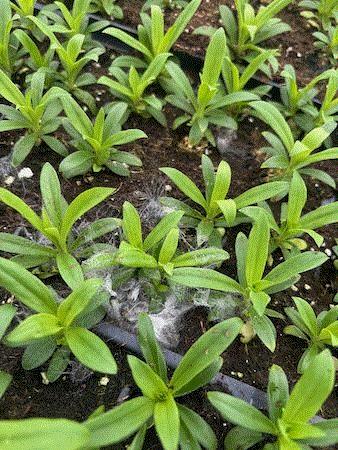
Let’s find out if this was a truly impossible challenge. I kid you not, I made four, what I thought were intelligent, guesses for what the white growth was before throwing in the towel and asking for the answer. My guesses were: saprophytic mold, rhizoctonia, sclerotinia and botrytis.
Were some of these included with your options? If so, I guess you can cross them out. What does that leave you with? Before you lock in your final answer, here’s a close up.
Do you see any additional clues? Do you see the small black spots on the white webbing and leaves? Unfortunately, the black spots are not the cause of the webbing or a side effect of it—our belief is the tiny black spots are shore fly frass (poop). Take a deeper look, look past the webbing if you can.
I doubt you can see them, but below the webbing are brown circular structures. If you can’t see them, you’ll have to take my word for it. Do you know what these brown balls are? It’s rabbit poop. The white growth is some unidentified fungus originating from the rabbit droppings. The good news is the fungal growth (mycelium) is not plant pathogenic and will not cause any harm to the plants. I haven’t heard, but I suspect the white growth will dry up and disappear over time. Please let me know if any of you guessed that the mycelium originated from rabbit droppings.
Thanks again Brent for sendiing this very challenging challenge my way.
Would you like to challenge your peers? If so, please feel free to send images of your known problems and I’ll see if I can use them for future challenges. Unless you want the photo credit, I’ll keep anything you submit anonymous. Please send your challenges to:
paul@pace49.com.


My email is paul@pace49.com if you have any comments, article suggestions or if you'd just like to say hello.
Best regards,

Paul Pilon
Editor-at-Large—Perennial Pulse
National Sales Manager—Pace 49, Inc.
This email was received by you and 33,975 other fine subscribers!
If you're interested in advertising in Perennial Pulse, contact Kim Brown ASAP and she'll hook you up.