Will on Regulating Growth
Retired Ball Seed Technical Services OG Dr. Will Healy has plant growth regulation on his mind lately, so we kicked off a miniseries of short videos detailing the reasons for using plant growth regulators (PGRs), what causes stretch, how to approach growth control using chemical or environmental strategies and much more.

So far Will has produced four videos, but I have a folder with even more to edit, so BOOKMARK THIS PLAYLIST and subscribe to our YOUTUBE SHORTS so you don’t miss them as I post them.
Here’s a teaser … Will is about to get into specific chemicals, when to use them and how they impact different crops. Of course, he’s seen the good, the bad and the ugly, and he knows the folks who did the research in the early days of each one, so there's nobody more qualified to teach us about it!
Josh’s Tip of the Week: Plant Growth Regulators—Ethephon
Technical specialist Josh Henry is taking over Nick's spot this week to continue ongoing discussions about specific plant growth regulators and how they work. This time, he’s diving into ethephon.
PROBLEM: Ethephon is a versatile plant growth regulator (PGR) used to improve branching, abort flowers and flower buds, delay flowering, enhance fruit ripening and manage plant height in a wide range of floriculture crops. When applied, ethephon breaks down into ethylene, a plant hormone that triggers physiological responses like increased lateral shoot development and flower inhibition. Proper chemical mixing, application timing and environmental conditions at the time of application are essential for optimizing ethephon applications while minimizing risks like phytotoxicity and delayed flowering.
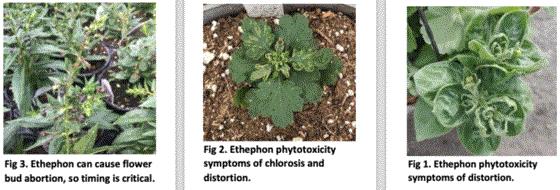
JOSH’S TIP: Ethephon (2-chloroethylphosphonic acid) is a synthetic plant growth regulator that when absorbed by the plant releases the plant hormone ethylene. Ethylene is a naturally occurring hormone that influences a wide range of physiological processes. Ethephon applications can result in reduced apical dominance, increased lateral branching, delayed flowering and shortened internodes. These effects make ethephon a valuable tool for growth regulation throughout the production cycle.
Uses: Ethephon can be used to suppress internode elongation, keeping plants compact through a different mode of action than gibberellic acid inhibitors. Applications to improve lateral branching are typically made one to two weeks after transplant to provide sufficient time for rooting prior to application because ethephon can delay or inhibit rooting. Ethephon can be used to abort flowers and flower buds, keeping plants vegetative and allowing them to bulk up prior to flowering.
In general, the last application of ethephon should be made six to eight weeks prior to the target sale date to provide sufficient time for flowering. For sensitive crops like petunias, calibrachoa and geraniums, growers should trial rates and timing to avoid unintended delays in flowering or excessive stunting.
Mixing: Ethephon is most stable at low pH with a target final solution pH between 4.5 and 5.0. Spray solution pH values greater than 6.1 render ethephon inactive. Growers should routinely test their water and neutralize excess alkalinity with acid or other conditioning agents. Commercial formulations are available with either 3.9% or 21.7% ethephon, so double-check the formulation to ensure correct mixing. Common spray rates range from 250 to 500 ppm with 2 quarts applied per 100 sq. ft.
Spray Applications: Ethephon degrades quickly in the spray tank and must be applied within 4 hours of mixing. Ethephon is absorbed primarily through the foliage and is not translocated throughout the plant, so uniform spray coverage is essential. Ethephon is moderately well absorbed by the plant over the course of 12 to 16 hours after application. It is also important to note that ethephon has one of the longest restricted-entry intervals (REI) of any PGR—48 hours. Crop-specific recommendations can be found in the GrowerTalks ANNUAL and PERENNIAL PGR guides. Trial applications are recommended before full-scale use. Remember, always read and follow the label to ensure products are compatible with your intended application.
Environmental Considerations: Ethephon efficacy and crop safety is highly dependent on environmental conditions and crop stress at the time of application. Ethephon is most effective at temperatures between 57F and 73F (14 to 22C), and under high humidity where foliar absorption is maximized. Applying ethephon in the morning can help reduce evaporation and improve uptake. Applications made under water or nutrient stress or during hot, dry or high-light conditions can increase the risk of phytotoxicity symptoms like lower leaf chlorosis (yellowing), leaf distortion or stunted growth.

Thinking Ahead: Phyto Info
If this season follows a similar trajectory to past years, in a few weeks phones and inboxes of tech experts across the industry will start to light up. One of the most common calls will be about symptoms such as browning and yellowing of foliage, stunted plants and even collapse. Then, our industry’s CSIs will go to work to determine the issue.
One of the more common diagnoses is phytotoxicity, so I thought it would be a good time to share this information from Michigan State University Extension to hopefully arm you with some preventative info.
The experts at MSU cover what phytotoxicity is and how to prevent it in PLANT PHYTOTOXICITY IN THE GREENHOUSE. Here's how the article begins:
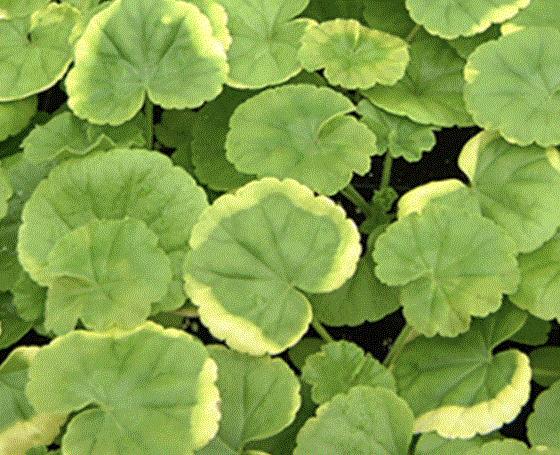
Phytotoxicity is simply plant damage—a toxic effect—from something the plant was exposed to. Leaf or flower injury can be caused by a chemical foliar spray or soil drench. Phytotoxicity symptoms may show up as leaf speckling, leaf margin necrosis (browning) or chlorosis (yellowing), brown or yellow leaf spots or patches, leaf cupping or twisting, plant stunting or plant death.
Click the link above for the full report to post and share with your production team. Photo credit for the geranium showing phyto symptoms goes to Dr. Erik Runkle at MSU.

Leaf Spotting on Spring Pansies
Leaf spotting on pansies is common, and although they are a low-pH-loving crop, when pH drops too low, dark spots can appear—signaling iron and manganese toxicity. Be sure to monitor soil pH regularly to avoid this issue. Your pH should be between 5.5 and 6.0, ideally.
But leaf spots can also be caused by a range of foliar diseases—namely Colletotrichum (anthracnose) and Cercospora. According to Tech On Demand experts, these pathogens favor moderate to cool temperatures and free moisture on leaves, so cooler nights and rain in the late afternoon/evening is a perfect recipe for an outbreak.
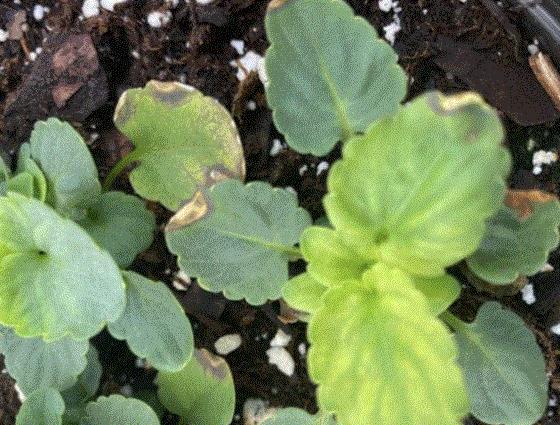
However, a common factor leading to disease that is often overlooked is low nutrition, so be sure to check your soil EC (soluble salt levels) when you are monitoring soil pH. Maintaining soil EC around 1.5 mS/cm (via Pour-Thru method for testing) and below 2.0 mS/cm will ensure your crops are receiving adequate (but not too much) fertilizer and reduce susceptibility to foliar leaf spot diseases. Below are a few key ID traits for these leaf spot diseases and how to manage them if an outbreak occurs:
Colletotrichum. Starts as small grayish/tan spots with black margins under warm, moist conditions. Spots often develop a concentric ring pattern, which can be confused with a viral disease. Lesions grow to infect stems and eventually cause the plant to collapse. Remove heavily infected plants and fallen debris to reduce spread, and apply fungicide with mancozeb or thiophanate-methyl + mancozeb ASAP when symptoms first appear.
Cercospora. Purple spots with “fuzzy” margins typically start on lower leaves. If untreated, small purple spots will begin appearing on upper leaves, and older lesions will expand into irregularly shaped tan spots with purple borders. Heavy infection will cause lower leaf chlorosis followed by leaf drop and overall stunting. Remove infected plants and debris ASAP and treat with fungicide. Mancozeb + thiophanate-methyl, myclobutanil, fludioxonil and chlorothalonil are all effective to control this pathogen.

Save the Date: New Perennials for 2026 & 2027—FREE Livestream!
Expand your knowledge and expertise in growing Proven Winners Perennials with an in-depth webinar scheduled for Thursday, March 12 at 1 p.m. Eastern/Noon Central. Host Chris Beytes and Walters Gardens Regional Product Manager Laura Robles will review 15 of the hottest new perennials available at retail in 2026. (Well, Laura will review them and Chris, who is not a perennial expert, will nod in appreciatively.)
REGISTER NOW!

As a bonus, Laura will give you an early look at 15 standout varieties Walters is planning to introduce for 2027. This live online session will deliver practical insights, best practices and growing tips to help optimize plant performance and elevate your perennial program. Be sure to get your perennial questions jotted down now so you can ask them on the 12th of March.
Finish Line ... a Friendly Reminder
For more than 20 years, Ball Publishing has bestowed the title of Young Grower and Young Retailer (of the year) on deserving individuals in the horticulture industry. Honorees are under the age of 35 and already doing big things in the industry—with the promise of much more!
These young people are nominated by peers, managers and others who see the impact they’re having in their businesses and communities. They can even nominate themselves! It truly is a high honor and one that deserves to be recognized for many reasons.
NOMINATIONS CAN BE MADE FOR THE 2026 AWARD NOW AND ARE DUE BY MARCH 1, 2026! Here are the links:
YGA Nomination Form
YRA Nomination Form
Our judges will pour over the nominations to select three finalists for each award, and each will be asked to write a guest editorial for the June issue of GrowerTalks or Green Profit based on a topic selected by our editorial team. Additionally, all six finalists are invited to attend Cultivate’26 in July and attend a gala dinner with editors, judges and sponsors before the awards ceremony at AmericanHort's Unplugged event for young professionals, where we will crown the winners.
Our two winners will be featured on the covers of the September GrowerTalks and Green Profit, and will get to help judge next year’s award candidates.
A huge thanks to the award sponsors—Ball Horticultural Company, BASF, The Garden Center Group and AmericanHort.
Talk to you next week!


Please feel free to send your comments, constructive criticism and topic ideas to me at bcalkins@ballhort.com.

Bill Calkins
Editor - Tech On Demand
This email was received by you and 25,432 other fine subscribers!
If you're interested in advertising in Tech On Demand, contact Kim Brown ASAP and she'll hook you up.