2026 CAST Sneak Peek: A Podcast Miniseries
With the holidays and all, maybe you missed a few Tech On Demand podcasts? I’ve actually uploaded 18 of them since the week before Christmas! Don’t worry—they’re each pretty short (and no, I did not abandon my family while they were home on break because I recorded them ahead of time).
This miniseries of podcasts was awesome because each one was a sneak peek into the themes and new varieties being planned for the 2026 California Spring Trials coming this March! I had a blast catching up with old friends and making new ones, and this casual, conversational vibe was on full display as we chatted about the event in general, specific plants that lived up to the hype last year, concepts planned for this year and plenty of teasers about what to expect this time around.
For these episodes, I collaborated with California Spring Trials registration managers at National Garden Bureau to talk with representatives from just about every exhibiting company in an effort to get you excited about the iconic industry event and some of the new plant introductions you’ll see on display in a few short months. There will probably be a few more to come, as well.
You can find these podcast episodes on all the major apps, so be sure to subscribe on your preferred platform so you never miss an episode. And if you’re not a regular listener, jump back into the archives and get caught up—there are more than 225 episodes as of today.
California Spring Trials is the horticulture industry’s “Parish Fashion Week” or “Detroit Auto Show” and with more than two dozen participating companies bringing hundreds of new plants to market for 2027 and beyond, opportunities abound to get inspired and plan new additions to your crop mix. I’ve attended the trials more than 20 times—both as a member of the media visiting each stop and as a representative of a breeding and distribution company stationed at one location for the entire week. It’s absolutely my favorite horticultural event of the year. And I’ll be back in 2026 with the Ball Publishing Bobblehead crew to cover CAST in every way imaginable. Check out LAST YEAR’S VIDEO COVERAGE for a taste of the trials.

As an important reminder, registration for this annual even is essential to help hosts create an amazing, customized experience for all attendees. REGISTER FOR CAST 2026 NOW! At the NGB-managed website, you’ll also find a trip planner, location information and more. Be sure to schedule plenty of time at each stop and with each exhibiting company!

Koppert Corner: Fungus Gnats & Shoreflies
Dark and wet January weather is the perfect setup for fungus gnat and shorefly development. Knowing which fly species you are dealing with will help you dial in the optimal control approach.
It's easy to remember: fungus gnats can be identified by their long legs, which dangle behind them as they fly onto and get stuck onto sticky cards. Shoreflies have short legs (shore = short), looking more like a traditional housefly.
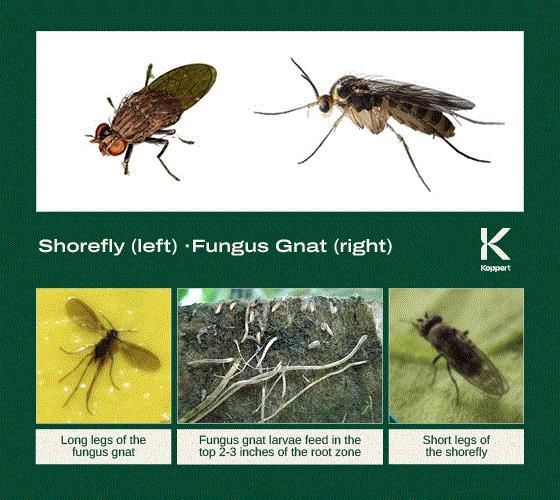
Fungus gnats
Adults do no direct damage to the plant, but each adult female has the reproductive capacity to lay 200-plus eggs, so managing adult presence early will greatly help to minimize population increases and root damage. Fungus gnat larvae feed mainly on plant roots and decaying plant material and can cause significant damage to young plants.
Fungus gnat eggs are laid in the top layer of root media and hatch in four to six days. Emerging larvae inhabit the top two to three inches of the root zone, feeding on small feeder roots and root hairs. They also have the capability of burrowing into base of cuttings and have the capacity to spread root pathogens. Fungus gnats pupate as a cocoon on or near the surface.
Control fungus gnat adults with a weekly tank mix spray/sprench of Isaria fumosorosea (Isarid). To manage both fungus gnat larvae and the potential root pathogens that they may spread in the root zone, apply a tank mix drench of Steinernema feltiae (Entomen) and Bacillus subtilis (Bacilirid) weekly. Once off mist, when dry downs between waterings are needed, soil-dwelling predatory mite Stratiolaelaps (Entomite-M) will keep fungus gnat populations managed.
Shoreflies
Adults and larvae survive on a diet of algae and soil fungi and rarely, if ever, feed on plant roots. However, managing them is necessary for several reasons. First, and most important, adult shorefly can spread diseases such as Pythium, Fusarium and Thielaviopsis through their feces. Second, when shipping young plants to others, it’s just a bad look when shoreflies emerge from incoming shipments of plant material.
Manage adult shorefly populations by hanging Yellow Wetstick Horiver or Rollertrap throughout consistently wet areas, especially those where algae is present. Suppress shorefly larvae populations with weekly Steinernema carpocapsae (Capsanem) drenches and remove algae and organic matter from floors and under bench areas to remove habitat and food sources.
Reach out to a Koppert IPM Consultant in your area to discuss a technical, lifecycle-based approach to managing fungus gnats and shoreflies.

Nick’s Tip of the Week: Managing Root-Zone Temps Post-Stick
Each week, I’ll work with my buddy Nick Flax, a technical services expert at Ball, to share a concern that’s come up during one of his numerous calls with growers across North America. This week, he’s discussing a critical piece of the propagation puzzle—dialing in your root-zone temperatures. As cuttings begin to arrive, hopefully this helps your team prepare.
PROBLEM: Proper management of temps once cuttings are stuck is critical for all propagators, and grouping crops by temp is a good strategy—but if it’s not possible, there are other options to optimize this important element of prop.

NICK’S TIP: Here are a few considerations and strategies for optimizing rooting temperatures post-stick.
What should the temperature setpoint be? Different genera have varying optimal temperature ranges for rapid rooting. While it’s virtually impossible to provide the precise optimum temperature for everything in a common propagation area, it’s operationally feasible to put crops into two or three groups based on ideal upper and lower temperature ranges (such as warm, moderate and cool.)
Look to culture sheets from different crops’ breeding companies for propagation temps. If overlap occurs for a given crop based on your propagation zone’s setpoint groups (like between moderate and warm), it’s generally more beneficial to put the crop into the warmer of the two if you want faster rooting.
If you are not able to have multiple, independent temperature-controlled zones in the same propagation house, use natural gradients across the house to create rough zones.
Air and soil temperatures are not created equal in the propagation environment. Recommended temp setpoints during Stage Two (callusing) and Three (root initiation) in cultural info for your crops generally refer to soil temperature, if not specified.
How do you deliver and manage root-zone heat? There are many ways to heat a greenhouse, but providing targeted heat during URC propagation can be very beneficial. Maintaining appropriate air temperatures during propagation is critical, but focus on root-zone temperature and supplementing heat to the propagation media wherever possible.
-
Under-bench heat pipes or radiant floor heating are excellent first stages to facilitate hitting target air and soil temperatures at the same time.
-
If you are propagating on benches over some type of below-crop heating, add a poly skirt to the bottom of your benches to help direct heat upward through your liner trays, rather than letting warm air from below roll up and around the benches.
-
If you are propagating with trays directly on heated floors, place some used (but sanitized) plug or liner trays on the floor beneath them. This will create a buffer between liner trays and the heat source directly beneath them and reduce the chance that media will get too hot on days when the heat is running constantly.
-
If your propagation area only has forced-air heating, installing heat mats (permanent or temporary) to ensure you are hitting your target root-zone temp can greatly increase your success.
Do not cut corners on systems like this or buy the least expensive option. The more precise your control of root-zone temps and the more reliable your heating system is, the better your success will be.
NOTE: The other factor to account for is your irrigation and mist water temperature. Use tempered water (65 to 70F) whenever possible to avoid unintentionally lowering root-zone temps. Especially while URCs are still fresh (Stage One and Two), crashing the liner media temperature can predispose cuttings to infection from different soilborne fungal pathogens.

Mealybugs on Succulents
I was looking back through late-winter/early-spring issues Tech On Demand experts have dealt with in years past and noticed one that popped up a couple times—mealybugs on succulent crops. When more than one grower reports the same problem like this one, I tend to think more of you might deal with the same thing and it’s better to get ahead of it proactively or at least file it away in your brain so you can react quickly. Here’s some information I searched up that might help you identify and eliminate this greenhouse pest if you encounter it in 2026.
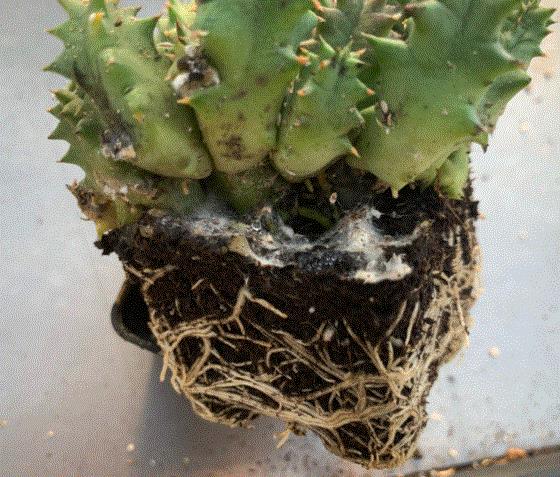
University of Wisconsin Extension published this PAPER ON MEALYBUGS a while back, but the content is still quite comprehensive and relevant. Here are the basic symptoms as described by UW researchers:
Mealybugs feed at stem tips, and where the leaf meets the stem. The citrus mealybug is more common on tropical foliage plants or soft-stemmed plants such as coleus, fuchsia, and cactus. Long-tailed mealybugs prefer dracaena over other species. Symptoms of mealybug feeding include stunting, chlorosis, defoliation and wilting. Because mealybugs feed on sugary plant juices (photosynthates), their waste contains a high sugar content and is referred to as honeydew. Honeydew is sticky and can support the growth of sooty mold fungi, which are not harmful to the plant, but if present in high enough concentrations, can impair photosynthesis in the leaves. Citrus mealybugs cause additional problems by injecting a toxin as they feed.
The document goes on to describe the appearance and lifecycle of mealybugs and recommend tips for scouting and control. This is a good one to bookmark or file away for if (or when) you and your team need it—obviously I hope you don’t, but better safe than sorry!

Young Grower & Retailer Award Applications NOW OPEN!
Each summer, for more than 20 years, Ball Publishing has bestowed the title of Young Grower Award winner and Young Retailer Award winner on two deserving individuals in the horticulture industry. Our honorees are under the age of 35 but have already done big things in the industry—with the promise of contributing much more.

These young people are nominated by peers, managers and others who see what an impact they’re having in their businesses and communities. They can even nominate themselves! It truly is a high honor and one that deserves to be recognized for many reasons.
NOMINATIONS ARE NOW OPEN FOR THE 2026 AWARD NOW! Here are the links:
Three finalists for each award are chosen, and each gets to write a guest editorial for the June issue of GrowerTalks and Green Profit based on a topic selected by our editorial team. Additionally, all six finalists are invited to attend Cultivate’26 in Columbus in July and attend dinner with editors, judges and sponsors before the awards ceremony—at the Cultivate’26 Unplugged event for young professionals.
Once we announce the winners, they will be featured on the covers of the September issue of GrowerTalks and Green Profit and will get to help select next year’s winners.
Act now, because nominations close March 1.
A huge thanks to the award sponsors: Ball Horticultural Company, BASF, The Garden Center Group and AmericanHort. Thank you for helping us support and recognize the future leaders of our industry!

Finish Line ...
There’s a new podcaster in town! And the series he kicked off this week is appropriately related to the topic above. Editor-in-Chief Chris Beytes has interviewed hundreds (probably thousands) of people in the professional greenhouse space over the past three decades, so he knows a thing or two about a thing or two when it comes to hosting engaging chats. Plus, he’s a black belt- level storyteller with a range of knowledge that keeps every conversation interesting.
In his new podcast (The Chris Beytes Podcast), Chris will talk with people across our industry about a range of topics ... starting with a series featuring past winners of the GrowerTalks and Green Profit Young Grower and Young Retailer of the Year Awards. See above for more on that …

For EPISODE 1, it's the very first YGA winner, Andrew Britten, who's now Technical Sales Manager for Tropicals & Foliage at Ball Seed.
Andrew talked to Chris about his horticultural history, the various positions he's had, how he went from Virginia to Indiana to Florida, his successes, his goof-ups and some of the lessons he's learned during his varied career.
Check out the inaugural episode on YOUTUBE and subscribe ASAP so you don't miss the many conversations sure to follow. And since Chris and I share the same recording platform, I know for a fact he’s recorded more of them … stay tuned!
You’ve got a lot of podcasts to listen to … so you’d better get started. I’ll talk to you next week.


Please feel free to send your comments, constructive criticism and topic ideas to me at bcalkins@ballhort.com.

Bill Calkins
Editor - Tech On Demand
This email was received by you and 25,448 other fine subscribers!
If you're interested in advertising in Tech On Demand, contact Kim Brown ASAP and she'll hook you up.