2025 #Wrapped
After talking with many folks around the industry, it seems the general consensus from a high level is that the year was pretty average, but still stronger than pre-2020 and with a lot of positive signs leading to overall optimism.
Without full-year data crunched and presented by industry economists, I won’t try to objectively analyze 2025, but I can share some of the spring 2025 numbers from bossman Chris Beytes’ Acres Online recap from back in early July.
Chris reported (based on 1,251 scores over 13 weekends from the end of March through the end of June that in the U.S. overall scores (1 to 10) averaged 7.4 for the season and Canada came it at 6.9. In the 13 years he’s been conducting the survey, the average is 7.2 for both countries.
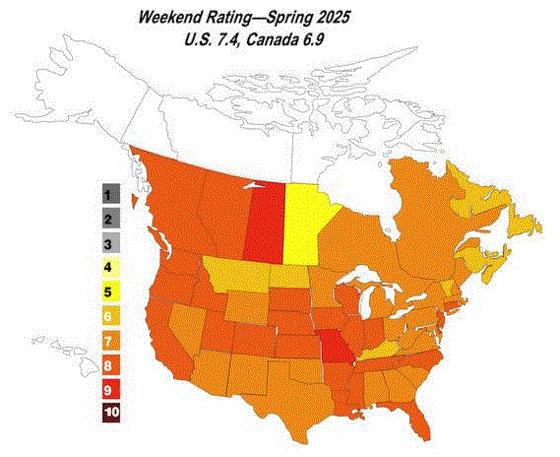
But the open-ended comments sent in by participants and the “gut feeling” scores they also send in were much higher—8.0 for the U.S. and 7.8 for Canada. This shows optimism and reflects some of the encouraging indicators that emerged from the season. Such as:
-
New customers and positive word-of-mouth marketing
-
Shoppers finding relaxation and enjoyment in flowers and plants
-
Sales dropping off less in bad weather/rain
-
Transactions were up for many respondents
-
Summer sales were up for many
-
Sales of flowering annuals were up
-
Shade combos and shade items were popular
-
Mondays and Thursdays are emerging as strong sales days
All in all, it seems like our industry is on solid footing—even in tumultuous economic times. The new customer base of millennials and Gen Z seems to like our stuff, and I think we’re doing a decent job of promotion on social media and leveraging positive lifestyle imagery related to followers and plants. As I always say, we sell products that make everyone happy!
Now, on to some Tech On Demand highlights from the year. We did generate a lot of content and grew engagement—which I’m sure you can guess is a goal for me and two of my core KPIs, professionally. Here come some of the highlights:

TOP PODCAST: Preemergence Weed Control
I uploaded more than 70 new podcasts in 2025, which actually surprised me … It was our biggest podcast year! And by December 31, we should be at about 225 podcasts total in our library. Statistics show that fewer than 3% of podcasts launched make to 200!
Of those 70-plus from this year, the one with the most downloads and streams was …
PREEMERGENCE WEED CONTROL FOR GREENHOUSES & NURSERIES, featuring guests Dr. Janna Beckermann and Steve Larson from Envu.
Janna and Steve have decades of experience in our industry and bring a lot to the table when it comes to the science behind greenhouse and nursery production, as well as the real-world application of products and strategies. When it comes to weed control in production settings, Janna said it best: The greatest cost is the cost of neglect.
From regionality and seasonality of weeds and their impact to application strategies for preemergence herbicides and keys to safe use, there was a lot to discuss. And apparently it resonated with a lot of listeners!
Of course, I try to cover a wide range of topics on the podcast to make sure there’s something for everyone. Some of the other top episodes included conversations around bio-IPM, resistance management, foliar disease prevention, combo plants, the future of horticulture, crop-specific production strategies and much more.
Be sure to subscribe to the Tech On Demand podcast on your favorite app so you never miss an episode. And if you’re not a regular listener, jump back into the archives and get caught up—there are more than 220 to choose from!

Nick’s Tip of the Week: Water Quality & Fertilizer Food for Thought (Part 3)
Each week, I’ll work with my buddy Nick Flax, a technical services expert at Ball, to share a concern that’s come up during one of his numerous calls with growers across North America. This week, he’s continuing the conversation about water quality and elevated EC by covering blending water with non-RO sources.
PROBLEM: Reducing the EC of your water can lead to a number of benefits. Last week, I covered how installing a reverse osmosis (RO) system can be a solution. But that’s not always an option.
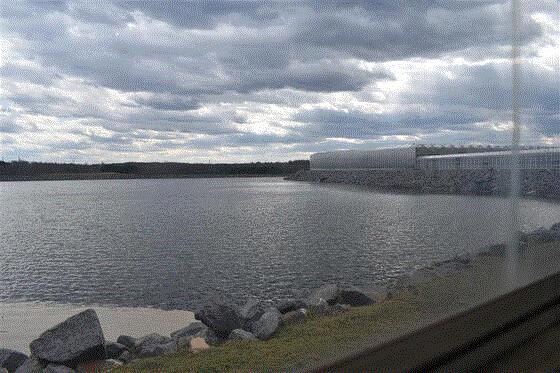
NICK’S TIP: Blending your water with another non-RO source is another way to reduce EC if your water tends to run on the “salty side.”
Sometimes when you build a greenhouse, municipal water is not available. However, utility infrastructure changes over time as municipalities grow, so it may become an option for you.
While there is often an upfront cost associated with doing this, getting a “city water” hookup can enable you to quickly and reliably lower irrigation water EC. Much like with an RO system, you can blend city water with your well water or switch over to the municipal source entirely. City water undoubtedly costs more than pumping water from your own well but it is frequently less costly than installing and maintaining a RO system.
As a bonus, many municipalities provide periodic water test readouts (either at standard intervals or upon request), which can help you to make better water quality management decisions over time.
If a municipal water hookup is not an option, you may want to consider installation of a retention pond or series of ponds. Ponds can be used to catch clean rainwater and roof runoff from greenhouse glazing. Rainwater is typically quite pure and naturally low in alkalinity and soluble salts. This water can either be blended with well water or used as-is to irrigate crops.
If you want to go a step further, you can convert your operation to a “closed irrigation” system, where all the leachate from your greenhouses drains into pond(s) for remediation and recirculation. This does add another layer of complexity to your irrigation/fertigation strategy, because you need to monitor nutrient level changes in your pond(s) over time, but can be a very cost-effective and resource-conscious strategy in the long-term.
With a pond system, you need to install a pumping system and filter incoming water to keep sediment out of your irrigation lines. It’s also highly advisable to integrate some form of water treatment system for pathogens and algae and a tempering system to ensure water isn’t super cold during the early part of spring. Keep in mind that collection of other surface runoff (ex. paved areas, stormwater runoff) is generally not advisable, because it introduces a whole new set of potential contaminants to your pond system like oil and gasoline, or waterborne/soilborne pathogens from offsite.
Depending upon the size of your pond project, there can be substantial upfront cost of implementation. However, depending on your location, there may be local, state and/or federal grants that can help to offset the cost. Reach out to your local university extension office and conservation district to find out what other resources are available to you.
A few weeks ago, I said I’d cover nutrient imbalances and some occasional oddball water quality concerns. But first, I wanted to touch on the general issue of elevated EC. To kick off 2026, I’ll actually discuss common nutrient-specific issues and how to remedy them.

TOP VIDEO: Sustainability in Horticulture
This fall, I had the opportunity to record a video podcast with Susannah Ball and Seth Reed discussing what it really means to DO BETTER when it comes to sustainability efforts for companies and people in our industry. The video really caught on, and I think it served to challenge us all to think about ways we can improve our relationship with people, our communities and the planet.
Susannah and Seth broke down how Ball Horticultural Company, a 120-year-old global company, focuses on sustainability—from aligning with the United Nations Sustainable Development Goals to empowering the launch of impactful initiatives at Ball companies around the world. We learned how teamwork drives innovation, how smart sustainability can lead to resilience, and why Ball chose this moment to release its 2025 sustainability report titled “Sowing Sustainability.” Whether you manage a greenhouse or garden center, lead a team or just want to make your business more future-focused, this episode offered practical insights and plenty of inspiration to grow greener and stronger—together.

I think we released about 30 videos in 2025 and some of the other most-viewed topics included rooting hormones, garden mum production pitfalls, cost accounting, calibrachoa production tips, PGRs and moisture management for perennial growers. You can find all of our videos on the BALL SEED YOUTUBE PAGE.

And … YouTube Shorts
New for me in 2025 (well, new as a priority), were YouTube Shorts. It’s something I played around with in 2024 but committed to this year. And it paid off! If you’re looking for a marketing tactic to add to your arsenal in 2026, I think Shorts and Reels (Facebook's short videos) might be a good bet. And they’re not difficult to make using some of the new, inexpensive tools available. I use Riverside.fm. Chris uses Opus Clips.

Anyways, we released about 50 SHORTS ON YOUTUBE this year sharing quick (3-minutes or less) technical tips focused on crop nutrition, pest and disease ID/control/prevention, plant physiology, water, light, temperature, etc. In total, they generated just under 22,000 total views.
And the top technical Short for 2025?
CALCIUM DEFICIENCY CAUSES + SYMPTOMS + CORRECTION.
Shout out to Josh Henry from our technical team for making the top of the list AND to all the guys on the team for taking time to think through engaging topics and record these videos. I think it’s sometimes more difficult to nail a 2-minute video than give a 45-minute presentation and these guys are getting really good at it. Watch for more in 2026.

TOP SOCIAL MEDIA POST: Broken Belt at the Worst Time
Before checking Meta analytics, I honestly had no idea what the top post in the Greenhouse Tech Team Facebook Group would be this year ... although I guessed it would be about garden mums, like in the past. Yes, garden mum nutrition and disease questions were high on the list in terms of engagement, but this year’s top post came in the middle of March when a pot filler belt went down.
On March 15, a group member posted this:
Hi, the belt on my pot filler isn’t working. We replaced the motor, but when I turn the machine on it’s not working still. I had the power checked and the voltage is all good—anyone know what could be wrong? The auger works just not the belt and I need it NOW!! UGGH!
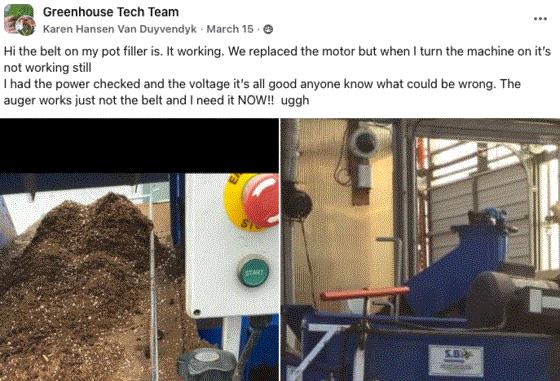
I’m sure everyone reading can commiserate and understands full well how a problem like this can be infuriating—especially in mid-March! Well, I’m happy to say that the Facebook group community of more than 6,000 peers jumped to action and posted more than 25 comments with ideas, suggestions and empathy. It looks like (from follow-up comments) that the issue was a circuit board and new one was shipped out within a week.
If you’re not a member of the group, CONSIDER JOINING. I’ve seen a lot of problems solved quickly by the peer-to-peer community over the past five years and I try my hardest to only approve membership requests from greenhouse professionals to keep the conversation focused on this side of the industry.

Finish Line ...
It’s always interesting to close out a year and 2025 is no different. It comes with highs, lows, reflections and plans for the future—personally and professionally for all of us, I’m sure.
I’m a goal-setting kind of person and someone who DOES set a New Year’s resolution. This past year, I went with the word “optimize.” For me it meant being more efficient, leveraging tools to get more out of each action, and trying to accomplish more but without adding to the overall time I spend doing things. Technology does help with this, but also planning, managing time and not getting distracted. I’ll give myself a B+/A- for the year.
Now, the goal is to continue doing what I learned and practiced while moving on to another resolution. For 2026, I’m going to go with “pay attention.” Although not as deep-sounding as “mindfulness” or “being present,” paying attention captures those things but in a more casual way. The more I stay focused on the things that matter and consciously avoid the stuff that doesn’t add value to my life, the better I think I’ll be as a husband, dad, employee and person.
Thanks for engaging with the newsletter, podcast, videos, social media and for catching up with me at shows and events this year. I appreciate you all and the industry in which we work. Hopefully you can also look back on 2025 and see growth—personally and professionally— and here’s to a fantastic 2026!
Talk to you next week/year!


Please feel free to send your comments, constructive criticism and topic ideas to me at bcalkins@ballhort.com.

Bill Calkins
Editor - Tech On Demand
This email was received by you and 25,461 other fine subscribers!
If you're interested in advertising in Tech On Demand, contact Kim Brown ASAP and she'll hook you up.