NEW PODCAST: Solving IGC Tech Challenges
In EPISODE 210 of my Tech On Demand podcast, I was joined by two guests representing a company called Brands in Blooms and a solution they’re bringing to garden center retailers: BloomSuite. It’s a click-to-edit website platform built specifically for garden centers ... but that’s far from the full story, as you’ll hear.
BloomSuite also offers an e-commerce component connecting your store to nursery fulfillment partners that ship plants directly to your customers. And if your marketing messages, social media and CRM are disconnected and operating in isolation, BloomSuite ALSO offers a CRM + marketing dashboard to tie it all together with pre-built customer personas, automated content generators, calendars for planning, the ability to send targeted emails and texts, as well as full Meta connectivity to upload your social media to Instagram and Facebook.

Brands in Blooms co-founders Jeff O’Brien and Jon Morrison explained what BloomSuite is all about and why the company is laser-focused on solutions for garden centers. The three of us also discussed the importance of having a website you’re proud of, why collecting data is only as good as your plan to use it, the high cost (and confusion) of stacking multiple platforms, how e-commerce opens you up to a new customer base, and how advanced tech could possibly allow us to be more human in the near future.
As a listener of this podcast (and reader of my newsletter), you’re encouraged schedule a FREE WEBSITE AUDIT with the BloomSuite team as a way to learn how these cutting-edge but simple-to-use tools can take your business to the next level. And if you’re attending MANTS in January, you’ll find the team at the Prides Corner Farms booth—so stop by and say hey.
Be sure to subscribe to the Tech On Demand podcast on your favorite app so you never miss an episode. And if you’re not a regular listener, jump back into the archives and get caught up—there are more than 200 to choose from!

Koppert Corner: Gerbera and Hydrangea—Crop Zero for Biological IPM
Who hasn’t had issues growing either of these two crops using solely a chemical IPM approach? Perhaps you’ve even stopped growing gerbera because you weren’t able to finish a clean crop free of thrips damage even when spraying once or twice weekly. Or maybe you’ve avoided growing hydrangea since the last time you had a late-season infestation of two-spotted spider mites that reduced your sell-through success.
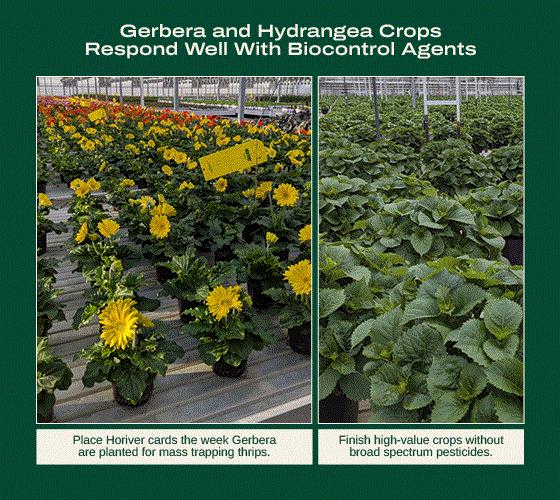
Take a New Approach
If any of the above scenarios sounds familiar, it’s time to reconsider your IPM approach in these crops. Utilizing a biological IPM solution allows you to finish clean, healthy, damage-free crops without weekly chemical pesticide sprays. Beneficial insects and the myco-insecticide Isarid are chemical-free alternatives for managing insect pests on high-value gerbera and hydrangea.
Drench with plant growth-promoting rhizobacteria Microflora to enhance nutrient cycling and allow the plants to grow and flower without the stress that pesticides can cause.
Further, pests develop no resistance to being eaten, so by pivoting to a biological/microbiological approach to growing these crops, we avoid resistance issues that can plague growers using chemical pesticides.
Where To Start
Hang yellow Horiver Wetstick cards in the plants within one week of putting crops in the greenhouse to begin monitoring for and mass-trapping thrips and other flying insect pests. Gerbera and hydrangea grown for sale in January to April are sold before the heat of summer kicks in, so it’s important to use a cool-season mite species. As these are high-value florist crops, it makes sound economic IPM sense to utilize Limonica, the most aggressive predatory mite available to commercial growers.
Since gerbera are propagated from seed, it’s unlikely that they’ll arrive with spider mites. However, mature dormant hydrangea may harbor two-spotted spider mites in diapause upon arrival. If growing in cooler regions of the U.S., it’s a good idea to release Spical (Neoseiulus californicus) weekly on a preventative basis and supplement with Spidex (Phytoseiulus persimilis) as needed for spider mite control.
Dial It In
There are several different strategies that can be used to manage aphids in gerbera and hydrangea. Which one to use depends on depends on your individual goals, greenhouse layout, crop mix and several other factors.
To determine the IPM approach that makes the most sense for your specific hydrangea or gerbera crops, contact a Koppert Technical Consultant today!

Nick’s Tip of the Week: Water Quality & Fertilizer Food for Thought (Part 1)
PROBLEM: In late November, I wrote about a bunch of water-quality concepts, irrigation water testing, macro and micronutrients, and so on. Apparently, that sparked a fire in many of you, because I’ve had a LOT of conversations with you about water quality management and fertilizer since then!
A.I. Nick is Back!
NICK’S TIP: There have been some common themes in these conversations that I haven’t written about in the past, so I’ll take the next couple of weeks to provide some add-ons to the discussion.
In WEEK 47, I broke down alkalinity—the core concepts, tools to calculate acid, and general management when alkalinity is high. What I didn’t touch on was how to implement acid injection into your operation.
If your raw water’s total alkalinity level is less than about 250 ppm CaCO3, there are a few ways you can incorporate acid into your irrigation/fertigation strategy. However, there are pros and cons to each method, so I will call out a few for each acidification approach:
1. Dedicated acid injection plumbed into your main irrigation line(s). This is exactly what it sounds like: install an acid injector immediately downstream of where your water source enters the greenhouse.
Pros:
-
Allows you to reduce alkalinity in both clear water irrigations and fertilizer applications to keep substrate pH from creeping up regardless of whether crops are being fed or watered. In turn, this enables you to switch between nitrate- and ammonium-based fertilizers with less concern for the long-term impact on substrate pH, and steer crop growth more easily simply by switching fertilizer formulations.
-
Simplifies adjustments to your acid proportioner if your water’s alkalinity changes significantly throughout the year if the system is only in one place (per range/water main).
-
Reduces monitoring and maintenance burden year over year. Fewer injectors mean fewer potential failure points.
Cons:
-
Maximum flow rate/peak demand in the greenhouse can become a limiting factor depending on your greenhouse size. The bigger your operation, the larger or more extensive your acid injection system needs to be to supply acidified water at workable pressure on your highest-demand days. In general, the bigger the injector, the more expensive it will likely be.
-
Increases the number of crops that could be adversely affected if you have a single injector/system that services many greenhouses and a failure or malfunction occurs. Ensure that you have some form of redundancy or the ability to make repairs quickly to reduce risk.
2. “Paired” acid injectors for each greenhouse’s fertilizer injector. Rather than have one large acid injector for multiple houses, pair a dedicated acid injector with fertilizer injector/injector manifold in each greenhouse. Be sure to plumb in a bypass that allows you to make clear water irrigations with acidified water, too.
Pros:
-
Also allows you to apply fertilizer and irrigate with alkalinity-adjusted clear water every time, and switch fertilizers to steer crop growth and development.
-
Facilitates multiple acid injection schemes for different production areas. For example, acid injection can be reduced to accommodate high pH-loving crops (ex. geraniums and marigolds) in one area without pushing substrate pH up for acid-loving crops (ex. petunias and pansies) in another greenhouse/section.
-
Reduces risk associated with possible failure of a single, centralized acid injection system.
Cons:
-
Incurs additional cost to buy, install and maintain multiple acid injectors throughout your operation.
-
Increases the chance for possible mixing errors if clear protocols aren’t established for each range or production area
3. Forego separate acid injectors and just add acid to your fertilizer stock solution. This is not ideal, but it is an easy way to combat the effects of alkalinity on substrate pH over time with minimal cost.
Pros:
-
Allows you to address alkalinity levels whenever you apply fertilizer but not when making clear water irrigations.
If you adopt a constant liquid feed approach rather than alternating between fertilizer and clear water, this will increase the impact of adding acid.
-
Eliminates the need to purchase, install, and maintain additional injectors.
Cons:
-
Limits how much acid you can add, depending on your alkalinity level and fertilizer stock solution concentration.
Higher alkalinity requires greater amounts of acid to neutralize. Mixing high concentrations of acid into concentrated fertilizer stock can quickly cause nutrients to precipitate/fall out of solution and turn into sludge in the bottom of your stock tank.
If your injection ratio is between 1:50 and 1:100, you can generally add acid to your fertilizer stock solution with few incompatibility issues. However, adding acid to stock mixed for higher injection ratios like 1:200 increases the odds of incompatibility concerns.
-
Increases safety concerns with handling acid and strong chemical reactions if done incorrectly.
Avoid adding concentrated acid to fertilizer stock solution as much as possible and add acid to your stock bucket/tank first, before adding water-soluble fertilizer.
To minimize severe chemical reactions and reduce the risk of salts precipitating out of solution:
-
Fill your stock solution container with at least ~1/2 to 3/4 of the clear water needed for the total volume you plan to mix,
-
Slowly add your acid while gently mixing the water until it is all mixed into the stock solution,
-
Slowly incorporate your water-soluble fertilizer powder a bit at a time while mixing/agitating until it is all added,
-
Top it off with water to hit your final volume and mix thoroughly.
Next week, I’ll dig into how to address a few common nutrient imbalances and oddball water quality concerns.

Mastering Photoperiod: 4-Part Video Miniseries
In a fan-favorite Tech On Demand MINISERIES that I like to call out when you might have a bit of time between crops to refresh on production best practices or share some continuing ed with your team, our favorite (at least my favorite) retired technical guru Dr. Will Healy broke down recent research related to photoperiod response of greenhouse crops into understandable information that will help you avoid flowering and growth issues and nail your crop timing.
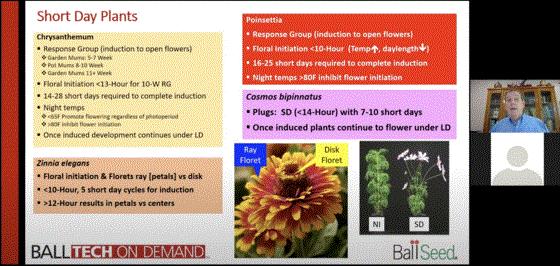
Get ready for a quick trip through different flowering classifications—Day Neutral, Long Day and Short Day—with time spent on major crops that fall into each group.
For the FIRST VIDEO, Will explained some terminology and background knowledge in flowering classifications that will help you and your team make production decisions using photoperiod response.
Looking specifically at day-neutral crops in PART TWO, he detailed a couple of the key crops—geraniums and impatiens—as well as other common annuals and perennials.
In the THIRD VIDEO, Will focused on facultative long-day plants, starting with petunias before breaking down the photoperiod response of calibrachoas, pansies, violas, snapdragons and more.
Wrapping up the photoperiod miniseries with VIDEO FOUR, Will turned his attention to short-day plants—specifically garden mums, poinsettias and zinnias.

LEDs for Propagation: What are You Doing?
Hey, let’s shout out another Will Healy masterclass while we’re at it. When you’re done with the photoperiod series and have greenhouse lighting on your mind, check out a Tech On Demand video covering research and greenhouse results using LEDs in propagation settings.
For this one, I once again called upon Dr. Will Healy to share some of his lighting experience to help demystify what can be a pretty complex topic. There’s no way to cover everything you need to know in 45 minutes, but Will does a fantastic job boiling it all down to one key question: What exactly are you trying to do? Having the end goal in mind is how you need to approach the topic.
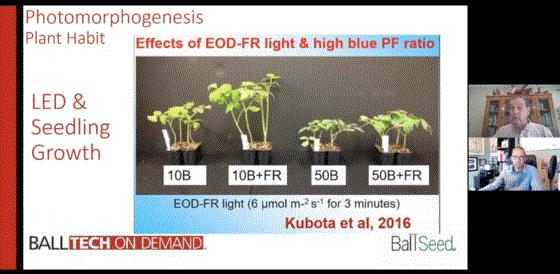
In LED LIGHTING FOR PROPAGATION, Will takes us through a primer on how LEDs work and the effects of different colors. He then jumps right into two key objectives, and making up the bulk of his message are the Three Ps: photomorphogenesis (habit and size), photosynthesis (carbohydrates = growth) and photoperiod (flowering versus branching).
With most greenhouse innovations, there are some downsides, or at the very least a learning curve. This is also the case for LEDs in propagation. Will warns that growing with LEDs pushes growth so much that there’s a significant risk of massive nutrient deficiency. Obviously, this is not what you want to encounter in prop, and Will shares the warning signs. He wraps up with eight important considerations to take into account when making a decision to go with LEDs. I’d share them now, but then you won’t watch the video. Although I suppose you can jump to the end of the video if that’s how you roll.

Finish Line ...
It’s been a wild week for many reasons, which I won’t go into but if you’ve got some good vibes or prayers to send to my family, we’ll take them. Anyways, it’s also been a busy week for me recording podcasts. I think I’m up to like 17 recordings in the past 10 days!
I tell you this as a teaser for a multi-part miniseries that kicks off in the next week or so. Watch for my 2026 California Spring Trials Preview podcasts with representatives from most of the exhibiting companies that are getting ready to introduce new plants next March. I caught up with them to discuss their trial stops, themes, the work it takes to bring CAST to life and, of course, to offer (audio-only) sneak peeks at what they have in the pipeline for 2027 production.
Why did I agree to take on this monumental task, you might ask? Well … because I love CAST, and after attending in some way or another for about 20 years, I still get amped up for the trip every year. Diane Blazek, executive director of All-America Selections and National Garden Bureau, and I cooked up this idea to coincide with the opening of registration for the event. She beat me to it, though, and the REGISTRATION SITE is now live, but the podcasts are still to come.
Stay tuned—you’ll be the first to know when they start rolling out.


Please feel free to send your comments, constructive criticism and topic ideas to me at bcalkins@ballhort.com.

Bill Calkins
Editor - Tech On Demand
This email was received by you and 25,465 other fine subscribers!
If you're interested in advertising in Tech On Demand, contact Kim Brown ASAP and she'll hook you up.