NEW Video & Podcast: Preventing & Managing Disease on Tropical Plants
Tech on Demand is on a roll! We've dropped another new VIDEO and PODCAST this week, following up on the previous topic covered with tropical and foliage plant expert Andrew Britten where he and I focused on insect pests impacting these crops. This time, we tackled disease.
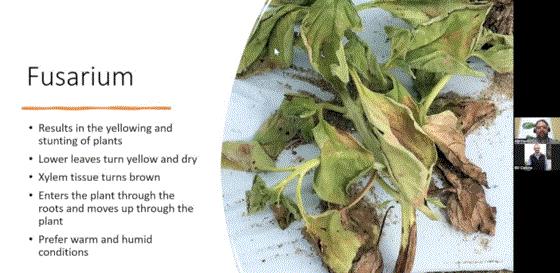
Andrew goes one by one through more than 10 diseases, sharing causes, how to identify and control them. Andrew covers:
-
Alternaria
-
Cercospora
-
Colletotrichum
-
Fusarium
-
Myrothecium
-
Phytophthora
-
Powdery Mildew
-
Pythium
-
Rhizoctonia
-
Rust
-
Sclerotium
The goal of this presentation (and THE PREVIOUS ONE) is to help you produce your best crops ever and send clean, healthy tropicals and foliage to market. For Andrew’s full slideshow covering all the diseases, click HERE.
To never miss an episode, subscribe to the Tech On Demand Podcast on any podcast app. We’re on Apple, Spotify, Google, Audacy, Podbean and more. And find dozens of Tech On Demand videos on the BALL SEED YOUTUBE CHANNEL.

Nick’s Tip of the Week: Getting Ahead of Pythium on Points
Each week, I’ll work with my buddy Nick Flax, a technical services expert at Ball, to share a concern that’s come up during one of his numerous calls with growers across North America. This week he’s looking ahead to cool-weather poinsettia production (which is when Pythium problems often emerge) and sharing some info to help you avoid root rot.
PROBLEM: With a couple months to go on your poinsettia crops before shipping, and with weather hopefully cooling down soon, I’m thinking back to calls I received last year about a fairly common disease that you might encounter under these conditions: Pythium.
In the greenhouse, we generally group Pythium (and members of this genus that were recently reclassified as Globisporangium) based on their optimum temperatures for causing disease. If you’ve been following this newsletter, you’ve likely read some of our past tech tips that referenced “warm-season Pythium” on poinsettias and other crops. Now that we’re heading into cooler weather, here are a few tips for managing those pesky cool-season root rot diseases on your poinsettias.
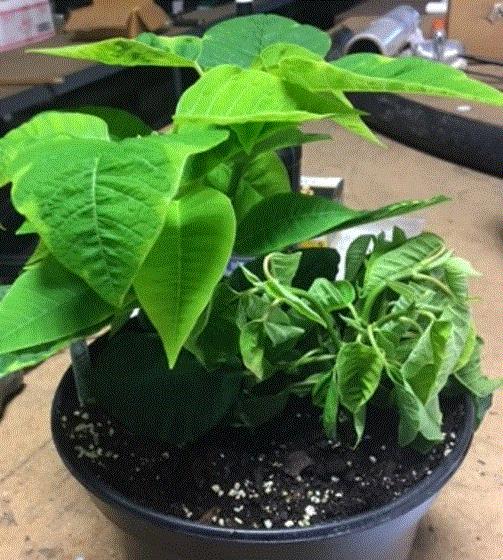
NICK’S TIP: Cooler days and nights mean your crops are at lower risk of heat delay. But remember, your cultural practices need to adapt to changing environmental conditions. For those of you still experiencing warm temps, you’re reading this just in time to get out in front of the changing weather. If you’re a grower in an area where temps have already dropped, here are a few things to consider doing soon in order to protect your poinsettia crops from mid- to late-season root rot.
Reduced water movement. Shortening daylength, cooler air temps and less-intense sunlight mean plants will be taking up water more slowly and transpiring less. Monitor soil moisture diligently and reduce irrigation volume as we get further into fall to avoid prolonged periods of saturated media or “wet feet.” These are ideal conditions for root rot.
Elevated soluble salts. As temps drop and water uptake decreases, fertilizer salts can more easily accumulate in your growing media. Though poinsettias are generally considered “high feeders,” be sure to check your substrate EC regularly, as high salt levels in your soil can damage roots and predispose your crop to attack from Pythium.
Higher disease pressure. The longer crops stay wet and the longer they’ve been in your greenhouse, the greater the chances that root rot will strike. Pythium preventatives, conventional chemistries and biological products all have a range of efficacy windows and prescribed reapplication times. Consider re-applying your favorite root-zone protectant at closer intervals within the labeled range to keep ahead of disease pressure. For example, if the label says to reapply every 4 to 8 weeks, consider reapplying every 5 to 6 weeks under prolonged periods of cool temps if the media is staying wet.
Considerations for biologicals. Trichoderma-based products like RootShield Plus or Obtego are powerful tools for controlling root rot on poinsettias. However, efficacy of these kinds of products hinges upon maintaining a higher population of beneficial microbes than pathogens in the root zone to outcompete them. As such, they may need to be reapplied more frequently than some conventional chemistries for maximum disease control. If you’re giving these types of products a try for the first time this year, be sure to double-check the label and reapply within the proper timeframe to achieve the highest level of disease control.

Case Study: Mum Low pH Correction
Tip necrosis was observed on a grower’s crop Week 33. You can see the issue in the photo. After conducting a “pour-through” test, pH values were identified between 4.7 and 5.0, indicating these plants were likely exhibiting iron (Fe) and manganese (Mn) toxicity. Both of these elements become more available to plants at low pH and accumulate in the tips of new leaves.
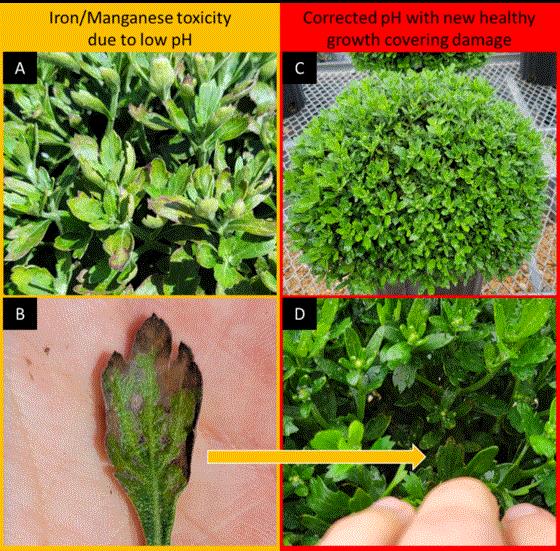
Three corrective measures were implemented with the help of our Tech On Demand team to save this crop:
-
Pots were drenched with flowable lime at 2 quarts per 100 gallons in Week 33 and again Week 34 using 1 quart per 100 gallons to bring pH values between 5.5 and 6.0 in an effort to avoid Fe and Mn toxicity.
-
Fertilizer was switched from acidic 20-10-20 to basic 14-4-14 for one week and then continued on an alternating schedule between 14-4-14 and 20-10-20 to curb pH drop. Ammoniacal nitrogen from 20-10-20 was also needed to encourage growth past damaged leaves.
-
Plant roots were also in poor condition, so irrigation was strictly managed to ensure the substrate was drying down between irrigations to encourage root development throughout the container.
Here are some key tips to help you and your team avoid a problem like this in the future:
-
Track pH and EC throughout production using 2:1, SME or pour-through method.
-
Check the roots often to make sure you’re irrigating correctly to grow healthy white roots.
-
Maintain a pesticide program following labels and FRAC-code rotations.
-
Take diagnostic steps and corrective measures upon observing nutrient or disease symptoms.

More pH Corrections: Marigolds
A few weeks ago, Nick Flax covered strategies to produce fantastic Day of the Dead (Día de los Muertos) marigolds for fall. Along those lines, the Tech On Demand team has received a few calls from some of you struggling with low-pH challenges as you finish up the crop. I thought it would be a good idea to call out what Nick had to say about this at the end of his tech tip.

If soil pH is slightly too low (5.9 to 6.0, for example), change your fertilizer to a more nitrate-based feed. This will gradually bring the pH back into optimal range.
If soil pH is drastically lower than it should be (5.5, for example), applying a flowable lime agent ASAP is highly advisable. Flowable lime will quickly correct the pH and add some additional buffer to prevent it from crashing again right away, but changing fertilizer to a less-acidic formulation is also advisable.
Unexpected Poinsettia Light Pollution
What’s scarier than Día de los Muertos? How about unexpected delays to the flower development of your poinsettia crop—that’s a real nightmare for many growers!
In a bonus video from our 36-part poinsettia production series, the experts from Selecta One shared some HORROR STORIES they’ve encountered working with hundreds of poinsettia crops over the years.

Listen to a few real-world tales of what light pollution can do to a poinsettia crop. You can’t believe (or maybe you can) some ways unexpected light can hit a crop once the sun goes down. After watching, you’ll no doubt want to spend some time in your greenhouse after hours looking for stray light coming in that you'd otherwise miss when you’re at home fast asleep.
Finish Line …
As you and your crew begin to plan for next year, it’s a good idea to stock up on resources so they’re on hand before you need them. Here's a must-have resource—The Ball Culture Guide: The Encyclopedia of Seed Germination. It has been a mainstay resource for growers since it was first introduced way back in 1989. That first volume was the culmination of a decade’s worth of research and development in seed germination knowledge and experience, thanks to the new technology of plug production.

Today, just as he did in 1989, horticulturist Jim Nau, the author of all four editions of the Ball Culture Guide, provides detailed information on germination, scheduling, production temperatures, lighting requirements, propagation and growing-on tips, final garden height and much more. The chart format makes it an easy-to-use guide for producing a multitude of seed-grown crops in all categories—annuals, perennials, potted crops, cut flowers, foliage plants, vegetables, herbs and ornamental grasses.
ORDER YOUR COPY TODAY!


Please feel free to send your comments, constructive criticism and topic ideas to me at bcalkins@ballhort.com.

Bill Calkins
Editor - Tech On Demand
This email was received by you and 25,845 other fine subscribers!
If you're interested in advertising in Tech On Demand, contact Kim Brown ASAP and she'll hook you up.