What’s Happening Here?
I hope your summer is going well. I can’t believe the year is already half over. They say time goes faster as you age, I prefer to think that I’m just having lots of fun.
Let’s start off the newsletter with a diagnostic challenge. Since it’s been a few newsletters since we last had one, I’ll make this challenge an easy one. Take a look at the veronica below.
Unfortunately, this isn’t a genetic breakthrough or an interesting new speedwell cultivar. This is the very popular cultivar Royal Candles. As you can see, the plant does not look as it should. Do you know the cause of this malady? Is this a nutritional disorder, herbicide damage, phytotoxicity, or caused by insects, disease, virus or some other bizarre phenomenon?
It’s time for me to ask, “What’s happening here?” Take your time to ponder the possibilities and enjoy the rest of the newsletter. I’ll reveal the cause of this unusual appearance before signing off. Good luck.
AAS Winners
All-America Selections (AAS) recently announced five winners for the 2023 garden season. The really cool part of this is three of them are perennials. Many of the past AAS perennial winners have become perennial staples and market leaders in their genera.
Any of these past AAS perennials award winners sound familiar?
|
Achillea Summer Pastels - 1990
Agastache Golden Jubilee - 2003
Alcea Queeny Purple - 2004
Coreopsis Early Sunrise - 1989
Dianthus Supra Pink - 2017
Echinacea Cheyenne Spirit - 2013
Echinacea Pow Wow Wild Berry – 2010
Echinacea Sombrero Baja Burgundy - 2020
Gaillardia Arizona Apricot - 2011
Gaillardia Mesa Yellow - 2010
Gaillardia Arizona Sun – 2005
|
Gaura Sparkle White - 2014
Lavender Lady - 1994
Leucanthemum Snow Lady – 1988
Leucanthemum Sweet Daisy Birdy 2021
Penstemon Arabesque – 2014
Penstemon barbatus Twizzle Purple - 2017
Rudbeckia x American Gold Rush - 2020
Rudbeckia Prairie Sun - 2003
Rudbeckia Cherokee Sunset - 2002
Rudbeckia Indian Summer - 1995
|
Before I pass along the award-winning plants, please allow me to share a little information on how the AAS winners are selected. First, did you know AAS has been trialing plants since 1932—that’s 90 years! That’s incredible, thank you All-America Selections for nine decades of awesome trials!
The plants in the AAS trials are new, never-before sold cultivars. They’re grown next to comparisons that themselves are consider to be best-in-class. Each entry is trialed at over 50 trial sites throughout North America and judged by over 80 horticultural professionals who VOLUNTEER their time to do these trials. Only those entries that have superior garden performance, better than the comparisons, are granted the AAS award designation.

The 2023 Winners Are…
Without any further ado, the 2023 AAS perennial winners are:
Echinacea Artisan Yellow Ombre
It’s interesting that I’ve featured this echinacea in each of the past two issues; however, it’s a great variety and worth mentioning again.
Artisan Yellow Ombre from Kieft Seeds is a F1 hybrid belonging to the first series of hybrid echinacea offered as individual colors. AAS Judges were impressed with the uniform growth habit, vibrantly colored flowers, and multi-branched plants that produce a prolific number of blooms. Hardy to Zone 4a.
Leucanthemum Carpet Angel
Carpet Angel from
Green Fuse Botanicals is the only groundcover shasta daisy in the world. It reaches just 6 in. tall and 20 in. across, has fantastic branching, and produces loads of large 3 in. fully double flowers. Hardy to Zone 4a.
Salvia Blue By You
With it’s early blooming, rich blue flowers and repeat blooms,
Blue by You from Darwin Perennials received high scores and rave reviews from the AAS judges. It provides season-long flowering and repeat blooms when the spent flowers are removed. Blue by You has shown great heat tolerance and excellent winter hardiness to Zone 4b.

What’s New at Pace 49?
My friends at Pace 49 (Hello y’all!) recently launched a brand-new website. The site is easy to navigate and is divided into products and programs. There’s tons of product information and innovative and effective methods of using their products. In my previous role as a consultant/researcher, I learned behind the scenes about the potential and results UpTake Pro, KleenGrow and Strip-It Pro could provide. Now that I’m back on the grower side of things, I get to experience these benefits firsthand.
I encourage you to visit
www.Pace49.com to not only see a pretty cool newly designed website, but more importantly to gather great information about how their products can help with your production challenges.
The Answer Is…
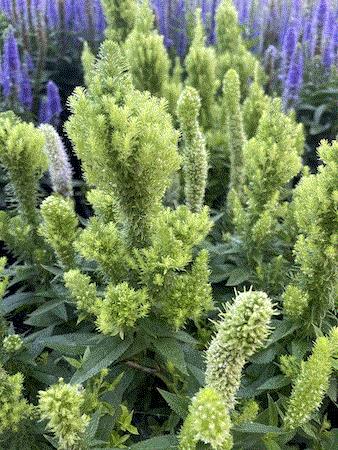
At the top of the newsletter, I showed the image of Veronica Royal Candles above and asked if you could identify the cause of its odd appearance. I’ve seen this before, but this was a little unusual as only a single plant looked like this—usually several plants within a block look this way. Check it out:
It’s very interesting how the entire plant of this single plant looks different from the others. Based on this last image and with only one plant looking this way, a lot of potential causes can be ruled out. For starters, I’d take nutrition, phytotoxicity and herbicide damage off the list of possibilities.
My guess is that most of you have already locked in your final answer. If your diagnosis is aster yellows, you correctly solved this challenge and for that deserve the rest of the day off or at the very least a brief moment to relish in a moment of victory.
Let’s Dive in Deeper
Aster yellows is often considered a disease, but I associate it more as a virus than a plant pathogen. It’s caused by a phytoplasma. Phytoplasmas are single-celled microorganisms (intermediate between bacteria and viruses) that live as parasites in the phloem of plants. They are vectored from plant to plant by aster leafhopper (Macrosteles quadrilineatus) and certain other leafhoppers.
I can’t say for certain that I’ve never observed a leafhopper inside a greenhouse, but I’ve definitely seen them outside, inside shade houses and in uncovered structures. It takes several weeks for aster yellows to become visible. In many instances, aster yellows arrives in the starting materials and my not be detected until the crop ages a bit.
Unfortunately, once a plant has aster yellows there is no cure and growers should manage it similar to how they deal with viruses. Plants with symptoms should be rogued out and destroyed to reduce the risk of aster yellows spreading to uninfected plants nearby. Consider managing the adults on susceptible crops using knock down insecticides such as bifenthrin, cyfluthrin, horticultural oils or insecticidal soaps. They can also be managed using systemic insecticides containing acetamiprid, imidacloprid or thiamethoxam.


Thanks for reading this edition of Perennial Pulse. My email is paul@opelgrowers.com if you have any comments, article suggestions or if you'd just like to say "hello."
Paul Pilon
Editor-at-Large—Perennial Pulse
Director of Growing—Opel Growers
This email was received by you and 34,676 other fine subscribers!
If you're interested in advertising in Perennial Pulse, contact Kim Brown ASAP and she'll hook you up.