9/30/2026
Keeping it Positive
Megan Gibb, Jeb S. Fields & Paul R. Fisher
Your choice of growing medium can save fertilizer cost, result in more consistent control of pH and nutrient levels and help you be a more environmentally conscious grower. When you apply controlled-release or water-soluble fertilizer, there are two aspects about your growing media that determine how much of these nutrients are retained versus wash out the bottom of the container (e.g., leaching). The first factor is water-holding capacity—components such as peat or coconut coir retain a lot of water (and therefore the nutrients dissolved in this “soil solution”). This means the container holds more water and nutrients after an irrigation than less-absorbent components such as bark.
The second factor, cation exchange capacity or “CEC,” is more complex. Stay with us—a bit of high school chemistry or soil science can help your bottom line and choice of growing medium!
 The ABCs of CEC
Cation exchange capacity is a measure of the number of negatively charged exchange sites in a growing medium. These “sites” are tiny, at the scale of molecules. Because these sites have a negative charge, they retain positively charged ions (“cations”), which are attracted like a magnet. Those cations could be nutrients such as ammonium (NH4+), potassium (K+), calcium (Ca2+), magnesium (Mg2+), iron (Fe2+) and manganese (Mn2+) that are critical for healthy plant growth.
Other cations include H+ (acid), which affects substrate pH. The high concentration of H+ on CEC sites is what makes peat and bark acidic. Sodium (Na+) is a cation that increases electrical conductivity (EC) without helping plant growth. Cations also include some heavy metals such as cadmium (Cd2+) that can contaminate food and medicinal crops.
Figure 1. An illustration of cation exchange sites on substrate particles (in this case peat), which can exchange cations such as acid (H+), calcium (Ca2+), potassium (K+) and iron (Fe2+) in the soil solution.
A higher CEC indicates greater ability to retain cation nutrients on the growing medium for use by the plant. The CEC sites can exchange cations between the substrate and the surrounding soil solution (Figure 1), which buffers (evens out) the overall nutrient levels available to plant roots.
There’s a related soil attribute called anion exchange capacity (AEC). However, the components we use in horticultural substrates have few positive exchange sites (i.e., low AEC) and therefore low retention of anion nutrients such as nitrate (NO3-) or phosphate (H2PO4-). Anions are consequently very easy to leach out with rainfall or heavy irrigation.
 Increasing CEC
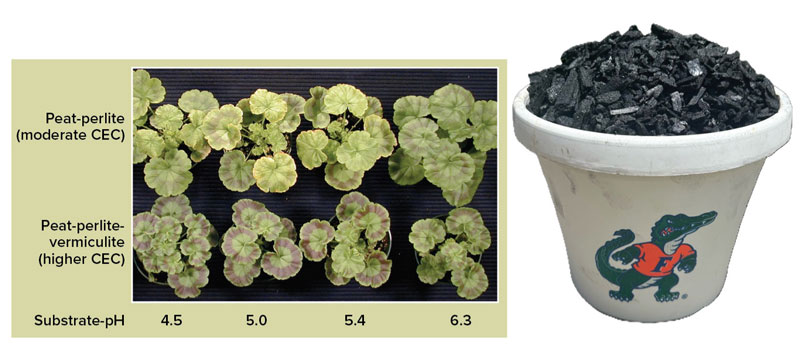
Figure 2 illustrates how increasing the CEC can buffer nutrient levels and benefit plant health. A common issue with iron-efficient crops like seed geraniums is iron/manganese toxicity at low pH. Geraniums absorb excess iron and manganese (both cations) at low pH (4 to 5.5) because in this pH range the micronutrients are highly soluble. Back in the 1970s when growers were first growing bedding plants in containers, they often included some topsoil in their substrate, which increased CEC. With the introduction of new soilless substrates, topsoil was removed, resulting in more consistent, lightweight and disease-free growing media. Despite these benefits, the decrease in CEC also meant it was more common for pH to drift over time and the appearance of iron/manganese toxicity symptoms became a more significant issue.
Figure 2. Appearance of seed geraniums after 21 days grown in 70% peat/30% perlite by volume (top) or 70% peat/15% perlite/15% vermiculite (bottom). Different substrate pH levels were achieved by increasing lime rate from left to right. Chlorotic and necrotic spots in the lower pH levels with the peat:perlite growing medium resulted from iron/manganese toxicity.
Photo by Brandon Smith, University of New Hampshire.
The plants in Figure 2 were all grown with the same water-soluble fertilizer. Adding 15% by volume of vermiculite to the growing medium increased CEC. Higher CEC meant that the growing medium held onto some of the cations, reducing the iron and manganese levels in the soil solution, which are highly available to plant roots. Even under low pH conditions, tissue levels of iron/manganese and symptoms of toxicity were decreased by increasing CEC with vermiculite.
To increase CEC in your substrate, you could incorporate components that are known to have high CEC. Alternatively, you could send a growing medium sample to a horticultural laboratory to measure CEC. Labs use specialized protocols to measure substrate CEC and it’s not feasible to measure CEC at your greenhouse or nursery.
Table 1 shows the relative CEC levels for substrate components. Few growers include high-CEC components such as mineral soil, black humus-like peat or clay for a variety of reasons, including low availability, inconsistent quality, tendency to become water-logged (high water retention and low air porosity), higher cost and increased weight (“bulk density”) per container.
In contrast, biochar is an interesting new component that has high CEC and can be manufactured in different particle sizes with the desired air and water balance. The CEC of vermiculite varies depending on the source and processing, and for many growers has limited availability. Blond Sphagnum peat has many positive attributes, including moderate CEC, but the industry trend is to substitute alternative components such as wood fiber or coconut coir, which have lower CEC.
Figure 3. Biochar is the pyrolyzed remains of organic waste materials, like residual wood chips shown here. The biochar process enhances CEC, offering a unique opportunity to enhance fertility with lightweight, organic components.
Photo by Megan Gibb.
Consequently, most growing media have low CEC. Nutrient and pH levels can change easily (i.e. they aren’t very “buffered” or resistant to drifts in pH or EC over time). This has several practical consequences:
- Irrigation: Avoid over-watering, which rapidly leaches out nutrients and pesticides into the environment.
- Nutrient management: Make sure you have a complete fertilizer program throughout the growing cycle, and monitor substrate-pH and EC on a regular basis.
- pH management: Including peat or bark along with limestone to neutralize their acidity results in a substrate that’s more buffered to pH. Because pH can change easily over time, you need to carefully manage the choice of fertilizer (especially acid ammonium versus basic nitrate) and water alkalinity versus acid injection.
- Plant health: Including components such as peat, biochar or vermiculite can reduce uptake of contaminant heavy metals such as cadmium or toxicity from micronutrients such as iron and manganese. GT
Megan Gibb has a Masters of Science degree from Dr. Jeb S. Fields’ soilless substrate research lab at the University of Florida IFAS. Their work is focused on engineering soilless substrate materials and developing substrate characterization methods. Jeb Fields is also editor-at-large of Nursery & Landscape Insider, a GrowerTalks newsletter. Paul Fisher is a professor at the UF/IFAS researching plant nutrition.