7/31/2026
New Natives Hitting Retail
Jeb S. Fields

As I combed through my favorite new plants hitting the market next year, I tried to sense a theme. As I compiled my list, I kept noticing something that linked several of the introductions—many were native taxa.
I like to keep in touch with many of the plant releases and breeders across the country to get an idea for what they’re pursuing and the direct link to natives doesn’t get mentioned too frequently. However, it’s clear that there’s an active pursuit of natives—or at least strong benefits to improving—native plants. Either that or they’re just incredible plant material that everyone likes to work with.
Moving outside the breeding world, native plants are quite the hot topic right now. As I make my rounds visiting growers, gardeners and overall plant enthusiasts, one thing is clear: there are definitely two sides forming on the native plant discussion.
The case for native plants is logical: Native plants are good for the environment and naturally occurring, so why wouldn’t they be good? The case against natives is more nuanced. Also, I don’t really see a case against native plants. Instead, it’s more a concern over the rapid onset of the native movement. Sometimes we tend to take things to the extreme; it seems to be a natural human tendency. If we’re strong believers in native plant superiority, why not push for more native plants? What if we could get municipalities to require native plants in new plantings or change landscape codes? Why not reach across the aisle, so to speak, and talk about the benefits of intermixing natives and what they can bring to the environment, without detracting from the love that brings so many of us into the trade?
 I had the chance to take a long car ride with Dr. Leynar Leyton, a colleague at the University of Florida, who just so happens to be a native plant breeder. We had hours of windshield time on our road trip and, of course, I decided to pick his brain for some more insight into the concept of native breeding.
I asked a philosophical question about native plants and breeding: “Once actively bred, is the plant still native?”
I tend to get many different answers to this one, but in this case the answer was a resounding: “Yes, of course, it is, Jeb. Why wouldn’t it be?”
The confidence and assuredness in this answer made me start to doubt the relevance of that question. In fairness, most ornamental plants aren’t genetically modified in a lab. Instead, they use classic breeding techniques, which involve physical cross pollination between two parents, evaluating offspring, rinse and repeat. The crosses that are made often occur naturally—in a sense, we just help them along and use some of their insights to search for specific outcomes. Why would that detract from the native status of a plant?
Moreover, why would we not want it that way? If people want natives, but they also want very showy focal pieces, what’s wrong with that? If these native plants are going to help push the industry forward, then that’s a good thing, in my mind.
 With that, let’s check out some can’t-miss shrubs hitting retail in 2027. I’ve denoted* the ones that are native taxa or nativars (cultivars of native plants).
1. *High-Viz Diervilla (Bailey/First Editions)
Diervilla x splendens Baildierone is one of the newest Northern Bush Honeysuckles to release in 2027 from First Editions. This one definitely pops out among the others due to its vibrant yellow and orange foliage, aligning with its moniker of High-Viz. You won’t overlook this one. The bright chartreuse foliage is the star of the show and the soft yellow blooms are a bonus. Even better, the new growth foliage starts as a gorgeous orange color, offering a thrilling two-tone shrub. It’s recommended in Zones 3 to 8, which makes it suitable for most of the U.S., the exception being the hottest parts of the south. It can tolerate drought and wet soil conditions—really an all-around champion in the landscape.
2. *Dreamscape Smooth Hydrangea (Bailey/First Editions)
The latest in the storied line from First Editions, this Hydrangea arborescens is a leap forward for pink-flowering smooth hydrangea. The mophead flowers start off with a deep ruby red that fade to a nice pink over their bloom period. Strong stems help keep the flowers up longer and withstand wind and rain much better than many of the mopheads on the market today.
 3. *Bubble Up Beautyberry (Proven Winners ColorChoice Shrubs)
This shrub is full of character and a fantastic take on one of my favorite native plants, Callicarpa americana. Beautyberry is not new to the trade, but in its natural form it can be quite leggy with inconspicuous flowers. The fruit are typically the center of the show. While that stays the same, Bubble Up has showy pale pink flowers in a nice compact form. It brings a bit of nature into the landscape with that natural understory feel, bringing backyard birds right to the forefront. Plus, it’s deer and heat resistant—something we can all find beneficial no matter where you live.
Bubble Up Beautyberry can set fruit with just a single plant. Even better, if you want to cut it back to the ground, it’ll regrow from established roots and set flowers/fruit that same year.
4. *Pickleball Ninebark (Proven Winners ColorChoice Shrubs)
Pickleball is a cultivar of P. opulifolius and is a compact native shrub with vibrant chartreuse foliage that leads to gorgeous flower clusters on the ends of each stem. There are tons of white flowers on this one that keep going most of the year, from spring through fall.
5. *Forever Young Arborvitae (Van Belle/Bloomin’ Easy)
Ever wanted an arborvitae, but don’t have the space for the classics? Forever Young might be your next favorite shrub. This compact Thuja occidentalis keeps a nice meatball form, getting 3- to 4-ft. tall and 2- to 3-ft. wide. Coming from a chance seedling, the soft green foliage keeps a fresh look year-round. I can see this as a great centerpiece for a planter or a small accent hedge.
6. *Milky Way Mock Orange Leucothoe (Van Belle/Bloomin’ Easy)
Philadelphus is a lesser-utilized species that has a ton of potential to be a regular performer in the landscape. They’re profuse bloomers, great pollinator attractors and drought resistant—a perfect combo for any modern landscape. Milky Way tops out at about 4- to 5-ft. tall and is cold hardy down to -30F, making it an excellent addition to any yard.
They get the name Mock Orange from their flowers, which closely resemble flowers in many citrus species. This resemblance is not only in the way the flowers look, but also their amazing smell.
7. *Cirque de Bloom Hibiscus (PDSI/Southern Living/Sunset Collection)
Hibiscus moscheutos and I go way back to my first days in graduate school. They’re one of my all-time favorites and there are so many fun cultivars available, it’s hard to imagine they can be improved, but they have. Three new entries hit retail this year under the Cirque de Bloom name: Red, Pink and White. As the name implies, these hibiscus definitely put on a show, with massive flowers you can use to bring color into the landscape. I’m especially excited for White, which features a deep blood-red center that slowly gives way to the white blossom.
8. Purple Raindrops Loropetalum (PDSI/Southern Living/Sunset Collection)
Loropetalum are some of the most recognizable and consistent shrubs in the trade. They’re known for their vibrant colors, low maintenance and their easy-to-manage nature. The purple foliage is what draws you in and the frilly flowers are an added bonus that bring that unique texture we all know and love. Purple Raindrops is one of the newest on the market and something worth getting excited about. A compact shrub, only reaching 2- to 2.5-ft. tall, Purple Raindrops is a great option to plant en mass as a barrier or border plant. Typically, loropetalum are used as the standard hedge, but this one brings the lower story into play. I can see it being used like liriope to set off a walkway or bed. It’s also a great size for containers, as it can take center stage in smaller areas. The color is maxed out with some of the deepest purples on the market that hold up in the sun.
9. *Garden Gems Cercis (Star Roses & Plants)
Here’s a three-for-one addition to the list. I’m confident that there isn’t a person alive that doesn’t love a redbud. There are three new Garden Gems Cercis hitting shelves in 2027 (well, these might be a bit large for the shelves, but you get my drift). Emerald Falls (pictured) and Amethyst Falls are compact weeping redbuds that will likely be found in smaller (3- to 5-gal.) containers—a perfect large shrub or small tree contender. As the names imply, Emerald Falls has a flush of green foliage, while Amethyst Falls has deep purple leaves.
I was going to just stick with these two compact, weeping cercis, but I can’t make my mind up when picking favorite plants, so I decided to lump in Citrine, as well. Citrine isn’t a weeper, but it’s certainly a looker. Vibrant orange-yellow foliage sets this one apart from others with dense foliage and a compact form. These three are going to be striking in any landscape.
10. Autumn Queen Encore Azalea (PDSI/Southern Living/Sunset Collection) 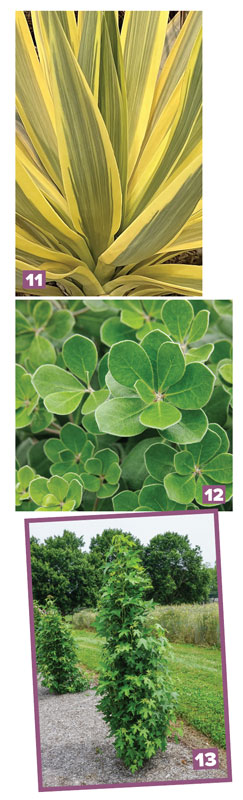
Spring in the south means it’s time for azalea blooms. The iconic flowering hedges that adorn most southern landscapes transform yards into picturesque scenes that people plan vacations around. Each year as the flowers fade, we all ask ourselves: Why does it have to end? Well, that’s the exact reason Encore Azaleas have become one of the most recognizable plant lines in America. Autumn Queen has bold fuchsia blooms that cover the shrub in spring and keep coming throughout the summer and fall. Topping out at 3 ft. by 3 ft., it has a nice dense and round form so there’s little maintenance needed.
11. *Citrus Twist Yucca (Monrovia)
Yucca gloriosa are known for the vibrant colors, drought tolerance and ability to bring that southwestern desert vibe to landscapes across most of the U.S. As with most Y. gloriosa, once established, Citrus Twist will require almost no additional water unless they’re very dry. They often go by the trade name Spanish Dagger due to their pointed leaves, which are, in fact, spiky at the tips, making them excellent for use where you want to limit foot traffic. That being said, these shouldn’t be relegated to offsite areas where their pointed leaves provide added benefits. Instead, this showy trunk-forming yucca has the potential to be the centerpiece of any landscape. Citrus Twist brings flashy color, as yellow stripes cut across the background of green for most of the year. Yes, these keep color through the winter. Even better, Citrus Twist dons a pink hue as they endure through the summer heat.
12. Pot Belly Pittosporum (Monrovia)
Pittosporum is one of those shrubs that doesn’t often get the recognition it deserves, but it’s a mainstay in the landscape. It’s everywhere and you might not always notice it, as it doesn’t always have the flash. Even better, you can throw anything at it and it’ll push forward. A truly reliable workhorse plant. Next year, Pot Belly will hit retail and bring some excitement to pittosporum.
This Pittosporum crassifolium keeps its tight ball-shape and doesn’t need much maintenance. My favorite thing is that after establishment, it hardly ever needs water except for extended drought, and can handle some salty coastal air. It loves the heat and grows slow, a true set-it-and-forget-it plant. Adorned in small, fragrant red flowers from spring through early summer, this is a landscape contractor’s dream.
BONUS: I know this article is about shrubs, but I couldn’t help myself when I saw this tree.
13.*StraightUp! Liquidambar (Star Roses & Plants)
I love to see fun takes on classic trees drop in the market. I’ve had an odd affinity for sweetgum since childhood—the seed pots were just so radical. As time went on, I realized most people weren’t as excited to pelt their brothers with the little spiked balls. GT
Jeb S. Fields is a professor of horticulture at the University of Florida who works with the nursery industry to support more efficient and sustainable production practices. He’s also the editor-at-large for the Nursery & Landscape Insider newsletter. He can be reached at jsfields@ufl.edu.