7/31/2026
Preventing Year-Round Weed Season
Chris Marble

It’s been said that as far as weed management goes, there are two seasons in the container nursery industry: spurge season (warmer months) and bittercress season (cooler times of the year). Spurges and bittercress do often rank at the top of the most common and troublesome container nursery weed species, but only focusing on a small select group of weeds can leave your nursery vulnerable to spread of other species that can also be problematic. One weed that’s often a problem at the same time as bittercress is chickweed.
Figure 1. Chickweed (Stellaria media) growth habit (A), leaf and stems (B), seedling (C) and flower (D).
Chickweed (Stellaria media) is a winter annual and is most commonly found in container nurseries from the fall through the spring. In nursery environments, it can persist into the summer months, especially in the more northern climates in the U.S. Although it’s native to Europe and parts of Asia, it has spread throughout the world and is a common occurrence in nurseries throughout most of the U.S.
Identification
Chickweed is usually found as a low-growing (prostrate), mat-forming weed (Figure 1a), but can grow up to 12 in. tall under the right conditions. Chickweed is light green in color with opposite leaves and pointed leaf tips (Figure 1b). Seedlings have noticeable mid-veins and a few thin hairs at the base of the leaf (Figure 1c). Flowers are small, white and at first appear as though they have 10 petals. However, in fact, chickweed only has five flower petals, but each petal is deeply split, giving the appearance of 10 petals (Figure 1d).
Reproduction and spread
Chickweed will most commonly flower from fall through spring and plants can begin to flower as soon as four weeks after germination. Chickweed is a prolific seed producer, with plants generating between 500 to well over 3,000 or more seeds per plant.
The tiny round reddish-brown seeds are contained inside an egg-shaped capsule and are spread by wind, water, people and equipment. Seeds are highly viable with no dormancy requirement, meaning that they can immediately germinate and begin to grow under favorable conditions as soon as they’re formed and mature. Peak germination occurs from about 55 to 65F (12 to 18C), but germination can occur outside of these ranges in some cases.
Management
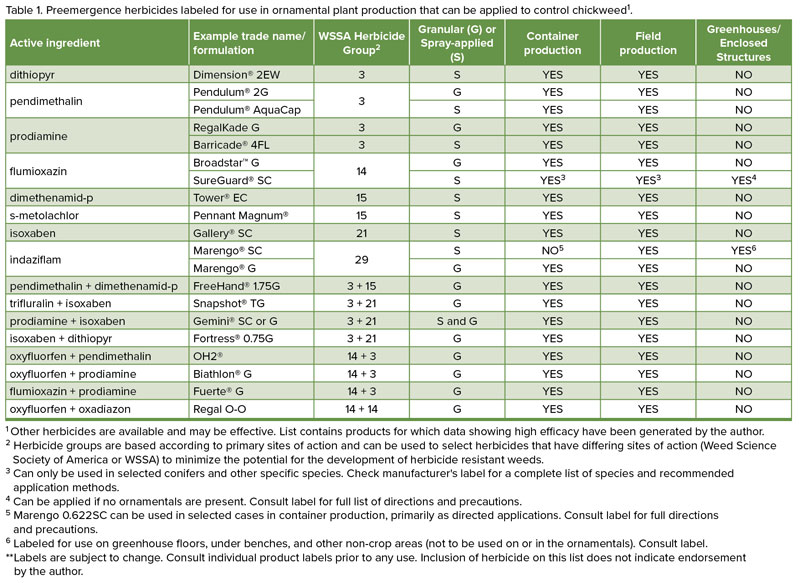
Chemical Control: As an annual weed, chickweed spreads exclusively by seed production. Consequently, preemergence herbicides are going to be the best chemical control strategy in containers. Luckily, chickweed is generally well controlled by most preemergence herbicides labeled for use in container nurseries (Table 1). In fact, chickweed could be considered somewhat of an “indicator” weed species in terms of herbicide practices because most products should provide good control if applied properly. If chickweed is routinely a major issue, it could be due to an application timing issue, an application rate or calibration problem, or some other issue such as improper sanitation practices or applications made in containers that already (or still) contained weeds.
While many preemergence herbicides can control chickweed, herbicide selection is still an important aspect of an overall weed management plan. First, ensure the herbicide you choose is safe on your crop list and rotate through herbicides with different modes of action (MOA) throughout the year, both to improve control and to prevent or delay resistance development. Since chickweed is typically an issue at the same time as bittercress (Cardamine spp.), be sure your selection is effective not only for chickweed, but for bittercress or whatever weed species or group of species are problematic at the same time of year.
Although there are no herbicides for postemergence control of chickweed in containers (when applied over the top of ornamentals), most non-selective and broadleaf specific postemergence herbicides will provide good chickweed control. Chickweed has developed resistance to certain groups of postemergence herbicides, such as certain acetolactate synthase inhibitors (ALS inhibitors), but postemergence herbicides labeled for use in nurseries and greenhouses—such as glyphosate, glufosinate, pelargonic acid, diquat and many others—will be effective.
Non-chemical control: Regardless of how well any preemergence herbicide program is dialed in, at least some hand-weeding is still going to be required in container nurseries. The common industry standard is to apply a preemergence herbicide, wait, and then before it’s time to reapply, hand weed any escaped weeds, usually eight to 10 weeks after the first application was made. This method can work, but if weeds are missed during that first application, they have eight to 10 weeks or more to grow, which is more than enough time for weed species such as chickweed to fully mature, flower and produce seeds. This cycle of treatment, waiting and weeding can eventually result in a higher seed load in the containers and significantly higher hand weeding costs.
Research led by Dr. Joe Neal from North Carolina State University showed that more frequent hand weeding, such as weeding pots every two weeks, can reduce overall weeding costs by about 40%. This method is effective for several reasons. First, workers are able to weed much more quickly—they only have to be concerned with larger weeds, as they’ll weed again in two weeks.
Secondly, the weeds won’t have the ability to fully mature and produce seeds in two weeks, so weed pressure decreases over time.
In addition to hand weeding, mulch—such as bark nuggets or rice hulls—are effective for chickweed and most other annual weed species common in container nurseries (Figure 2). Mulch is an ideal option for ornamentals that are chemically sensitive and cannot be treated with standard preemergence herbicides. Rice hulls are also a great option for liner trays and young plants, which are too small to be treated with herbicides.
Recommendations will differ by mulch type, but in general, a 1-in. layer of a mulch, such as rice hulls, is sufficient for months of weed control if the entire container media surface is covered. An important consideration for rice hulls is that they control weeds by being hydrophobic and quickly drying out following rainfall or irrigation. As a result, rice hulls are much more effective on weed seeds that land on top of the mulch, as opposed to seeds already being present in the pots. From a production standpoint, this means that it would be ideal and recommended to apply rice hulls and most other mulch types as soon as possible after potting or even during the potting process.
Combining chemical and non-chemical control options along with knowledge of the biology of chickweed and other nursery weeds is going to be the best control strategy. Together, these tactics will give you options in all parts of your production system, while also allowing you to plan and stay ahead of the weeds all year round. GT
Chris Marble is Associate Professor at the University of Florida’s Mid-Florida Research & Education Center in Apopka, Florida.