7/31/2026
From Home Gardens to Market Insights
Celina Gómez

This article is part of a special ASHS series, “Bridging Research & Practice,” featuring an article adapted from an ASHS journal publication that presents academic horticultural research directly to industry professionals. To learn more about ASHS please visit, ashs.org.
A few summers ago, I found myself staring at a spreadsheet filled with data from cultivar trials of compact vegetable plants we were evaluating for indoor and outdoor production. We were rating plants in hopes of providing recommendations to growers on the best cultivars to produce based on plant performance and assumed consumer preferences.
Around that same time, the COVID-19 pandemic moved the in-person American Society for Horticultural Science (ASHS) annual meeting online. While viewing presentations from my home office, I came across a brilliant talk by Dr. Natalie Bumgarner from the University of Tennessee-Knoxville, who introduced the idea of using citizen science to engage home gardeners in evaluating new plant varieties.
Michael Fidler and Sofia Gómez assisting with project kit distribution in 2024.
 That moment sparked a research effort that’s since grown into a multi-state program built around citizen science. Today, this work focuses on understanding plant performance, consumer preferences and the human aspect of gardening. I’ve led three of these projects and one key takeaway has been consistent throughout: When people are invited into the research process, they generate insights that are difficult for us as scientists to capture in other ways.
How we got here
Across four papers resulting from these projects, we’ve asked a simple question from different angles: What makes a plant successful in the hands of a consumer?
Our early work focused on evaluating compact tomatoes, plants with strong potential for container and indoor gardening. We began by evaluating gardeners’ experiences with starting tomato plants at different stages of development (from seed, seedling or flowering plants), wondering if the starting plant material influences satisfaction and success.
 We then explored how participating in citizen science itself affects gardeners’ attitudes, showing that involvement in research can increase both engagement and confidence.
Photo submitted by a participant showing an update at the beginning of the project in 2024.
Building on that, we examined cultivar preferences for compact tomato plants and demonstrated that citizen scientists can reliably generate data on yield, performance and consumer preferences across a wide range of environments.
Along the way, we also explored broader product questions that are directly relevant to the horticulture industry. For example, is there an opportunity to market premium vegetable plants with small, green fruit, which may provide faster satisfaction for consumers and a lower likelihood of failure? How do gardeners respond to novel fruit and flower colors or different growth habits? Finally, which traits ultimately drive purchasing decisions?
Each of these studies added a piece to the puzzle. But our most recent project brought all of these elements together in a way that feels especially relevant for growers and the broader horticulture industry. In our most recent paper, “Beyond Yield: Assessing the Impact of a Multi-state Citizen-science Gardening Project on Participant Well-being, Attitudes and Plant Preference,” we expanded our focus beyond plant performance to include something we often talk about, but rarely measure: How gardening affects health and wellbeing.
We partnered with collaborators across Indiana, Iowa, North Carolina and Tennessee, and recruited more than 600 participants in just four weeks. From that pool, about 200 citizen scientists were selected and received project kits. Participants grew plants with unique ornamental traits, including pink-flowering strawberries and multi-plant marigold containers with different flower colors. Throughout the season, participants provided feedback on plant performance, preferences and their overall experience, while also providing data on mental wellbeing, gardening confidence and behavior. The results were clear: Participants were more active, alert, attentive, determined, interested and proud, and these changes led to action. About 66% started a home garden the following year, and 77% purchased more gardening supplies. For the industry, that represents more than engagement—it represents measurable market growth.
Let’s keep the conversation going!
If you’re a grower, breeder, retailer or distributor, I’d love to hear from you. What products are you curious about testing? What questions do you have about consumer preferences? Where do you see opportunities to better connect with your customers? One of the goals of this work isn’t just to share results, but to spark collaboration and make sure our research aligns with industry needs. You can reach me at cgomezva@purdue.edu.
Why this matters
At its core, this research is about helping you make better decisions with real-world data. Citizen science gives us a practical, scalable way to test plant products in the environments where they’re actually used: patios, balconies and backyards. It allows us to evaluate not just yield or finish time, but also consumer satisfaction, perceived value and repeat purchase behavior.
 For growers and breeders, these insights can directly inform product development. For example, we’ve seen how features such as compact growth, unique color and early visual appeal can strongly influence consumer preference and willingness to pay.
Photo submitted by a participant showing an update of the project in 2024.
For retailers, this type of data can support better assortment decisions and more effective marketing. If we know that consumers are drawn to multicolor versus single-color plants, or that ornamental traits like pink strawberry flowers increase appeal, this can translate into higher sales. And for the entire industry, this work helps us better understand our customers. Not just what they buy, but why they buy it and what keeps them coming back.
One of the most exciting takeaways from our latest study is the ability to quantify the benefits of gardening on human wellbeing. We often say that plants make people feel better. Now we’re starting to build the data to support that claim. Our findings show measurable improvements in mood, confidence and engagement, all tied to a relatively simple gardening experience. This opens the door for growers and retailers to incorporate wellbeing-focused messaging into their marketing and outreach.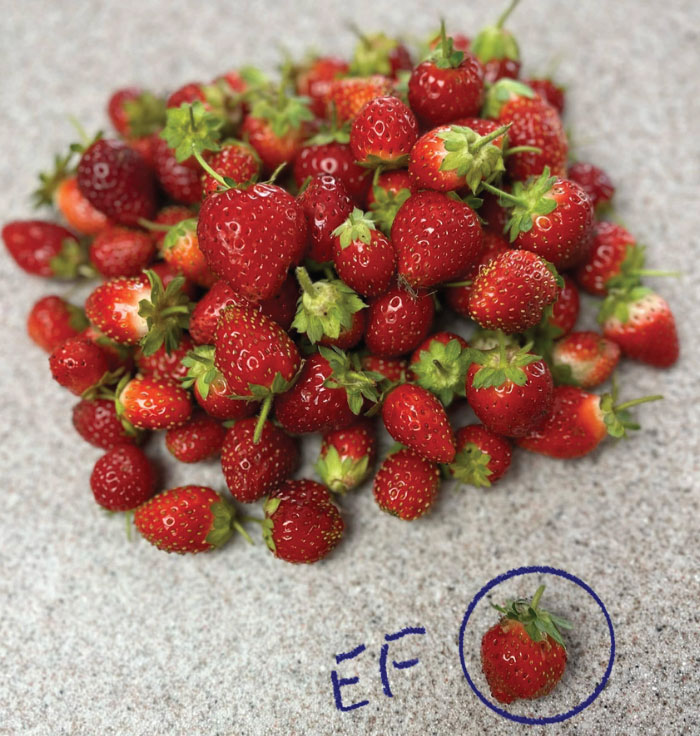
Imagine point-of-sale materials that highlight stress reduction or marketing campaigns that emphasize gardening as a way to increase physical activity and improve mental health. These aren’t just feel-good messages; with the right data, they become credible value propositions. In a competitive marketplace, especially one increasingly connected to health and wellness trends, that’s a powerful differentiator.
Photo submitted by a project participant showing an update on fruit yield.
Some may question whether citizen scientists can consistently generate reliable data. My answer is yes. Across our projects, survey response rates have ranged from 51% to 95%, far above typical research benchmarks. Participants are motivated, engaged and surprisingly consistent in their observations. But beyond data quality, what makes this approach truly valuable is its reach. We’re capturing performance and consumer preference across climates and skill levels that no single researcher can replicate. That diversity is exactly what makes the findings so relevant to commercial horticulture.
 These projects are also a great example of what can happen when academia, extension and industry work together. We’ve partnered with researchers and extension specialists across multiple states, creating a network that connects directly with local communities.
Photo submitted by a project participant showing an update of the project in 2023.
At the same time, we’ve engaged industry partners in meaningful ways. In our latest project, a representative from a breeding company joined us for a webinar to walk participants through the process of developing new varieties, from concept to commercialization. Those interactions do more than educate; they build connections between the people who work with plants and the people who buy them.
There’s still a lot to learn. But if there’s one thing these projects have shown, it’s that people are eager to participate. They want to grow plants, share their experiences and be part of something bigger. GT
Celina Gómez is an Associate Professor of Horticulture at Purdue University.