7/31/2026
Canker Diseases of Trees
Fulya Baysal-Gurel & Pratima Subedi
Canker is a common disease of woody plants that causes localized, sunken, dead areas (cankers) on the bark of twigs, branches, stems and trunks. Small, black fungal fruiting bodies may develop on or around the canker surface, and affected wood often shows internal discoloration. On stone fruit trees, cankers may also produce gummosis (gum exudation), while some pathogens cause sooty cankers characterized by a black, powdery mass of fungal spores beneath the bark.
Although canker diseases primarily affect woody tissues, some pathogens can also infect leaves, flowers, fruits and roots. Symptoms vary depending on the pathogen and host species, but commonly include wilting, branch dieback and reduced plant vigor. As the pathogen colonizes the plant, it disrupts water movement through the vascular tissue, causing branches to decline and, in severe cases, die (Figure 1).
Cankers may take months to several years to girdle large branches or trunks. As they expand, affected stems become structurally weakened and more susceptible to breakage during storms or high winds. Severe infections can result in extensive branch loss and, ultimately, the death of the entire plant. Canker diseases are a significant concern in nursery production because they reduce plant quality, marketability and overall productivity.
Causal agents
Most canker diseases are caused by fungi, although some bacterial and oomycete pathogens can also produce canker symptoms. For example, the bacterium Xanthomonas citri causes citrus canker, while Pseudomonas syringae causes canker on many ornamental plants and fruit trees. Common fungal pathogens include species of Cytospora, Neonectria (formerly Nectria), Seiridium, Botryosphaeria and Phomopsis. Oomycete pathogens, particularly Phytophthora species, are also associated with canker diseases on a variety of woody plants.
Among woody ornamental plants, fungi in the families Botryosphaeriaceae and Diaporthaceae are the most common causes of canker diseases. Studies conducted in Tennessee nurseries have identified several canker pathogens affecting Eastern redbud, including Botryosphaeria dothidea, Diplodia seriata, Lasiodiplodia theobromae, Neofusicoccum parvum and Diaporthe eres.
Host range
Canker diseases affect a wide variety of woody plants, including fruit crops such as apple (Malus domestica), mango (Mangifera indica), olive (Olea spp.), avocado (Persea americana), and plum and prune (Prunus spp.); nut crops such as almond (Prunus spp.), walnut (Juglans spp.), and pistachio (Pistacia spp.); forest trees such as pine (Pinus spp.); and numerous woody ornamental plants, including dogwood (Cornus spp.), maple (Acer spp.), redbud (Cercis spp.), eucalyptus (Eucalyptus spp.), hornbeam (Carpinus spp.), incense cedar (Calocedrus decurrens), manzanita (Arctostaphylos spp.), poplar (Populus spp.), sycamore (Platanus spp.), and willow (Salix spp.).
Many canker pathogens have a broad host range. For example, species in the fungal family Botryosphaeriaceae have been reported on more than 500 plant species worldwide, allowing them to infect numerous economically important crops and ornamental plants.
Disease cycle
Canker pathogens typically infect plants through wounds caused by pruning, insect feeding, freeze injury, leaf scars or other mechanical damage. Many of these pathogens are opportunistic and are more likely to infect plants weakened by environmental stresses such as drought, frost, poor nutrition or other unfavorable growing conditions.
Fungal spores are spread primarily by rain splash, wind and contaminated pruning or grafting tools. The pathogens can survive between growing seasons in infected branches, pruning debris, dead plant material and, in some cases, infected seeds. Insects such as bark beetles, ambrosia beetles, scale insects and fruit flies, as well as birds, can also contribute to pathogen spread.
Most fungi in the Botryosphaeriaceae family grow best at temperatures between 77 and 86F (25 and 30C). Warm temperatures combined with prolonged moisture or extended periods of wetness promote spore germination, infection and disease development.
Management strategies
Cultural management: Cultural practices are the foundation of canker disease management and are essential for reducing disease development and spread. Prune infected branches at least 4 to 6 in. below the visible canker to remove infected tissue. Because many canker pathogens survive between growing seasons in infected fruits, shoots, twigs, branches, pruning debris and dead trees, all diseased plant material should be collected and removed from the production area. When labeled products are available, apply a preventive fungicide immediately after pruning to protect fresh pruning wounds.
Avoid pruning and other mechanical operations during wet weather, as moisture favors infection and disease spread. In orchards and nurseries, maintain proper plant spacing to improve sunlight penetration and air circulation within the canopy, which helps reduce humidity and leaf wetness. Use only disease-free budwood, cuttings, rootstocks and scion wood, as pathogens can be introduced through infected propagation material and grafting wounds. Grafting should be avoided during periods of wet weather or when plants are under stress.
Maintaining vigorous, healthy plants is one of the best ways to reduce canker development. Avoid excessive nitrogen fertilization, particularly in late summer, as it can promote susceptible new growth. Applying slow-release fertilizers and mulch can improve overall plant health. In addition, minimizing environmental stresses—such as frost injury, hail damage, drought and nutrient deficiencies—can help reduce the likelihood of infection by opportunistic canker pathogens.
Resistant cultivars: Selecting resistant or tolerant cultivars is one of the most effective and sustainable strategies for managing canker diseases. When available, choose cultivars that have demonstrated resistance or tolerance to the target pathogen. In addition, select cultivars that are well adapted to local growing conditions—including climate, soil type and site characteristics—to reduce plant stress and improve overall health, making plants less susceptible to infection.
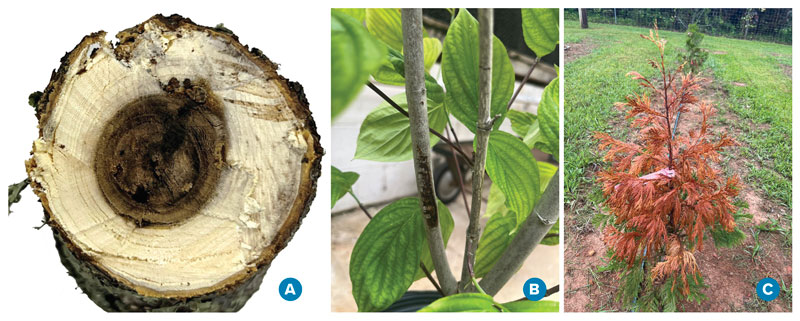
Figure 1. Symptoms of canker diseases: (A) internal wood discoloration in Eastern redbud (Cercis canadensis); (B) necrotic canker lesion on flowering dogwood (Cornus florida); and (C) flagging and dieback of incense cedar (Calocedrus decurrens).
Source: Taylor & Francis Online.
Irrigation: Use drip irrigation whenever possible instead of overhead irrigation. Overhead irrigation promotes rain splash, which can spread fungal spores from infected to healthy plants and increase the risk of disease. Drip irrigation helps keep foliage and stems dry, reducing favorable conditions for infection and limiting pathogen spread.
Scouting: Regular scouting and early detection are essential for limiting the spread and severity of canker diseases. Routinely inspect susceptible plants for symptoms such as sunken lesions, branch dieback, bark discoloration, gummosis or fungal fruiting bodies. When canker is suspected, laboratory testing—including pathogen isolation and molecular diagnostic methods such as PCR or qPCR—can help accurately identify the causal pathogen and support appropriate management decisions.
Sanitation: Proper disinfection of pruning tools is essential to prevent the spread of canker pathogens and reduce inoculum buildup in nursery production. Pruning tools should be cleaned and disinfected between plants and after cutting infected branches. Our research demonstrated that readily available disinfectants—including Clorox, Lysol, ethanol and KleenGrow—significantly reduced the transmission of Botryosphaeria dothidea under greenhouse conditions. In addition, disinfected pruning tools reduced canker lesion length by up to 70% compared with non-disinfected tools. Incorporating routine tool sanitation into pruning practices is a simple and effective way to reduce disease spread.
Chemical and biological management: Fungicides and biological control products are most effective when used as part of an integrated disease management program that includes sanitation, proper pruning and practices that reduce plant stress. Several Trichoderma species have demonstrated the ability to suppress canker pathogens through antagonistic activity.
Our research showed that preventive applications of Ulocladium oudemansii strain U3 (BotryStop) and Trichoderma harzianum strain T-22 + T. virens strain G-41 (RootShield Plus) significantly reduced canker disease caused by Botryosphaeria dothidea and Diaporthe eres in Eastern redbud and flowering dogwood under greenhouse and shadehouse conditions. In addition, greenhouse and shadehouse trials demonstrated that the fungicides triticonazole + pyraclostrobin (Pillar SC), mefentrifluconazole (Avelyo) and flutriafol (Rayora), when rotated with fluopyram + trifloxystrobin (Broadform), effectively managed canker diseases caused by B. dothidea and D. eres.
To reduce the risk of fungicide resistance, always rotate fungicides with different modes of action and follow label directions regarding application timing, rates and the maximum number of applications per season. GT
Fulya Baysal-Gurel and Pratima Subedi are with Tennessee State University’s Otis L. Floyd Nursery Research Center in McMinnville, Tennessee.