6/30/2026
Maximize Your Lisianthus
Kate Cassity-Duffey & Jessica Cudnik

This article is part of a special ASHS series, “Bridging Research & Practice,” featuring an article adapted from an ASHS journal publication that presents academic horticultural research directly to industry professionals. To learn more about ASHS please visit, ashs.org.
Lisianthus is a high-value staple for any specialty cut flower program, prized for its rose-like blooms and exceptional vase life. However, field-growing in the Southeast comes with a major hurdle: intense heat and light that often stunt stem length and degrade flower quality.
To help growers overcome these regional challenges, Kate Cassity-Duffey from the University of Georgia partnered with Jessica Cudnik from American Takii. Their three-year study (2022–2024) at the UGA Durham Horticulture Farm focused on a practical, low-cost solution: Using shade cloth to boost marketability and stem length in organic field production.
 The setup
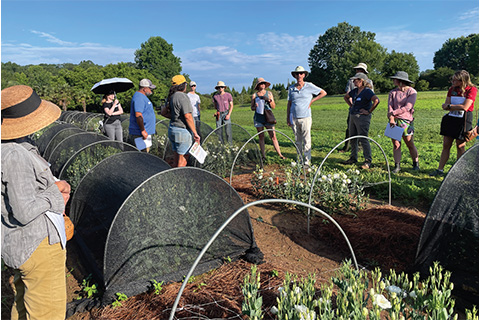
The team tested Group I and Group II Arena White Lisianthus under three conditions: 0%, 30% and 50% black shade cloth. Plugs were planted in mid-April at 6-in. spacing and grown using standard organic practices, including commercial organic fertilizer and fish emulsion. To keep the study practical for growers, the shade structures were built using simple, inexpensive bent EMT conduit.
The results: What growers need to know
1. Timing and total yield—If you’re looking to hit an earlier market window, shade isn’t the answer. The study found that:
- First harvest timing is driven by climate (specifically temperature), not shade. Group I typically hit harvest between 62 and 70 days after transplant, while Group II took 76 days.
- Shade impacted the timing of the yield over the season, but total yield remained steady. Regardless of the shade level, growers can expect a total harvest of approximately 35 stems per square meter.
 2. The trade-off: Stem length vs. quality—While shade significantly impacted the physical characteristics of the flowers, more wasn’t always better:
- As expected, shade triggered longer stems. In Group I, 50% shade added 4.2 in. of length. In Group II, it added a significant 7.5 in. compared to the open field.
- While 50% shade produced the longest stems, it actually decreased overall quality. Lower light levels reduced photosynthesis, leading to lower bud counts and decreased marketability. It also significantly delayed the harvest window for both groups.
- Growing in the open field (0% shade) resulted in the shortest stems and lower quality. Shade also acted as physical protection from rain events, which can shatter blooms and decrease quality.
The verdict: 30% shade is the “sweet spot”
For Southeastern growers looking to compete in the wholesale market, the 30% shade treatment emerged as the clear winner.
- Thirty percent shade increased stem length and overall marketability for both Group I and II while maintaining the high bud count that high-quality, well-bred lisianthus is known for.
- While Group I stems remained somewhat short for international standards (averaging 18.5-in. across all treatments), Group II flowers grown under 30% shade reached an average of 26.8 in., making them highly competitive for wholesale markets.
- The conduit-and-cloth structures provided a vital buffer against heavy rain, preserving the delicate petals during the bloom phase.
Field day at the University of Georgia Durham Horticulture Farm highlighting shade and lisianthus trials.
Practical takeaways
This research shows that an inexpensive investment in 30% shade cloth can directly improve your bottom line by increasing the percentage of marketable, long-stemmed flowers. While 50% shade offers the most length, the loss in bud count and quality makes it a risky choice for field production.
By utilizing 30% shade and selecting Group II varieties for later-season harvests, U.S. growers can produce field-grown lisianthus that rivals high-end imports. GT
Kate Cassity-Duffey is Assistant Professor of Horticulture at the University of Georgia and Jessica Cudnik is Flower Product Manager for American Takii.