6/30/2026
What Influences the Effectiveness of Systemic Insecticides?
Dr. Raymond A. Cloyd

Systemic insecticides can be applied to plant leaves as a spray or to the growing medium as a liquid drench or granule to manage sucking insect pests, such as aphids (Figure 1), leafhoppers, thrips and whiteflies. The systemic insecticide active ingredient accumulates in plant leaves for a period of time, depending on the physical characteristics of the active ingredient. Systemic insecticides must have specific properties that allow them to function as systemics, including: 1) level of water solubility that enables the active ingredient to be transported in the vascular tissues (xylem and phloem); 2) ability to be absorbed by plant leaves and roots; and 3) provide sufficient residual activity that protects plants from sucking insect pests throughout the growing season. (Systemic insecticides registered for use in greenhouse production systems are presented in Table 1.)
Figure 1. Systemic insecticides are used to manage insect pests, such as aphids.
Systemic insecticides are typically converted into substances or metabolites in plants or are metabolized in the insect body, which are more toxic to insect pests than the original active ingredient. Insect pests are killed when they ingest plant fluids containing the metabolites of the systemic insecticide. The ability of systemic insecticides to protect plants from insect pests throughout the growing season depends on the method of application: foliar or growing medium.
Foliar applications of systemic insecticides 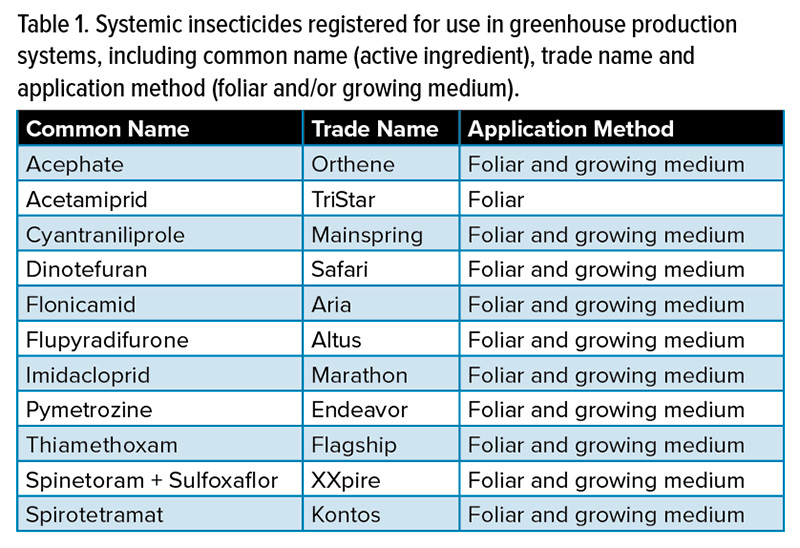
Systemic insecticides, in general, after applied to leaves enter the phloem and then diffuse into the xylem, resulting in transport upward (Figure 2). The ability of a systemic insecticide to penetrate through the plant leaf depends on: 1) retention of the spray solution on the leaf surface; 2) rate of evaporation of spray droplets; and 3) permeability of the leaf cuticle. In addition, systemic insecticides applied as a foliar spray may be exposed to decomposition by enzymes after penetrating through the leaves.
Young leaves tend to absorb more of the spray solution than older leaves. Moreover, transport upward is more common in the periphery (outside boundary) of young leaves than older leaves. However, the leaf veins may disrupt the movement of the spray solution because the connecting vascular tissues (xylem and phloem) restrict the movement of the systemic insecticide.
 Growing medium applications of systemic insecticides
Systemic insecticides applied to the growing medium are absorbed by plant roots and transported upward to plant leaves through the transpiration stream in the xylem, allowing the systemic insecticide to accumulate in the periphery or leaf edges where insect pests feed (Figure 3). The movement of a systemic insecticide upward toward the terminal growth (apex) is more common than downward (basal) movement.
Figure 2. Systemic insecticides applied to leaves enter the vascular tissues, resulting in upward transport.
The effectiveness of systemic insecticides in maintaining insect pest populations below plant-damaging levels depends on the growing medium, which can influence the absorption of systemic insecticides by plant roots. Certain growing medium types bind to the active ingredient, thus inhibiting absorption by plant roots (Figure 4).
 For example, a sandy loam growing medium allows for absorption and uptake by plant roots, and transport of the systemic insecticide active ingredient throughout the plant. However, a growing medium with a high clay content will bind to the active ingredient, thus reducing the amount of active ingredient absorbed by roots and transported throughout the plant, which may reduce the effectiveness of the systemic insecticide in maintaining insect pest populations below plant-damaging levels. Consequently, applying higher rates may be required to compensate for binding by the growing medium.The organic matter content of a growing medium can reduce the effectiveness of systemic insecticides against plant-feeding insect pests. Organic matter binds to the systemic insecticide active ingredient, which reduces absorption and uptake by the roots. A growing medium with a high organic matter content will bind to the active ingredient of systemic insecticides more so than a growing medium with low organic matter content. In addition, a growing medium with a high organic matter content and small particle size reduces the rate of absorption of the systemic insecticide active ingredient.
Figure 3. (Top) Diagram showing transport of systemic insecticide throughout a plant after an application to the growing medium.
Figure 4. (Bottom) Certain growing media bind to systemic insecticides, thus inhibiting absorption by plant roots.
Light intensity affects the transpiration rate of plants, which may influence absorption, uptake and transport of the systemic insecticide active ingredient throughout the plant. Consequently, a reduction in absorption and uptake may lead to less active ingredient transported throughout the plant, which will affect the ability of systemic insecticides to maintain insect pest populations, such as aphids and whiteflies, below plant-damaging levels. Furthermore, any delay in uptake and transport of the systemic insecticide within the plant may affect the ability of the systemic insecticide to lessen the development and number of generations of insect pest populations.
Below are statements from product labels regarding factors that may influence the effectiveness of systemic insecticides:
- “Therefore, control of pests from the systemic activity of Flagship 25WG may be delayed for one or more weeks depending on plant size, rate of uptake from the soil or rate of translocation within the plant.”
- “When Mainspring GNL is applied by drench to the root system of plants, it will be translocated upward in the plant due to its systemic activity. Systemic upward movement in herbaceous plants will be quicker than in those of woody plants, such as trees and shrubs. Soil applications should be made prior to anticipated pest infestation to allow adequate systemic movement to achieve optimum levels of control.”
- “Media with 30% or more bark content when treated with Marathon 1% Granular Greenhouse and Nursery Insecticide may confer a shorter period of protection.”
- “When making applications of Aria in hot and dry conditions, use larger droplets to reduce effects of evaporation.” GT
Dr. Raymond A. Cloyd is a Professor and Extension Specialist in Horticultural Entomology and Plant Protection at Kansas State University. He can be reached at (785) 532-4750 or rcloyd@ksu.edu.