2/27/2026
Highlights From the Winter Shows
Jennifer Polanz & Chris Beytes
MANTS: As big and bright as ever
By all accounts, MANTS (the Mid-Atlantic Nursery Trade Show) is the annual kickoff to the horticulture year. Did you know it dates all the way back to 1970, making it 56 years old? And while it didn’t set records for attendance this year, it also wasn’t far off, with more than 10,800 visitors in attendance and more than 890 exhibiting companies filling the Baltimore Convention Center. The record still remains 2008, with more than 12,800 visitors, according to the showrunners. Still, it was an impressive turnout, boding well for 2026, and while the action on the trade show floor ebbed and flowed, many exhibitors said they were having quality conversations with attendees.
As far as the mood? Cautiously optimistic, with some exhibitors saying they’re seeing conservative orders being placed by growers and retailers. There wasn’t a lot of talk about inflation or tariffs—at this point those just seem baked into the cost of doing business and vendors are becoming more strategic about where they source product.
And, as usual, there were some interesting products there that could help growers and retailers differentiate themselves.
 1. HIP Labels
The new BioTAG from HIP Labels is an exciting breakthrough in soil biodegradable plant tags. According to President and Owner Bob Lovejoy, the tags hold up through the production cycle and outdoor elements and feel like plastic. But when put in soil alongside the plant, it’ll spend 10 to 15 months breaking down, and then within another 90 days it’ll be completely gone, turning into carbon and water.
“This is the product that eliminates plastic,” he said during a new product introduction session. “No compost pile is needed. Again, throw it in the hole.”
The length of time it needs depends on the type of soil. Kelvin Okamoto, president of Green Bottom Line Inc., who consulted on the development of BioTAG, clarified the tags are made from a mineral-filled bio-plastic, which needs microbes and water from soil to break down. The breakdown rate depends on the moisture content, which means sandy soil will take longer and loamy soil works faster. Clay soil depends on the type and whether it has microbial activity. The tags can handle any kind of typical water-based inks and pictures of the tags after several months of being out in the elements show no fading. These tags will be available this year for nursery and greenhouse growers and grower-retailers.
2. Bloomin’ Easy
Bloombux Blush and Bloombux Magenta are small-leaf rhododendron hybrids that can sub in for boxwoods. The bonus on these, obviously, is they flower heavily. Bloombux Blush has a light pink flower and is smaller, only reaching about 2-ft. tall and wide. Magenta, meanwhile, has a richer pink flower and is larger at somewhere between 2- to 3-ft. tall and wide. They’re hardy down to USDA Zones 5b to 9, and Bloomin’ Easy’s Kevin Cramer said they show signs of improved resistance to Phytophthora and improved tolerance to a wider range of soil pH than typical rhodies. Their natural habit is tidy and appropriate for hedging and/or topiary, similar to a boxwood.
“We and many growers in the Bloomin’ Easy network believe Bloombux will become well established across the regions suited for them,” Kevin said. “It helps that they grow well across the coasts where there’s high population density.”
3. Plant Development Services Inc.
In the Plant Development Services Inc. booth, we saw a number of new introductions, but the one that could be a game-changer is Camellia Early Surprise, the first hybrid of its kind that reliably blooms starting in August, said Business Development Director Kip McConnell. They already have Early Wonder, but that’s not a hybrid, it’s an earlier (October) blooming straight Camellia japonica.
New hybrid Early Surprise, meanwhile, provides those sought-after blooms months earlier and Kip said this could revolutionize camellia breeding. They’re looking to have upwards of 15 different bloom forms and colors coming in the future. Those future cultivars will also include some dwarf selections and some ideal for patio trees. Early Surprise is a more dwarf cultivar, topping out at about 8 ft. and will be available to the trade in fall of 2026 with retail availability in 2027.
4. Jolly Farmer
Every year, Jolly Farmer has an exclusive product through an industry breeder and this year that exclusive is Caliloco Jolly Tiger, a new calibrachoa bred by Westhoff. It will only be available in 2026 through Jolly Farmer. This calibrachoa has striking bright yellow petals with a bold, dark striped center and a tight habit, making it great for baskets and containers.
 5. Garden District
During a new product showcase event, Jack Gearing of Windmill Nursery talked about new introductions through the Garden District Collection, a branded shrub program that he said was “created with a powerful, simple goal—we wanted to bring exceptional breeding, we wanted to bring outstanding garden performance, strong visual appeal at an affordable price.”
The brand is currently a collaboration of three growers: Windmill Nursery in Raleigh, North Carolina; Tom Dodd Nurseries in Semmes, Alabama; and Stokley Nursery, also in Semmes, Alabama. Breeders include Jeff Beasley, Mark Griffith and Dr. Michael Dirr, and just a few plants in the collection include Cherry Creek Abelia, Cascade Dream Distylium (pictured), Garnet Flame Loropetalum, Sugar Snap Blueberry and Rise-N-Shine Hydrangea. The growers offer a branded pot and tag. The tag is required, but the pot is optional.
New Plants from TPIE
At the Tropical Plant International Expo (TPIE) in Fort Lauderdale in January, we found an abundance of interesting and potentially profitable retail products at TPIE 2026 to write about over on the Green Profit side. We were also on the lookout for new and trendy tropical plants and houseplants you’ll want to grow, stock or just be inspired by. Here’s some of what we found at TPIE, held January 21-23.
6. Altman Specialty Plants
Michaelmoelleria vietnamensis Sapphire from Altman Specialty Plants and grown by Dewar Nurseries of Apopka is a native of Vietnam. This gesneriad (meaning it’s related to African violet, gloxinia, streptocarpus and sinningia) is the only species in this genus. Sapphire, a patented cultivar, features soft green leaves with silver markings and delicate blue flowers. We can only assume it likes the same care as those other gesneriads: a bright north window, uniform moisture and some humidity.
7. Casa Flora
Blue Oil Fern (Microsorum thailandicum) from Casa Flora appears as though a blue spotlight is shining on it. Either that or it’s been tinted with dye, like a poinsettia. (Note how the liner does not yet show the blue coloration.) But all that shimmering blue iridescence is real. It’s native to the shaded understories of Southeast Asian rainforests, with that color originating from microscopic leaf structures rather than from pigment. It’s a tropical fern, suited for Zone 10 and beyond, or interior use, with proper care.
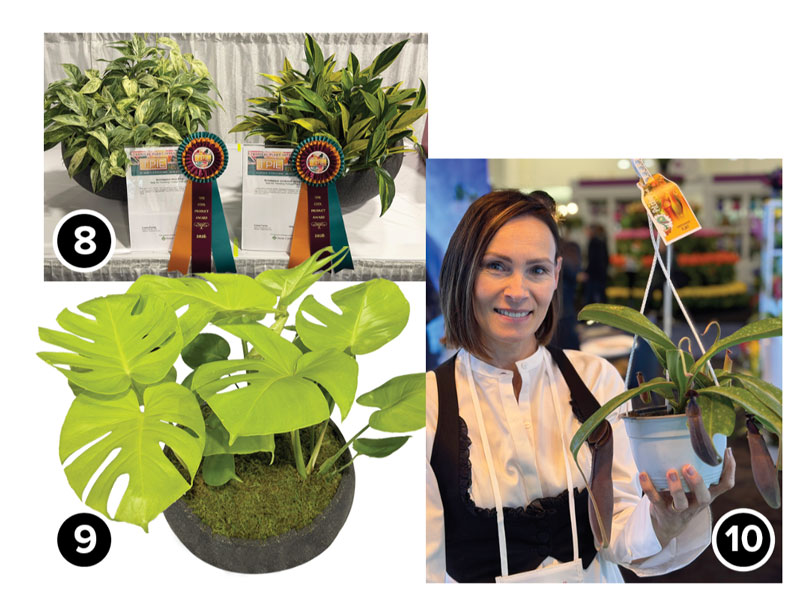
8. & 9. Costa Farms
Costa introduced two scindapsus, both of which caught the eyes of the Garden Center Group’s Cool Product judges. S. hederaceus Blue Albo has blue-green leaves variegated in creamy white, while S. coriaceus Variegated has dark green leaves streaked with electric neon green. These will be nice collectible additions for any indoor gardener who enjoys the standard argyraeus.
One of TPIE’s Favorite Trending Foliage Plants (as picked by the attendees) is Monstera deliciosa Golden Compact from Costa Farms. Monsteras remain trendy and a golden one is certain to sell.
10. Deroose Plants
Nepenthes Midnight, a carnivorous pitcher plant with deep plum purple pitchers, is another Cool Products winner. It’s being shown off by Paul Deroose’s wife, Annick. Deroose also won a Favorite Trending Foliage Plant award for another nepenthes called Gaya, which has large red-orange splotched pitchers.
11. Suntory 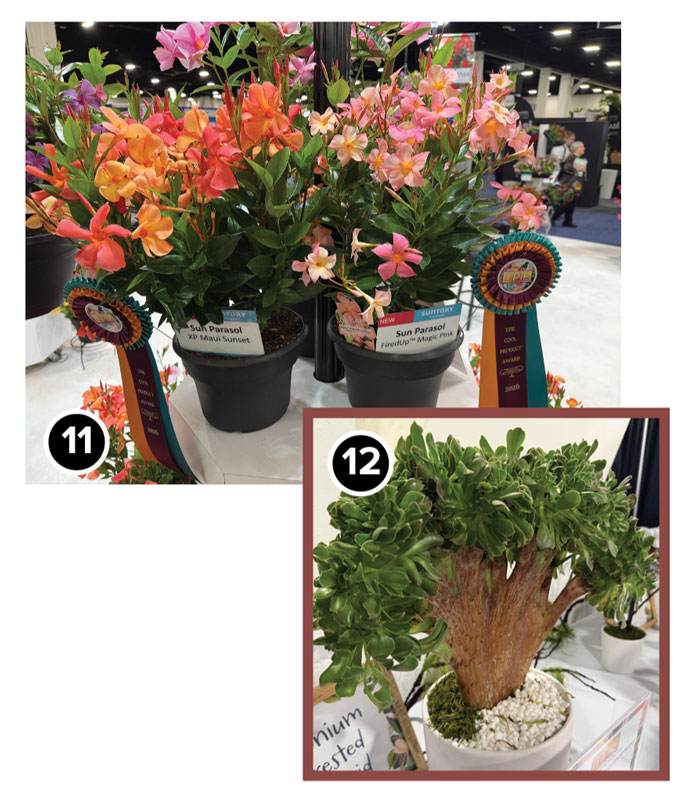
Suntory showed two new Sun Parasol Dipladenia hybrids in the Sun Fire Nurseries booth. FiredUp Magic Pink is the newest in the FiredUp collection, which feature an upright habit, narrow leaves and pinwheel-shaped flowers. Magic Pink reveals its magic with flowers in changing hues of pink and peach. Sun Parasol XP Maui Sunset is part of the Sun Parasol XP, with the XP representing “extreme performance” with superior branching and flower power. Maui Sunset has extra-large coral-orange blooms.
12. Penang Nursery
Aeonium Crested Hybrid is definitely interesting! We’ve seen these exotic aeonium offered by small nurseries (at collector’s prices), but Penang has them in various colors in commercial quantities.
Machines and More from IPM
Internationale Pflanzenmesse—aka IPM—has been held in Essen, Germany, since 1983, when about 100 German and Dutch exhibitors joined for the first exhibition. Today, that number is more than 1,400 from 41 countries with nearly 40,000 attendees coming from around the world to learn about the latest in horticultural genetics, technologies, supplies and services. GrowerTalks has attended for the last 20 years because: 1) It’s the biggest international show that covers every product and market segment; and 2) we never get tired of exploring the vast halls of the Essen Messe to bring you the latest and greatest technologies and ideas. Here are some highlights from the 2026 event, held January 27-30.
 Dramm: Something old and something new
Dramm is a long-time IPM exhibitor and a friendly American face in Hall 3, so when we found ourselves needing a rest and a beverage, we stopped in for a bit Wisconsin hospitality before striking out again. At the table, we noted a strangely elongated blue plastic water breaker with small holes in the back of the body and a fine mesh screen where the water comes out. Curious, we asked Kurt Becker about it.
“That’s our Screen-Aire 350PL,” he answered.
“Is it new?” we asked.
“It’s been around for at least 15 years,” he said.
Hey, it’s new to us, so perhaps it’s new to you, too.
The Screen-Aire is designed for putting out a lot of water (20 gal. a minute), but doing so very gently, so you can quickly water plants without disturbing the soil or washing away your slow-release fertilizer. It does that by aerating the water—much like a kitchen faucet. Kurt said it’s perfect for large plants or for quick watering right before shipping. They’re about $40, but Dramm’s Louie Dramm (who owns a nursery) said it’ll pay for itself in about four hours. Now that’s ROI!
Oh, and to guide your hoses as you quickly water with your new Screen-Aire 350? Try Dramm’s Heavy Duty Hose Guides, which work great with sprayer hoses, too.
 2. New livery for TTA-ISO
We reported last year on the merger of high-end machinery makers TTA and ISO Group and told you they’d be focused first on sales and marketing. Now they’re more visibly combining the two firms, with new livery on their equipment moving forward. It’s a good, clean look. The next step—which is happening now—is combining the forces of their R&D talent. For instance, they’re developing one vision system to control their machines (right now they have three).
As for the question of which machine or technology will win out? There are still hundreds of TTA and ISO transplanters in the field working dependably, and TTA-ISO will continue to take care of those customers—including providing new machines to expand their production lines, when asked.
3. Javo goes orange
More new livery, this time for potting machine maker Javo, which has had the same sort of burnt orange paint scheme for years (and before that, a gray-green). Now they’re bright orange, to reflect their Dutch origin, they told us. But more importantly, the slogan “Javo Orange” indicates a new modular system they’ve developed that allows customers select individual standardized components—base, function and options—to create their desired potting machine configuration. Javo said it will make maintenance, service and upgrades fast and efficient.
4. Degramec’s Rollo conveyor
This is a space-saving way to deploy conveyors in your greenhouse: roll it out like a hose, then roll it back up. It’s not quite that simple, of course, but Belgium’s Degramec has designed a conveyor belt that unrolls from a powered reel. You place rollers along the path, plus an end roller. On a smooth surface, the belt can lay right on the ground. It can even feed onto a main conveyor to carry plants into your headhouse. It comes in varying widths, with length up to 75 meters (about 250 ft.).
5. Logiqs’ VAF benches
Horizontal air flow (HAF) happens up high in the greenhouse. Internal transport experts Logiqs has introduced vertical air flow (VAF) down at crop level to create “perfect climate near the plants.” The technology pumps tempered air (with the desired temperature and humidity) up through the bench and into the plant canopy, which they say keeps the stomata open, improving CO2 uptake and boosting photosynthesis. And you can still utilize the bench’s ebb-and-flow system. The VAF technology has been tested on both bromeliads and vegetable young plants with good results.
6. Lommers’ pruning machines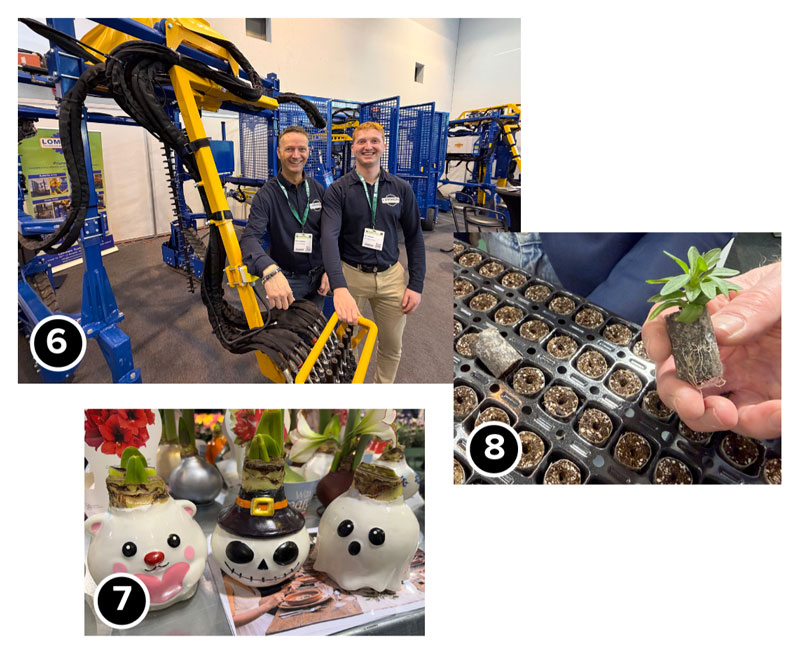
When we heard that Monrovia owns a bunch of Lommers Tuinbouwmachines’ pruning equipment and had ordered even more, we had to check out their stand. They manufacture mobile trimmers used to shape woody ornamentals—top them, trim the sides straight or at an angle, form balls … anything but spirals (which are still left to the “horticultural craftsmen”). Even though these solid machines are meant to endure field use, you can still see the Dutch attention to detail in the quality of the razor-sharp reciprocating cutting heads (of which they offer four styles). Pictured are founder Toine Lommers and his son, Tim.
7. Figurines Amaryllis from AgroFloral
We’ve been following the waxed amaryllis trends since it started some 10 or 12 years ago. You know—you dip an amaryllis in wax, flatten the bottom and maybe add a wire ring and it needs no container. They started in just a few wax colors, then added glitter and paint, and most recently someone dressed them up with fabric “sweaters.” The latest idea? Molded wax holiday shapes, including pumpkins, ghosts, Christmas trees, bunnies, chicks and more.
AgroFloral from Peru grows the bulbs and created the molding process. They told us it came from demand by Chinese customers, who didn’t like the uneven shape of a waxed bulb—they wanted something more perfect. The molded figurines are an offshoot from that.
8. GreenProducts’ Green Plugs
This caught our attention because there was a Ball Seed sign on the stand. Turns out Ball Seed is the exclusive distributor of Green Plugs in North America. On the surface, a Green Plug looks like the paper pots so widely used in propagation. But Green Plugs, we’re told, are made on actual cigarette-rolling machines using carefully selected potting medium. A cigarette has to be packed extremely uniformly to ensure even burning. They reasoned that the same uniformity can be applied to a growing plug to ensure very uniform water- and air-holding capacity. That’s what makes Green Plugs easier to water in and easier to keep properly watered. They suggest you test them on your most difficult-to-root varieties and you’ll see the difference. Green Plugs come premade in 102-, 72- and 50-cell sizes. GT