2/27/2026
Improve Vinca Production With Effective Management of Phytophthora Blight
Charles Krasnow, Ph.D.

Annual vinca (Catharanthus roseus), also called Madagascar periwinkle, is a popular bedding plant grown throughout the United States. Vinca is heat and drought tolerant, ever-blooming with characteristic showy flowers and an upright habit. The annual vinca crop is usually grown for sale as a bedding plant, although it can be found growing as a perennial in tropical climates.
Heavy sporulation of Phytophthora from the edge of an infected stem. Note the lemon-shaped sporangia. (Magnification 40x.)
Significant blighting of vinca plants in the landscape, showing wilting and plant death.
Vinca thrives in a range of planting sites such as boarders, gardens, groundcover and as potted specimen plants. Novice gardeners are fond of this crop for the ease of maintenance in the landscape, adding to the plant’s widespread appeal. The closely related species Vinca minor is primarily used as a groundcover and doesn’t have the range of beautiful flower colors or match the versatility of catharanthus.
Vinca is generally disease free, with occasional reports of Alternaria leaf spot, gray mold and damping off of seedlings. An exception that limits the easy culture of this crop is Phytophthora blight, an annual threat to commercial production of vinca that causes significant economic loss. In order to ensure that plants stay healthy during production and in the landscape, an integrated disease management program is needed that includes fungicide application and cultural control practices.
Identifying the symptoms of Phytophthora
Phytophthora blight is caused by the pathogen Phytophthora nicotianae (also referred to as P. parasitica). This pathogen was first discovered on vinca in India in 1916 and has since become a problem for this crop in China, Europe, Mexico and the United States. Ideal temperatures for pathogen growth (86 to 92F/30 to 33C) are often found in the greenhouse and landscape during the summer. Cool temperatures don’t favor pathogen growth.
Phytophthora produces sporangia (Figure 1) and swimming zoospores that are able to move in water and are attracted to plant roots. This is a common means of pathogen movement in surface water and allows Phytophthora to spread rapidly. Flood floors, ebb-and-flood benches, and black plastic-covered rows provide a means of zoospore spread when a thin layer of water is present. Recirculating irrigation water can be especially problematic even when a small percentage of infected plants are present in the greenhouse acting as an infection source. A survival spore called the chlamydospore, which is, produced in infected roots and plant debris, allows the pathogen to persist in the environment. In some cases, an overwintering oospore is also produced. These survival spores are especially challenging to get rid of in the greenhouse. Sanitation practices, including chemical shock treatments, are necessary to clean out pipes and holding tanks that may be harboring spores. In field plantings of vinca, fumigation with Vapam where available will reduce pathogen survival.
Phytophthora blight is a troublesome pathogen that can quickly infect healthy plants when conditions are warm and humidity high (Figure 2). Symptoms initially appear as brown water-soaked spots on leaves and petioles that eventually blight the entire leaf. Lesions can be observed in the branch axils, at the base of petioles and leaf blades. The leaves of infected plants curl inwards and have spreading dark green brown lesions (Figure 3).
Seedlings are highly susceptible, and a web-like appearance can develop in trays when high humidity persists. The disease is also commonly observed in the landscape. When stems of mature plants are infected, girdling lesions develop and the plant may wilt in one to two weeks (Figure 4). Root rot of vinca can also occur; however, this is less commonly observed than the aerial blight phase of the disease. Often, the roots of severely blighted plants remain healthy and white. Plants that are infected with root rot may appear stunted and yellow and eventually wilt completely.
Controlling Phytophthora
Management of Phytophthora in the greenhouse includes cultural and fungicide controls. As this pathogen is a “water mold,” recirculating irrigation water can be a significant source of spread and plays a key role in disease development. If Phytophthora has been diagnosed as the problem, having a water-treatment plan with chemical treatments such as chlorine, UV treatment and filtration with coarse and fine filters can be helpful in reducing pathogen numbers.
 Crop resistance can improve survival under adverse growing conditions. Certain vinca varieties, such as the robust Cora XDR series, have resistance to the Phytophthora pathogen. Victory Red and Little Pinkie were partially resistant in one trial in the southwest U.S. Varieties that have been university tested for resistance can be reliably grown in greenhouses and nurseries disease-free.
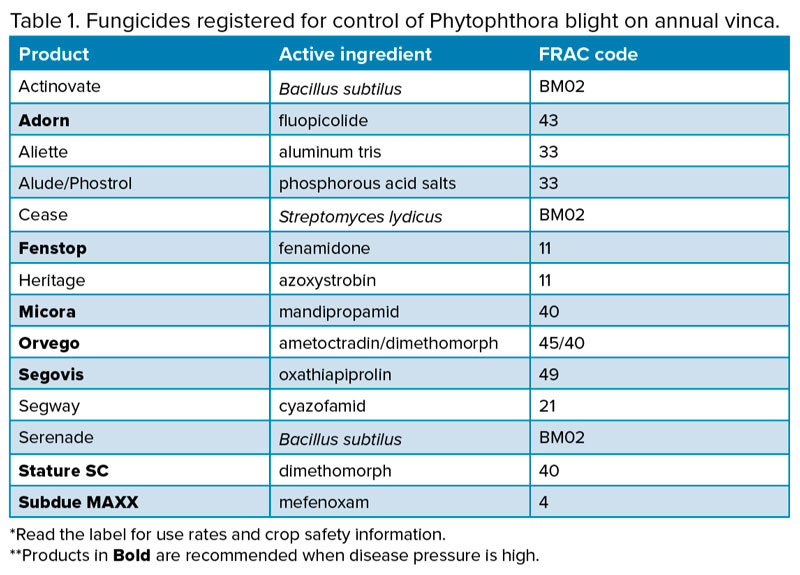
When growing annual vinca, a fungicide rotation program will provides added protection. The fungicides listed in Table 1, when applied preventatively, can reduce the chances of disease. A fungicide program should begin at transplant with a drench or dip of an effective product, followed by foliar sprays of recommended fungicides.
Wilted vinca with inward curling leaves caused by a stem lesion from Phytophthora.
Advanced stem rot caused by Phytophthora. Note the healthy appearing white roots.
In one trial in Florida, applications of Aliette (1 lb./100 gal.), Banrot (6 oz./100 gal.) and Subdue (1 fl. oz./100 gal.) provided significant levels of disease control. The fungicides shown with boldface in the table have been found to be effective when disease pressure is high on vinca and other bedding plants. When vinca is grown outdoors in a shadehouse, choosing effective fungicides may be paramount in preventing disease.
For best levels of control, apply products at the minimum labeled spray interval. Rotating among FRAC codes is important to reduce the chances of fungicide resistance developing and improve performance. GT
Charles Krasnow, Ph.D., works for the Greenhouse and Nursery Extension for the University of Connecticut.