11/28/2025
Battling Botrytis
Janna Beckerman, Ph.D.

Botrytis, better known as gray mold, is one of the most frustrating—and costly—diseases of greenhouse ornamentals. Caused mainly by Botrytis cinerea, this fungus is a master opportunist, capable of infecting annuals, perennials, woody ornamentals, conifers, bulbs—even ferns! It thrives in cool, humid environments and can quickly turn beautiful blossoms into moldy messes. Seedlings, cuttings, blossoms and buds are especially at risk, often collapsing before they ever reach the sales bench. The result? Lower quality, lost marketability and plenty of frustration (Figure 1).
Identify the enemy: Symptoms and signs
The first symptoms of Botrytis are often subtle: small, water-soaked spots on leaves, stems or petals that quickly turn tan or brown (Figure 2). On flowers, Botrytis causes blighting—petals shrivel, discolor and die prematurely. Leaves may show tan or brown spots that expand into large dead areas. When the infection reaches stems, it can form cankers that weaken plants and cause them to collapse entirely (Figure 3). Under humid conditions, these spots become covered with the disease’s telltale grayish-brown fuzz (Figure 4), which are thousands of spores (conidia) capable of spreading the disease. Signs of disease include masses of fungal spores (conidia) easily spread by air currents, splashing water or even routine handling. That heavy spore production that’s so diagnostic of the disease also increases the risk of fungicide resistance, making management even more challenging.
What fuels an outbreak
Botrytis spreads quickly where humidity is high and plants are packed closely together. The fungus loves overcast days, moderate temperatures (between 60 to 70F [15 to 21C]), humidity and still air. When relative humidity stays above 85% or when leaves remain wet for long periods, conditions are perfect for spore germination. Dense canopies restrict airflow and trap humidity, which only worsens the problem. Overcast weather conditions reduce plant transpiration and increase humidity and moisture—and Botrytis.
Anything that stresses or injures plants also makes them more susceptible. Wounds from pruning, handling or insect feeding provide easy entry points. Spent blooms, fallen petals and decaying leaves harbor spores, keeping infection pressure high.
 Integrated management: Layering the defense
Controlling Botrytis takes a multi-pronged, integrated approach that combines good sanitation, environmental management, and careful chemical or biological intervention.
Sanitation: Cleanliness is key. Keeping a greenhouse spotless is easier said than done, but it’s one of the most powerful weapons against Botrytis. Remove senescing flowers, fallen petals and any diseased tissue daily. The fungus can persist on debris, so regular cleanup is essential for long-term success.
Environmental control: Reduce humidity. Botrytis cannot infect dry tissue. Use horizontal airflow fans (HAF), venting systems and wider plant spacing to increase air movement and speed drying. Avoid watering late in the day—wet foliage overnight is an open invitation for gray mold. Drip or sub-irrigation systems are preferable to overhead watering whenever possible.
Fungicides and biologicals: Use in rotation, not more. When weather or greenhouse conditions favor disease, the strategic use of fungicides is necessary to prevent Botrytis infection. Rotate fungicides with different FRAC codes to prevent resistance. Avoid over-reliance on high-risk groups such as thiophanate-methyl (FRAC 1), iprodione (FRAC 2) or strobilurins (FRAC 11). Be sure to include multi-site protectants (FRAC M) in the rotation, which not only helps to manage Botrytis, but any resistant isolates.
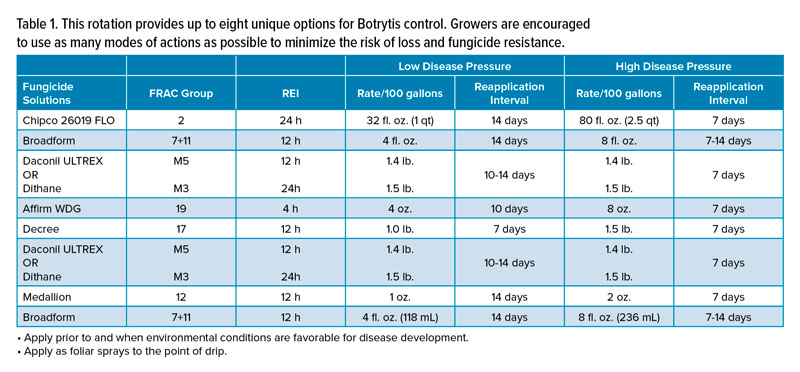
Fungicide rotation is an essential component of Botrytis management. Fungicide-resistant Botrytis isolates have been reported to every major class of modern fungicides. To minimize losses due to fungicide resistance, a robust management program that rotates between multiple classes is essential (Table 1).
 Be mindful of phytotoxicity—some fungicides, particularly those containing copper or chlorothalonil, can damage delicate blooms (like cyclamen, roses or poinsettia bracts). Mancozeb products (e.g., Dithane, Manzate) may be safer alternatives, though they can leave visible residues. Adding a spreader (such as Capsil, Brandt 719 or Silwet-77) can improve coverage and minimize residue buildup.
Biological boosters
Biological control agents such as Trichoderma and Bacillus species will not eliminate Botrytis, but can help suppress it by out-competing the pathogen and stimulating plant defenses. Studies in other crops have shown that they’re especially valuable tools for resistance management within an integrated program.
The bottom line
There’s no silver bullet for Botrytis blight—but combining cultural, environmental and chemical control strategies form a strong, sustainable defense. Stay vigilant, stay clean and stay dry—and you’ll stay ahead of gray mold. GT
Janna Beckerman, Ph.D. is a Green Solutions Team Specialist for Envu.