10/30/2026
A Solid Structure
Dr. W. Garrett Owen
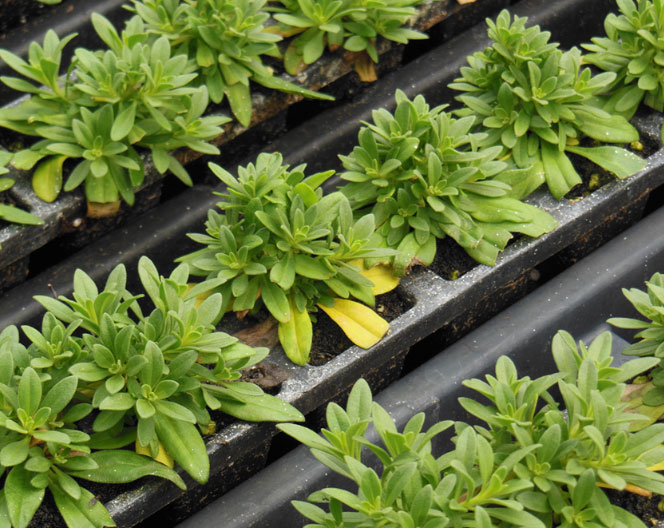
A well-branched finished plant starts with a well-branched rooted liner (Figure 1). Managing both stem elongation and lateral branching during liner production helps establish the plant structure needed for continued growth after transplant. A compact liner isn’t necessarily a well-branched liner and plants with limited lateral branching may require additional time, labor or PGR applications to develop the desired fullness during finishing. Therefore, growers should evaluate both young plant size and branching when determining whether liners are ready for transplant. Consider the following strategies when developing a branching program for rooted liners.
Figure 1. Well-branched calibrachoa liners following the use of a branching strategy during liner production.
Understanding apical dominance
Plant architecture is strongly influenced by apical dominance, in which auxin produced in the shoot tip suppresses lateral bud development. When apical dominance is strong, plants prioritize vertical growth of the main shoot rather than development of lateral shoots. If left unmanaged, rooted liners may become taller with fewer branches and reduced fullness. Pinching removes the actively growing shoot tip and a primary source of auxin, disrupting apical dominance and allowing lateral buds below the pinch to develop into branches.
When to promote branching
Timing is critical when promoting branching in rooted liners. Strategies to promote branching should be implemented while plants are actively growing and early enough to allow lateral shoots to develop before transplant. Delaying a pinch or PGR application allows apical dominance to persist longer and can limit lateral shoot development. Promoting branching early provides more time for newly developing lateral shoots to elongate and contribute to a fuller, more uniform liner.
The timing of a branching strategy should be based on plant development and the desired liner specifications. Consider the number of nodes, lateral bud development, stem elongation and overall plant form when determining whether a pinch or PGR application is needed. Because growth and branching habits vary among crops and cultivars, the appropriate stage for promoting branching will also vary. Monitoring crop development throughout liner production can help ensure branching strategies are applied with sufficient time for lateral shoots to develop before transplant.
 Pinching to promote branching
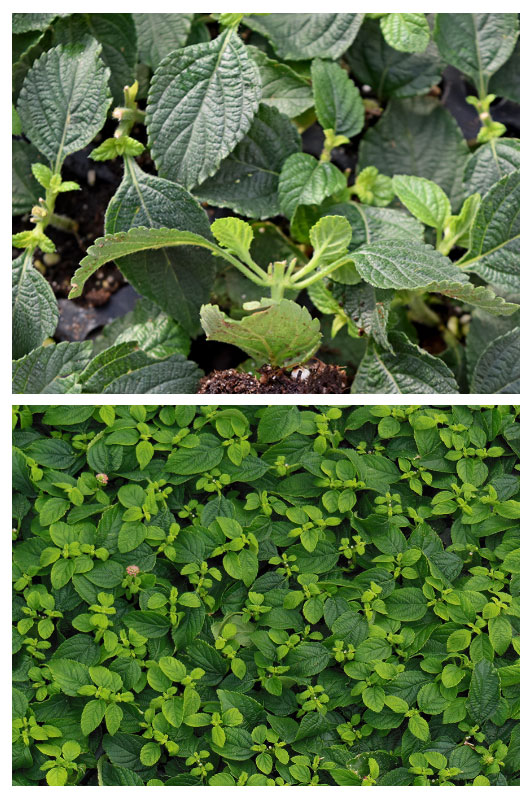
Pinching is a common strategy used to promote lateral branching in rooted liners. By removing the shoot tip, apical dominance is disrupted and lateral buds below the pinch are allowed to develop into branches (Figure 2). The number of nodes remaining below the pinch can influence the number and position of lateral shoots that develop and, ultimately, the plant form. Therefore, the location and consistency of the pinch are important when establishing the desired liner architecture.
Figure 2. Lantana liners following mechanical pinching to remove the shoot tips, disrupt apical dominance and promote lateral branching.
The timing and severity of the pinch should be based on crop development and the desired number of lateral shoots. A soft pinch removes the shoot tip and a small amount of immature growth, while a harder pinch removes a greater portion of the stem, leaving fewer nodes from which lateral shoots can develop. Regardless of the type of pinch, plants should have sufficient time following pinching for lateral shoots to develop before transplant. Pinching too late or inconsistently across the crop can result in variable branching and may delay crop development.
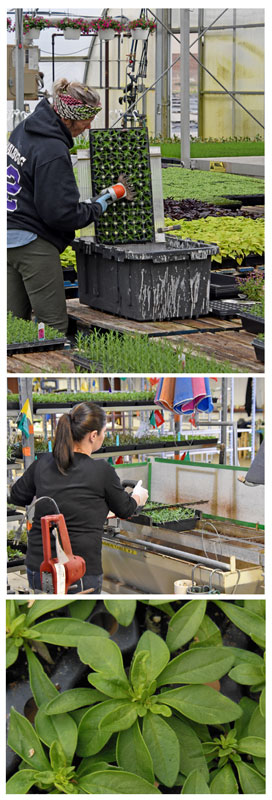
Labor is another important consideration when determining whether to pinch rooted liners. Manual pinching can effectively promote branching, but treating large numbers of liners requires considerable time and consistency among employees. For crops requiring multiple pinches or when labor availability is limited, the time and cost associated with manual pinching can become substantial. In these situations, mechanical pinching (Figure 3) or PGRs that promote branching may provide alternatives or complements to manual pinching.
Using PGRs to promote branching
Plant growth regulators can also be used to promote lateral branching in rooted liners (Figure 4). Ethephon and benzyladenine (BA) are two active ingredients commonly used to promote branching in responsive crops. These PGRs can be particularly useful when labor is limited or when large numbers of plants need to be treated uniformly. However, plant response varies among crops and cultivars, and is influenced by the active ingredient, concentration, application volume and timing, and environmental conditions.
 Ethephon products, such as Collate 2L and Florel, can promote lateral branching while also suppressing stem elongation and aborting flowers or flower buds. These responses can be beneficial during liner production when the goal is to promote vegetative growth and develop plant structure before transplant. Benzyladenine products, such as Configure, promote lateral bud development and can increase branching in responsive crops. Because sensitivity to ethephon and BA varies among crops and cultivars, growers should conduct small in-house trials before applying either active ingredient broadly. Crop-specific PGR recommendations can be found in the GrowerTalks PGR guides for annual bedding plants and herbaceous perennials.
Figure 3. Examples of shearing rooted liners to promote lateral shoot development.
It’s also important to distinguish between PGRs used to promote branching and those used primarily to control stem elongation. Anti-gibberellin PGRs—such as paclobutrazol products, including Piccolo 10XC and Bonzi—suppress stem elongation and can help maintain compact growth, but a compact liner isn’t necessarily a well-branched liner. When selecting a PGR, first identify the desired plant response: promote branching, suppress stem elongation or manage both. This distinction can help growers select the appropriate active ingredient and avoid relying on growth control alone to improve plant form.
Pinch, PGR or both?
Pinching and PGR applications don’t need to be considered separate strategies. In some instances, integrating both can provide greater control over branching and plant form. An early pinch can establish plant structure by promoting uniform lateral shoot development, while subsequent PGR applications can be used to encourage additional branching or control stem elongation. Combining these practices allows growers to manage different aspects of plant growth and development during liner production.
Selecting the appropriate approach will depend on the crop, natural branching habit, production goals, available labor and time remaining before transplant. Some crops may develop sufficient branching following a single pinch, while others may respond well to a branching PGR without requiring a manual pinch. Crops with strong apical dominance or those requiring greater fullness may benefit from integrating both practices. Ultimately, the goal is to select the practice or combination of practices that produces the desired branch number, plant form and liner uniformity for the crop.
Figure 4. (Bottom photo) Calibrachoa liners sprayed with a branch-promoting plant growth regulator.
Environment influences branching
Greenhouse environmental conditions influence lateral shoot development and the response to branching strategies. Increasing daily light integral (DLI) can support lateral shoot development following a pinch, while warmer temperatures accelerate plant growth. Light and temperature can also influence the magnitude and duration of PGR responses. Monitoring these environmental conditions along with plant development can help growers anticipate changes in crop growth and PGR response. Adjustments to PGR concentration, application timing or intervals between applications may be needed based on current growing conditions and crop response. Therefore, branching strategies may require adjustment as seasonal growing conditions change.
Better branching starts with the liner
Producing full and uniform finished plants begins with establishing adequate branching during liner production. Whether using pinching, branching PGRs or a combination of both, success depends on selecting the appropriate strategy and timing it to provide sufficient lateral shoot development before transplant. Crop response, production timing, labor availability and environmental conditions should all be considered when developing a branching program. By managing branching early, growers can produce better-structured liners that develop into full, uniform finished plants. GT
Dr. W. Garrett Owen is Extension Specialist and Assistant Professor of Sustainable Greenhouse & Nursery Production Systems in the Department of Horticulture and Crop Science at The Ohio State University. He can be contacted at owen.367@osu.edu.