10/30/2026
A Season of Two-Spot Cotton Leafhopper on Hibiscus
Muhammad Z. “Zee” Ahmed & Shimat V. Joseph
As we wrap up another production season, it’s a good time to look back at the pests that shaped the year and prepare for the next one. One insect that continues to demand attention is the two-spot cotton leafhopper (TSCL). We first introduced this pest to GrowerTalks’ readers in 2025 when it appeared in Florida and began spreading through the southern states. Since then, a significant amount of work has been completed on its control and its movement through ornamental systems.
A brief background
TSCL remains a regulated pest in several states. Hibiscus growers who ship plants across state lines should continue to scout regularly and treat immediately when the leafhoppers are found. Hibiscus isn’t the crop most severely damaged by TSCL; cotton and okra experience far greater injury in agricultural systems. However, hibiscus plays a different and important role. Interstate trade of this plant serves as a pathway of spread. When transported to a new state, TSCL populations can build on hibiscus in nurseries and then move into landscapes or agricultural fields. Because of this, hibiscus growers must keep plants clean to prevent movement of this pest beyond the nursery.
 Symptoms & control
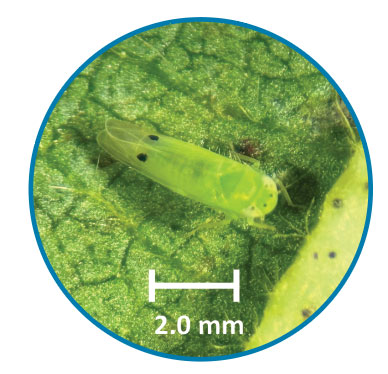
Symptoms of hopperburn on hibiscus begin with pale yellowing along the leaf margins. This progresses to bronzing, browning and curling. Leaves may drop prematurely. These symptoms can resemble nutritional issues, so growers should confirm leafhopper presence before making management decisions. Adults are small and bright green with two black spots at the end of the wings. Nymphs are pale green and fast-moving. Eggs are inserted inside veins and midribs, which makes early detection difficult.
Yellow sticky cards placed over the canopy remain one of the easiest ways to detect adults. The two black spots make them easy to identify on the cards. Growers can also sample terminals showing hopperburn by placing a plastic bag over the terminals and tapping gently to dislodge leafhoppers. A white tray works as well. A light spray of alcohol or soap solution helps keep insects in place so they can be collected and identified. These simple tools allow growers to detect TSCL early and begin treatment before hopperburn spreads.
The latest TSCL research
Studies from other parts of the world show that TSCL eggs hatch in about five to nine days during warm months. Nymphs pass through five instars and complete development in roughly two to three days per instar. Adults live about two weeks. Development on hibiscus is slower than on cotton or okra, which creates overlapping cohorts and a steady progression of hopperburn across blocks. Cold tolerance studies at Clemson University found that early instars and adults die after a week at 40F (4C), but eggs and late instars survive. This means TSCL could persist through mild winters and short periods of cold storage, which is important for shipping and regulatory compliance.
Movement studies published in “The Journal of Applied Entomology” by Ahmed et al. (2026) showed that all TSCL populations in the United States belong to a single haplotype. This indicates a single introduction event and explains why populations across states behave similarly. A risk assessment published in Insects by Ahmed and George (2026) ranked TSCL among the top invasive species of concern because of its rapid spread, hidden egg placement, and economic and regulatory impacts.
Clemson University received a USDA-APHIS grant in 2026 to strengthen invasive species defense in the Carolinas. TSCL was one of the pests included in this effort. The grant supports research on detection, field surveys, management and prevention of spread from nurseries to landscapes and agricultural fields. This investment reflects the importance of keeping hibiscus clean so TSCL doesn’t move into cotton-producing regions.
A regional response has also taken shape as TSCL continued to spread across the Southeast. Funding from the Southern IPM Center supported the formation of a multi-state working group and the launch of stop2scl.org. A meeting held in April 2026 brought together 94 participants from universities, federal agencies and state departments of agriculture from 17 states, as well as industry partners and international collaborators. The group reviewed research updates, shared observations across commodities and agreed on a regional priority list focused on early detection, diagnostics, overwintering biology, virus risk, resistance management and unified communication tools. This coordinated effort now provides a shared roadmap for research, extension and regulatory actions across the Southeast.
 New research on control has expanded our understanding of what works best. A study by Attia and Joseph (2026) published in PLOS ONE compared four insect growth regulators, or IGRs (azadirachtin, buprofezin, novaluron and pyriproxyfen), against TSCL nymphs and adults.
Buprofezin and novaluron stood out as the most effective and fastest-acting. Both reduced survival of nymphs within 24 hours and eliminated nymphs within three days. Buprofezin also reduced adult survival. Surfactants provided only a slight improvement in IGR efficacy. These IGRs are useful for suppressing future cohorts when paired with an adulticide.
A two-spot cotton leafhopper adult.
Photo: Zee Ahmed, Clemson University.
A study published in Arthropod Management Tests by Yadav, Tan and Ahmed (2026) evaluated afidopyropen, bifenthrin, cyantraniliprole, dinotefuran, flupyradifurone and tolfenpyrad on hibiscus in an outdoor nursery pad. Two applications were made 28 days apart. All products reduced adults and nymphs within seven days. Flupyradifurone, tolfenpyrad and bifenthrin provided the fastest knockdown. Safari and Ventigra also provided strong residual suppression. These results give growers several effective options for immediate reduction of TSCL populations.
A follow-up laboratory study published in Insects by Yadav, Tan and Ahmed (2026) examined the acute and residual toxicity of bifenthrin, flupyradifurone and tolfenpyrad. Bifenthrin, even at below-label rates, caused mortality within 24 hours. All three products caused 100% mortality within 72 hours in residual assays. Adults were harder to kill than nymphs and higher application rates killed faster. Although lower rates worked in the study, labeled rates should be used to achieve consistent results and prevent resistance.
Biological control research conducted in Florida and published by Revynthi et al. (2026) in Insects identified two parasitic wasp species—Anagrus vulneratus and a closely related Anagrus species—attacking TSCL eggs. These native parasitoids appear to have switched from local hosts to TSCL. Their distribution and impact are still unknown, but they may become useful biological control agents in the future.
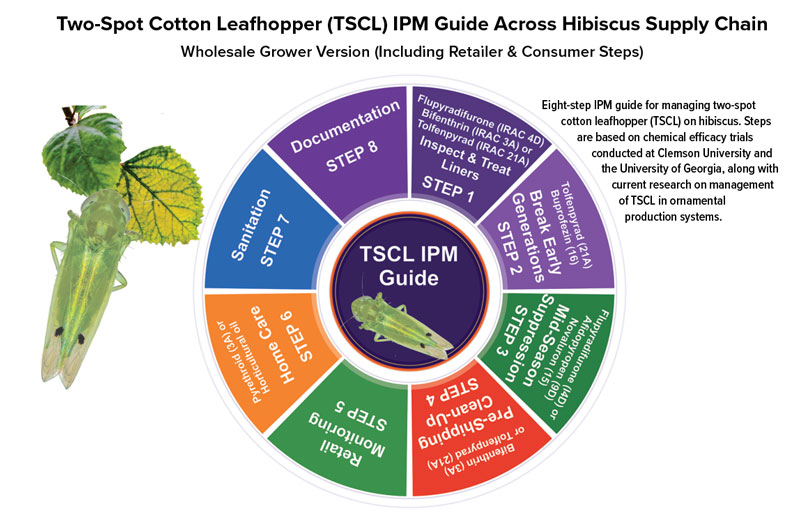
All of this research comes together in a management plan: Begin scouting now using yellow sticky cards, beat sheets or bagging methods, especially on plants showing hopperburn symptoms. Start treatment immediately when TSCL is found. Hopperburn continues even after adults leave, so waiting will not solve the problem.
Use fast-acting adulticides such as tolfenpyrad (IRAC 21A), flupyradifurone (IRAC 4D) or bifenthrin (IRAC 3A) to reduce populations quickly. Pair adulticides with IGRs, such as buprofezin (IRAC 16) or novaluron (IRAC 15). Rotate insecticide modes of action to prevent resistance by moving from 21A to 4D to 28 to 9D to 16 or 15 and then back to a different adulticide group.
Re-evaluate plants seven and 14 days after treatment to ensure suppression of new nymphs. Apply systemic products before flowering or use non-flowering stock blocks to protect pollinator-friendly labeling. Maintain records of scouting and treatment for regulatory compliance, especially when shipping to states where TSCL is regulated. GT
Muhammad Z. “Zee” Ahmed is an Assistant Professor and Extension Specialist of turf and ornamental entomology at Clemson University. Shimat V. Joseph is an Associate Professor and Extension Specialist of Turf and Ornamental Entomology at the University of Georgia. We thank JC Chong (SePRO Corporation) for his helpful comments.
GO HERE to view the complete guide online.