9/30/2026
Dialing In
Luke Finn, Patrick Veazie & Brian Whipker
New Guinea impatiens (Impatiens hawkeri) consistently rank among the top-selling annual bedding plants in the United States, known for their vibrant color and strong landscape performance. Growers aim to produce a high-quality, retail-ready crop while managing input costs and maintaining substrate conditions for favorable growth. However, fertilization practices vary considerably and identifying a strategy that balances efficiency, cost, environmental responsibility, and stable substrate pH and electrical conductivity (EC) remains a challenge.
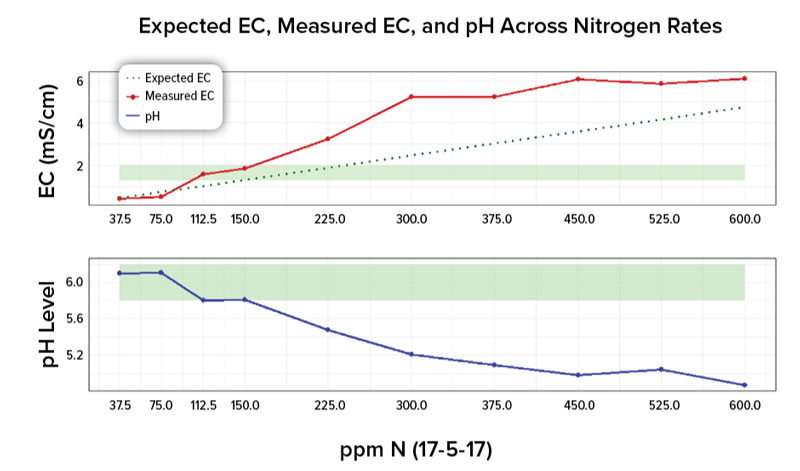
Figure 1. Expected vs. measured EC comparison, pH readings and demonstrated New Guinea impatiens growth curve from low (37.5 ppm N) to high (600 ppm N) fertility.
Nutritional guidelines for New Guinea impatiens have remained relatively unchanged over time, mostly due to slow historical growth and a lack of research. A historical recommendation from the Ball New Guinea Impatiens Guide suggests feeding at 100 to 200 mg·L–1 nitrogen (N). More recent recommendations remain similar, generally suggesting 100 to 200 mg·L–1 N, while Plant Root Zone Management recommends a slightly lower range of 100 to 150 mg·L–1 N.
To better define optimal fertility rates, a study was conducted at North Carolina State University that evaluated 10 rates of nitrogen to determine their effects on plant growth, substrate pH and EC in New Guinea impatiens. Both light- and dark-leaved varieties exhibited less shoot growth at low fertilizer rates (≤37.5 mg·L–1 N). Growth was also compromised at excessive fertility rates, with light-leaved varieties exhibiting stunting at ≥300 mg·L–1 N and dark-leaved varieties at ≥225 mg·L–1 N. Across both varieties, optimal growth occurred within a moderate range of 75 to 150 mg·L–1 N. These findings suggest that optimal nitrogen rates for modern New Guinea impatiens may be lower than many current industry recommendations, potentially reducing fertilizer inputs without exhibiting a drop in plant quality.
Monitoring for pH & EC
A critical component of successful production is the consistent monitoring and management of substrate pH and EC, both of which are directly influenced by fertilization practices. As nitrogen increased from 37.5 to 600 mg·L–1 N, the Expected EC Concentration (green dotted line in Figure 1) rose from 0.465 to 4.74 mS/cm, respectively. Measured EC (solid red line), followed closely with expected values until fertilization rates reached 225 mg·L–1 N. Beyond this point, substrate EC increased at an elevated rate, reflecting the accumulation of nutrients beyond the plant’s capacity for uptake and utilization. This threshold represents the practical upper limit for fertilization, as rates that exceed 225 mg·L–1 N contribute little to growth, while simultaneously inducing substrate imbalances and increasing input costs.
 Fertilization practices also have a large effect on substrate pH, regardless of formulation (acidic, neutral or basic). Fertilizers contribute to acidification through plant-driven uptake processes. When nutrient supply exceeds plant uptake, the result is a decline in substrate pH. In this study, PourThru Substrate pH (solid blue line) decreased once fertilizer rates surpassed plant uptake capacity. This is consistent with findings from previous work at NC State on poinsettias, geraniums, petunias, pentas and gerberas, demonstrating that higher fertility rates can drive pH downward even when using a basic fertilizer formulation.
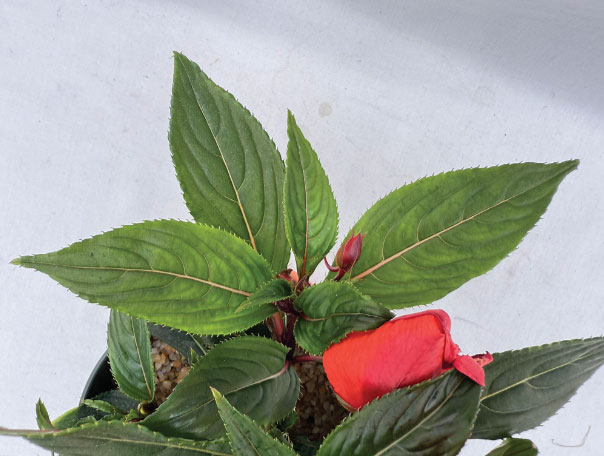
Figure 2. Interveinal chlorosis of the upper foliage is a typical symptom of elevated substrate pH. Also note that over-irrigation, cold growing or root rot can also limit iron uptake and result in the development of symptoms.
Maintaining substrate pH and EC within the recommended ranges is critical for preventing nutrient disorders and ensuring efficient nutrient uptake. When substrate pH and EC are outside of recommended ranges, it can lead to nutrient imbalances, reduced uptake efficiency and visible foliar symptoms. As with most crops, New Guinea impatiens are sensitive to pH fluctuations. Elevated substrate pH can induce interveinal chlorosis in the upper foliage, most attributed to an iron (Fe) deficiency. On the other hand, low substrate pH can lead to the increase of micronutrient availability, particularly iron (Fe) and manganese (Mn), resulting in lower leaf chlorosis, spotting and necrosis due to toxicity.
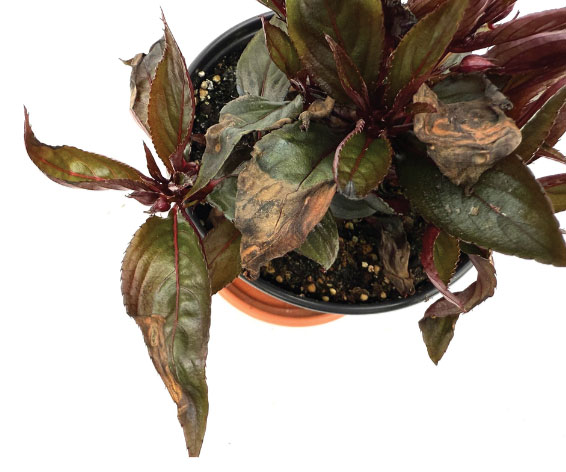 On the other hand, when New Guinea impatiens are exposed to high EC, they exhibit distorted growth that can often be paired with necrotic spotting throughout the whole plant. Similar symptoms may be observed due to poor growing practices, so it’s important to consistently monitor substrate pH and EC, and evaluate growing practices. Nutritional guidebooks for New Guinea impatiens (“New Guinea Impatiens: A Ball Guide & New Guinea Impatiens Insider”) are readily available and allow the grower to see a disorder, deficiency or toxicity image.
Figure 3. Chlorosis and necrotic spotting of the lower foliage is a typical symptom of low substrate pH. This is often a result of iron and/or manganese or micronutrient toxicities.
Ultimately, successful nutrition management in New Guinea impatiens requires a balanced and responsive approach. Fertilizer rates must be sufficient to support growth while avoiding being provided in excess. By combining proper fertilization practices with consistent monitoring of substrate pH and EC, growers can optimize plant performance while minimizing unnecessary inputs. Growers should aim to create a plan that best suits their needs and production system.
This research was sponsored by the American Floral Endowment. The next steps will be analyzing New Guinea impatiens tissue values to provide refined leaf tissue nutrient standards based on large sample sizes and meta-analysis. These values will be utilized in creating grower-friendly tools.
New grower resources: Researchers at North Carolina State University have created a new guide on diagnosing New Guinea impatiens nutritional disorders. “New Guinea Impatiens Insider” highlights overall best management practices, as well as diagnosing New Guinea impatiens disorders. This book is print-on-demand available from the lulu.com bookstore. GT
Luke Finn (Masters of Science student) and Patrick Veazie (Ph.D. candidate) are graduate students at North Carolina State University with a focus in technical floriculture production. Dr. Brian Whipker is a professor of floriculture at North Carolina State University.