9/30/2026
Integrating Effective Whitefly Chemistries With BCAs in Ornamental Crops
Powlomee Mondal & Muhammad Z. “Zee” Ahmed
Whitefly populations build quietly in ornamentals. They begin as tiny pale dots tucked under young leaves, which are easy to miss. By the time a few adults fly out from the canopy when disturbed, the population has been growing for weeks.
Our article in the May 2026 issue of GrowerTalks highlighted a small group of chemistries that performed well across ornamental crops, with cyantraniliprole, dinotefuran, afidopyropen and pyrifluquinazon showing strong activity against Bemisia tabaci, a common whitefly species in greenhouse and nursery production. These insights come from 15 years of published research and give growers a clear, practical suggestion of which options delivered dependable suppression.
This October update shows how these chemistries integrate with biological control, based on published studies conducted across laboratory, greenhouse and semi-field settings. Together, this and the April articles give growers a comprehensive view of how chemical and biological tools can be used side by side.
Commercially available natural enemies (i.e., biological control agents) of whiteflies fall into three groups. Predators include Chrysoperla carnea, C. rufilabris, Delphastus catalinae and Orius insidiosus. Predatory mites include Amblyseius swirskii. Parasitoids include Encarsia formosa, Eretmocerus eremicus and Eretmocerus mundus. Entomopathogens include Beauveria bassiana, Cordyceps fumosorosea (also known previously as Isaria fumosorosea) and Lecanicillium muscarium (not commercially registered or widely available in the United States).
Biological control performs best when insecticides and microbial products are chosen and timed to minimize disruption (the lethal and sub-lethal effects that reduce the survival, activity or establishment of natural enemies) to natural enemies. Some chemistries may still be compatible when applied in ways that limit exposure to natural enemies.
Table 1 (scan the QR code to access it) summarizes 73 published studies conducted between 1976 and 2026 and reports only the chemistries that were actually tested on each natural enemy. Compatibility information for Beauveria bassiana and Cordyceps fumosorosea was extracted from the last 16 years of published work. Because these studies were drawn from global literature, some of the products evaluated aren’t registered for ornamental use in the United States or Canada, and several aren’t registered for ornamentals at all. The dataset also includes studies conducted in agronomic crops and laboratory bioassays, where natural enemies are exposed to more direct and concentrated residues than they typically encounter in greenhouse or nursery ornamentals. For these reasons, the compatibility patterns should be interpreted as risk categories, not guarantees that the same results will occur in ornamental production, and they shouldn’t be assumed to predict how a chemistry will perform in those systems.
In this article, chemistries causing less than 30% mortality or less than a 30% reduction in fecundity, oviposition or development were classified as compatible. Chemistries causing approximately 30% to 70% mortality or life table reduction were classified as least compatible. Chemistries causing greater than 70% mortality or severe developmental or reproductive disruption were classified as harmful. These categories reflect only the conditions and species tested in the original studies and include both acute and sublethal effects because sub-lethal impacts can quietly reduce biological control even when adults survive.
Several studies reported compatibility only under specific conditions. These included situations where compatibility depended on dose, where lower or intermediate exposure produced minimal disruption while higher exposure increased risk. Some studies reported compatibility only when materials were applied in a particular sequence, where the order of application influenced natural enemy response.
Other studies showed strain-specific outcomes for entomopathogenic fungi, where different Beauveria and Cordyceps isolates responded differently to the same chemistry. Timing also influenced compatibility in some cases, with certain materials appearing safe only when applied before natural enemy release. A few studies reported harm only under extended or direct exposure, such as prolonged contact periods or direct topical application to eggs. These conditional responses show that compatibility is not a fixed property of a chemistry, but depends on dose, timing, strain and exposure pathway. They also reflect the diversity of study settings represented in Table 1, which include laboratory assays, plant-based assays, greenhouse trials, semi-field bioassays and agronomic crop experiments.
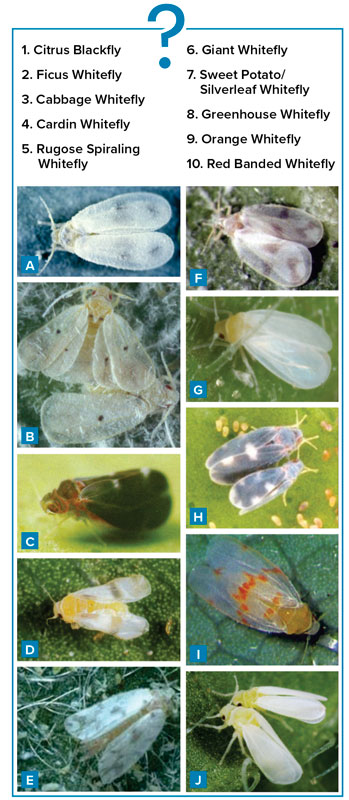 This “puzzle” image shows 10 whitefly species used for training and diagnostic reference. The answers are: A is cabbage whitefly, B is cardin whitefly, C is citrus blackfly, D is ficus whitefly, E is giant whitefly, F is rugose spiraling whitefly, G is greenhouse whitefly, H is orange whitefly, I is red banded whitefly, and J is sweetpotato or silverleaf whitefly. Adult sizes aren’t shown to scale because the photographs were taken at different focal lengths and angles. Colors may differ from field appearance due to lighting, camera settings and natural variation. Individuals within a species can vary in appearance, influenced by age, host plant and environmental conditions. Not all whiteflies appear uniformly white.
Image credits: Ahmed et al. 2016, Whiteflies of Florida Picture Manual, University of Florida. Prepared by Zee Ahmed, Clemson University.
Across the published studies in Table 1, several chemistries appeared compatible with natural enemies under the conditions reported. The insect growth regulator buprofezin was most frequently noted as safe and appeared compatible with Encarsia formosa, Eretmocerus eremicus, Delphastus catalinae, Chrysoperla carnea, Chrysoperla rufilabris and Lecanicillium muscarium in the trials that evaluated it. Pyriproxyfen also showed broad compatibility and performed without disrupting E. formosa, E. eremicus, D. catalinae, Orius insidiosus and C. carnea.
Several other insect growth regulators, including fenoxycarb (not registered in the United States), lufenuron (not registered in the United States), flufenoxuron (not registered in the United States) and methoxyfenozide were reported as safe for parasitoids, predatory mites and lacewings. Feeding-related chemistries, such as pymetrozine and flonicamid, appeared compatible with E. formosa, E. eremicus, Amblyseius swirskii and O. insidiosus.
Cyantraniliprole fit well with O. insidiosus and chlorantraniliprole performed safely around this predator in multiple studies. Aleycid (not registered in the United States) appeared compatible with E. formosa when applied at the timing described in the published work.
Several modern chemistries, including flubendiamide (not registered in the United States), metaflumizone (not registered for ornamental in the United States), spiromesifen, spirotetramat and sulfoxaflor were compatible with A. swirskii and some parasitoids when used under the conditions reported. Botanical materials such as bitter gourd extract and neem oil were compatible when tested alongside synthetic chemistries. Trials that evaluated only botanicals were not included in this review.
Whitefly Table QR code.png
Practical examples: How Growers Can Interpret Table 1
Encarsia formosa and Eretmocerus spp.—Across the studies that evaluated parasitoids, buprofezin, pyriproxyfen, fenoxycarb and flonicamid were repeatedly reported as compatible under the conditions tested. Cyantraniliprole and spirotetramat produced intermediate or mixed effects, and were therefore classified as least compatible. Thiamethoxam, imidacloprid and spinosad repeatedly caused high mortality or strong sub-lethal disruption and were classified as harmful when parasitoids were exposed directly. These patterns reflect only the chemistries and exposure conditions evaluated in the published studies and don’t imply compatibility or incompatibility for products that weren’t tested or for chemistries not registered for ornamentals.
Amblyseius swirskii—Predatory mite studies showed that flonicamid, flubendiamide, metaflumizone, methoxyfenozide and spiromesifen were compatible under the conditions tested. Sulfoxaflor and spirotetramat produced variable responses and were considered least compatible. Abamectin, deltamethrin and spinosad caused high mortality to predatory mites and were classified as harmful when applied directly over active populations. These classifications apply only to the specific chemistries evaluated in Table 1 and shouldn’t be generalized to products that weren’t tested or to chemistries not registered for ornamental crops.
Beauveria bassiana and Cordyceps fumosorosea—Studies evaluating entomopathogenic fungi reported buprofezin, neem oil and dinotefuran plus pyriproxyfen as compatible under the conditions tested. In contrast, imidacloprid and the fungicide mixture pyraclostrobin plus boscalid were harmful to fungal strains. These classifications reflect only the specific products evaluated in the fungal studies and don’t imply compatibility or incompatibility for other chemistries, formulations or application methods. Several of the chemistries evaluated in fungal studies aren’t registered for ornamentals or not registered in the United States or Canada, which limits their practical use even when compatibility data exist.
Delphastus catalinae—Only one study directly evaluated D. catalinae. In that comparison of two insect growth regulators, pyriproxyfen produced few negative effects and was considered compatible, whereas buprofezin reduced longevity and reproduction and was classified as harmful for this species. Although buprofezin is compatible with many other natural enemies in Table 1, its effects on Delphastus were negative in this specific study. Patterns from other predator studies suggest caution with spiromesifen and spirotetramat, and a recurring pattern of harmful effects from imidacloprid, bifenthrin and fenpropathrin, but these effects weren’t tested directly on Delphastus and are therefore noted as inference rather than direct evidence. These inferred patterns are included only to help growers interpret the broader dataset and shouldn’t be treated as species specific conclusions or recommendations.
Why growers should use this table
This article isn’t intended to replace side-effect information provided by biocontrol companies or the International Organization for Biological Control. Instead, it fills a gap that existing resources don’t address. Side-effect databases typically report compatibility, but don’t link compatibility to whitefly efficacy in ornamentals, don’t integrate global peer-reviewed studies and don’t connect natural enemy responses to the chemistries that have performed well on Bemisia in ornamental crops. Because some databases are unavailable or incomplete, and because app-based tools don’t consistently connect compatibility to efficacy, this review relied strictly on published research.
Although the dataset is global, includes agronomic crops and contains chemistries not registered for ornamentals or not registered in the United States or Canada, it still provides growers with a consolidated reference that shows how commonly used insecticide groups have performed around natural enemies across many study settings.
The value for ornamental growers is practical and technical. First, the table shows which chemistries have repeatedly produced low disruption under controlled exposure, which helps growers identify softer options when biological control is active. Second, it highlights chemistries that have repeatedly produced high mortality or strong sublethal effects, which helps growers avoid applying disruptive materials over active releases. Third, it shows where compatibility depends on dose, timing, strain or exposure, which helps growers understand why some disruptions occur even when a chemistry is generally considered soft. The table therefore supports more informed rotations that reduce disruption to natural enemies and maintain steadier suppression across ornamental crops. GT
Muhammad Z. “Zee” Ahmed is an assistant professor and extension specialist of turf and ornamental entomology at Clemson University. Powlomee Mondal is his Ph.D. student in the Turf & Ornamental Entomology Lab at Clemson University’s Pee Dee Research & Education Center. We thank JC Chong (SePRO Corporation) for his helpful comments.