9/30/2026
Benary’s Begonia Strategy
Lowell Halvorson
For most production growers, the benchmark has always been simple: If a cultivar doesn’t offer a meaningful advantage over dependable wax begonias like Cocktail or Whiskey, why grow it? Those series earned their reputation. Plants germinate uniformly, finish predictably, ship well and deliver reliable landscape performance. They remain among the best choices for traditional bedding plant programs.
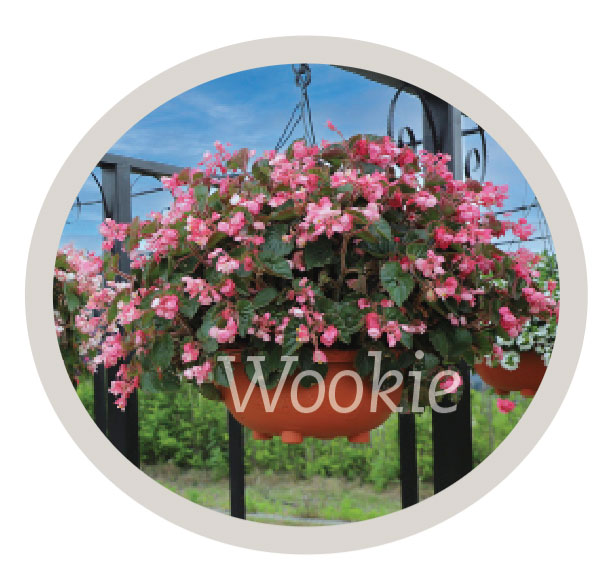
Baskets want something that fills the space “basket pretty,” rising up and draping over.
Every few years, however, another begonia arrives.
Big. Whopper. Stonehedge. Wookie.
If your first reaction is, “Not another begonia!” you’re hardly alone. Production growers have spent the better part of two decades sorting through an ever-expanding assortment of series names, all bound by the same colors and leaf types. It’s easy to dismiss the whole exercise as another breeder adding their me-too SKU to an already crowded marketplace.
I don’t think that’s what’s happening.
I’ve written before about why the begonia market has become so crowded. What I haven’t done is focus on Benary alone, a recognized force in the category. Rather than producing one more begonia every few years, the company has been quietly filling application niches. Does it fulfill a need? Does it resolve an issue? In short, Benary approaches begonias with discipline. Seen that way, their lineup clicks into place.
 Big: The first major step
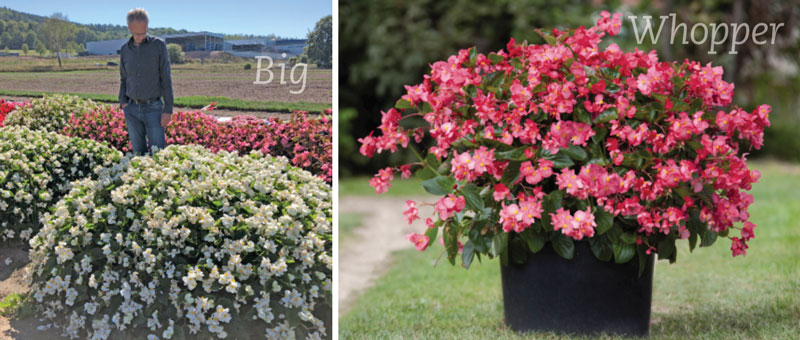
Big wasn’t intended to replace the traditional wax begonia. It established the interspecific hybrid as a viable landscape plant. Compared to conventional B. semperflorens types like Cocktail and Whiskey, it brought greater vigor, larger flowers, thicker foliage and noticeably better summer performance in deeply southern locations. More importantly, it provided Benary with a broad set of genetic tools to expand the category beyond the limitations of straight B. semperflorens. If Benary pushed, begonias would flex using the interspecifics.
Left: These trial photos shows the height that mature Bigs can reach.
Right: A key difference between mature Big and Whopper is the shape. Whereas Big keeps its mound round and color close to the canopy, Whopper has more dragon in its blood, so the color is held out and over the foliage.
Then came Whopper.
It wasn’t simply, “Big, but bigger”—Whopper pushed begonias into specimen territory. Landscapers suddenly had a begonia capable of making a visual statement from across the street instead of across the sidewalk. In commercial applications where impact translates directly into perceived value, size matters.
 Stonehedge took that same idea one step further. (Careful with the name—it’s a pun.)
At first glance, Stonehedge appears to be little more than another oversized hybrid. Look closer and it becomes clear that its real purpose is scale. This is a plant built for large beds, municipal installations and commercial properties where ordinary bedding plants disappear. It becomes a substantial mass as the season ages.
Notice the progression:
- Big established the category
- Whopper expanded it
- Stonehedge stretched it to its practical limit
Also note each series is defined by its mature size, not the size of the plant in the finished pot. Stonehedge, for example, can get 3-ft. tall and wide—nobody ships a SKU like that. In a 6- or 8-in. pot, a Stonehedge Begonia looks more like a larger Big or Whopper, not the thicket of succulent branches and flowers it becomes.
Stonehedge is the beast. Plantings can get deep and wide. For comparison, Big Begonias are at the head of the walkway.
Then Benary zagged
Instead of making an even larger landscape begonia, Benary changed direction. Wookie isn’t about bigger; it’s about better baskets, and it may turn out to be the most interesting cultivar of the group.
For years, growers have used upright begonias in hanging baskets simply because they were available. They worked well enough. But well enough isn’t the same as purpose-built. Wookie was bred to develop the rounded, cascading form consumers expect from a premium hanging basket. Instead of growing upward into the hanger, it naturally spreads, drapes over the rim and creates a fuller presentation at retail.
That’s not another SKU. That’s a different application.
More importantly, it solves a merchandising problem without asking growers to revise their production systems. One of the greatest barriers to adopting new genetics isn’t seed cost or licensing fees—it’s operational inertia.
Every new crop has new protocols and sometimes new schedules. Most growers don’t change because they’re stubborn. They’d rather their successful production system remain in place undisturbed, like a carefully constructed Jenga tower. Pulling one piece, even for a better one, is a risk.
Different timing, different spacing, different growth regulator strategies, different schedules—the burden of change rumbles through the system. If a grower can produce a better finished basket while changing very little about the production process, the decision becomes much easier. Wookie’s fuzzy stems are botanically interesting, but the real news is a better begonia basket kicked out with existing protocols.
Stepping back, a pattern appears
Benary hasn’t been trying to replace Cocktail, Whiskey or the other dependable wax begonias that built the industry—those varieties remain exceptionally good at what they do. They germinate well, finish predictably and continue to earn their place in production schedules.
The hybrids aren’t replacements; they’re specialized tools:
- Need a premium landscape plant? Big.
- Need greater presence? Whopper.
- Need maximum landscape impact? Stonehedge.
- Need a premium hanging basket? Wookie.
Many growers still view these introductions as competing products when they’re actually complementary. Instead of asking, “Which begonia should I grow?” the better question is, “Which application am I trying to serve?” Answer that question and the lineup sorts out easily. Sometimes an industry’s innovations aren’t dramatic breakthroughs—sometimes they’re the result of patiently filling one empty niche after another. GT
Lowell Halvorson is a consultant and writer in Fairfield, Connecticut, for retail and wholesale horticulture, specializing in business development. He also covers the breeding community for GrowerTalks magazine. You can contact him at (203) 257-9345 or halvorson@triadicon.com.