8/31/2026
What a Show!
Chris Beytes, Jennifer Polanz & Jennifer Zurko
That’s the first thing that comes to mind when we think about Cultivate’26 and this is for three reasons:
- Plenty of attendees, with every aisle packed all day Sunday and Monday (Tuesday always slows down, but nobody seemed bothered because the first two days were so good)
- Everybody was in a great mood
- The trade show was overflowing with products, inspiration and expert brains to pick
We never get official attendance figures, but we wouldn’t be surprised if this year’s numbers surpassed 2025. But it doesn’t matter because everybody who is anybody was there, either attending or exhibiting.
But the best thing about Cultivate’26 has to be the networking. You can buy plugs or pots with a phone call or a mouse click, but you can’t make new contacts or renew old ones without rubbing elbows. And the breakfasts, lunches, dinners, receptions and award ceremonies ran from early to late. We even got to network in the Columbus airport on the way home!
Take a tour of some Cultivate’26 highlights with Chris Beytes.
What’s the State of Our Industry?
The great thing about Dr. Charlie Hall’s annual State of the Industry report at Cultivate is the ability to compare where we are currently versus the past and to get a data-driven glimpse at where we may be heading.
But first, the past: Charlie, an esteemed professor in the Department of Horticulture Sciences at Texas A&M University and holder of the Ellison Chair of International Floriculture, showed us overall 98% of growers were up in gross sales dollars compared to 2019, and six in 10 growers this year were up more than 25% over that 2019 number. Why 2019 and not just year-over-year? It’s the pre-pandemic baseline and shows that while growth year-over-year for the past five years has decelerated, there’s still growth and the trend is still positive.
We’re in an interesting cycle of growth, plateau, growth, plateau and on. For growers, pricing increases continues to drive the growth, while unit sales are flat. On the retail side, it’s a similar story with increases in average ticket driving growth and transaction counts staying flat to just slightly up. Charlie likened the season not to a home run, but a stand-up double. Not pandemic-era numbers, but still solid.
Looking forward at his recession dashboard indicators and other data, there’s both good news and potentially bad news. The good is while consumer confidence is down, spending doesn’t reflect that with consumption up 2.4% and household income increasing at the top of the “K” in the K-shaped economy.
“How we feel does not equal how we spend,” Charlie noted. “Consumer confidence is not really something I care about. I don’t care about how we feel; I care about how we spend our money.”
The not-so-great news is inflation appears to be sticky and the Fed may not move on it either way (if they do, they may raise rates slightly, Charlie said). We’re not building a lot of new houses right now with a 6.43% 30-year mortgage rate (Charlie noted here to be prepared with trees and shrubs for when those rates go below 5% to meet latent demand), and some key inputs will be increasing. He forecasted top increases for 2026 to be:
Fuel/energy: +10%
Fertilizer: +8%
Freight/trucking: +6%
And then there’s the Strait of Hormuz …
“That is the critical pinch point,” he said. “If you want to know whether or not we’re going into a recession, you tell me what’s going to go on with the Strait. Because if it deteriorates rapidly, we’re talking about global recession.
“If we get it straightened out, then now we’re talking about another favorable economic climate for 2027.”
The scenarios are if the Strait gets figured out and if new renegotiated Section 301 tariffs aren’t any worse than what we have right now, the result will be a 2.5% increase in input costs for 2027. But if the Strait isn’t straightened out and the tariffs are higher than now, he estimates input costs will increase 4.4% or up to 5.4% for next year. The risk of recession was low based on current data and Charlie built himself a handy-dandy Claude AI-driven daily assessment of recession risk to keep a watchful eye on it.
Of course, all of that is out of your control, but what IS in your control is how you respond. Charlie recommended making sure you understand and defend your value position (especially the health and wellness aspect of plants), and home in on your operational efficiencies and automation to really get them dialed in. He also recommended taking a look at your SKU rationalization to see which products can carry more of your input increases with increased margins.
“We have to, as an industry, continue blowing our own horn in terms of the health and wellbeing benefits that we bring,” he said, noting it’s a topic the Horticultural Research Institute has research on. “Because when you look at consumers, it’s not the environmental benefits that carry the day anymore.
 “Particularly with Millennials … the number one benefit of plants and green spaces in their mind is all about health and wellness.”
Plants
Fyre Wing Heuchera From Terra Nova
We talk about it on the flip side in Green Profit, but this introduction was the new variety star of the show: It’s the first and only serrated-leaf heuchera on the market. And we mean deep serrations—“doubly serrated,” Chuck Pavlich called it. Chuck, their director of new product development, said Fyre Wing came from one little oddball deformity he found on a Delta Dawn Heuchera some five years ago. The magic of breeding and selection and who knows what else led to this unique seven-colored series. He said they’re fast to produce in tissue culture—which is a good thing because they sold 150,000 in the first three hours of the show!
 Monrovia
This breeder keeps cranking out new introductions and these are a few that caught our eye:
Nandina Limeade—A VERY chartreuse shrub that’s also known as Heavenly Bamboo grows 2- to 3-ft. high and wide. Hardy to Zone 6.
Farfuguim Seto-Nishiki—This Japanese tropical is hardy to Zone 7, but can also make for a great houseplant.
Rose Light My Fire—This shrub rose has interesting bicolor blooms in yellow and red that ages to a dark sunset. They said they’ve conducted extensive trials to determine that it’s very disease resistant. Hardy to Zone 4.
 Bailey Nurseries
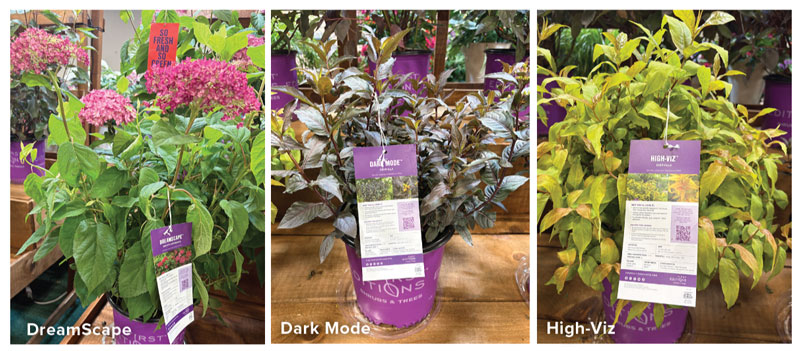
There were multiple new varieties being shown at Bailey Nurseries, but the big standouts were First Editions DreamScape Smooth Hydrangea and the two new diervillas in the First Editions lineup: High-Viz and Dark Mode.
First DreamScape, a new Hydrangea arborescens and the follow-up to last year’s FlowerFull introduction. DreamScape has a lot of the same attributes, with strong stems that don’t flop, a high level of disease resistance and bigger flowers with more coverage, said Alec Charais, chief marketing and product development manager at Bailey Nurseries. Where FlowerFull has creamy white blooms, though, DreamScape adds ruby pink blooms to the mix. It’s hardy to USDA Zones 3 to 8.
As for the diervillas, Dark Mode—so aptly named for its purple-black foliage—came out of the Bailey Innovations breeding program and is a real performer in the landscape, keeping its dark color throughout the seasons, whether hot or cold. High-Viz, meanwhile, offers vivid apricot new growth that matures to chartreuse, then changes to orange and red in the fall, showing off in multiple seasons. They both have yellow blooms and are hardy to USDA Zones 3 to 8.
 Magical Hydrangea From Plants Nouveau
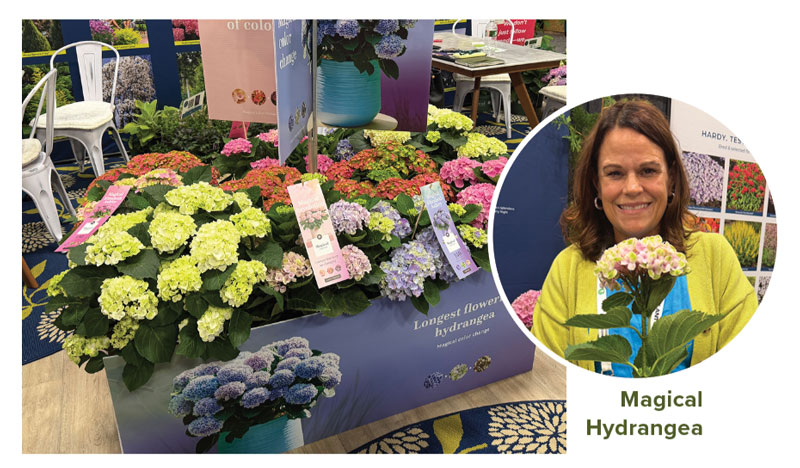
The fun display out in the concourse drew us in; the fact that we’d never heard of Magical Hydrangea made us want to know more. Developed from French and Dutch breeding and sold exclusively in Europe for the last 12 years, Angela Treadwell-Palmer of Plants Nouveau said that she’s been trying to get Magical into North America for a while and now it’s available.
They’ve chosen five cultivars and a small grower network to produce Magical Hydrangeas (Bayview Flowers, Foliera, KW, Rainbow Greenhouses and Willowbrook Nurseries). There are many reasons why they consider them magical: First, the colors on the blooms change throughout its life cycle, giving you multiple hues. Second, it’s very versatile. They call it “the perfect gift-to-garden hydrangea” because you can grow it for Easter and Mother’s Day as gift plants or for spring bedding plant sales. They also have sturdy, thick stems and flower heads that don’t shatter, so they make great cut flowers. (That’s Angela holding a stem of Magical Verdigris.)
Lastly, the blooms last for more than 150 days. Angela said that she had one last for 180 days in a pot on her front porch. There’s POP signage and displays for retail, too.
 Dümmen Orange Potted Mums
We’re selective when covering new varieties at Cultivate, but Dümmen’s new potted mums made the cut because we rarely see new varieties. GemPops is a four-color series of mini cushions that are cute as a button! Ruby, Quartz, Citrine and Amethyst are the colors. They’re from mutation breeding, so the series is uniform in habit and timing, making these trio pots possible.
Growing Media, Irrigation & Pest Control
Griffin
A product of interest to food, cannabis and ornamental producers alike, Biota Nutri is a line of organic, plant-based, water-soluble nutrients that’s new in the U.S., but has been proven in the Netherlands within the CEA market. In partnership with Griffin Greenhouse Supplies as its sole distributor in the U.S., Biota Nutri provides a range of products that growers nationwide can rely on to dial in their fertilizer programs.
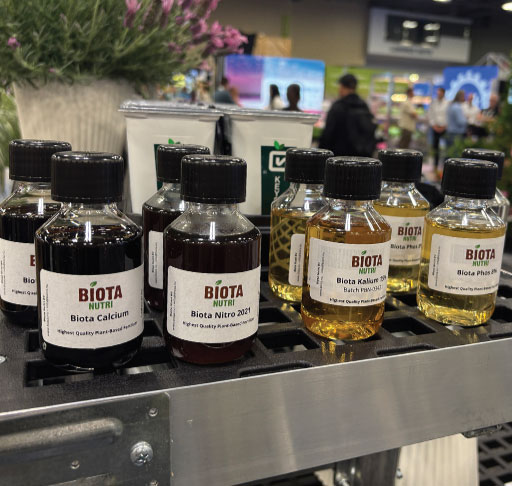 According to Dr. George Grant, GGSPro Technical Services Manager at Griffin, the products are made from byproducts of the food waste systems (residual generated from industrial vegetable processing), so they’re sustainably sourced and part of a circular process. Biota has the capability of producing over a dozen different fertilizer inputs, he said, including concentrated nitrogen and phosphorus sources, powdered iron, trace elements, and more.
Another interesting aspect of this product line is it’s been engineered to minimize biofilm and algae development in irrigation lines, which can be a major headache for organic growers.
Dramm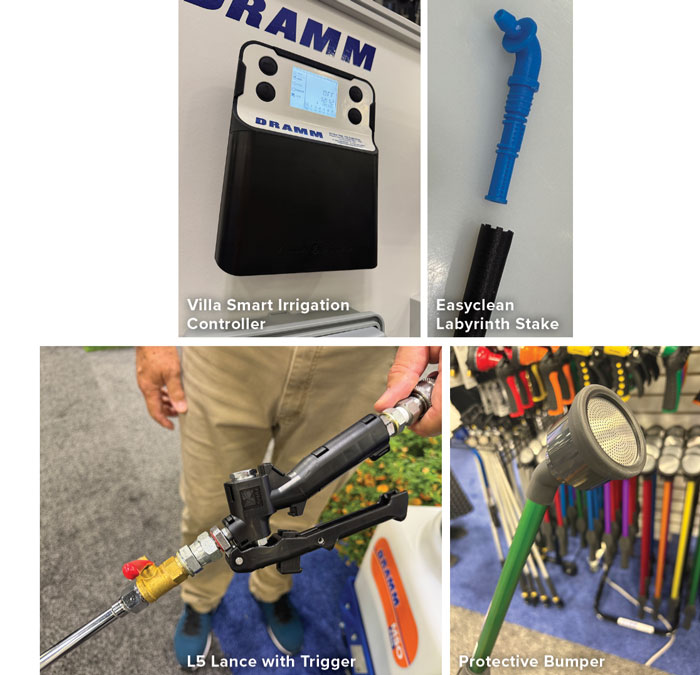
As always, Dramm had numerous innovations for helping you irrigate or apply chemicals to your plants. And the least expensive of all only costs about 30 cents! It’s a new design of labyrinth drip stake that’s quick and easy to clean. A labyrinth drip stake is designed to help even out the pressure among different lengths of tubing coming from one pressure reducer. But the labyrinth, which does the pressure-evening work, can easily clog and they’re a pain to clean. The Easyclean Labyrinth Stake just unscrews, for easy flushing/cleaning.
Of course, you need to control that irrigation and Dramm offers a new unit called the Villa Smart Irrigation Controller that can be controlled via Wi-Fi or Bluetooth, so you can see and program all your irrigation zones from your laptop, tablet or phone. You can even link multiple Villas together. It’s just $500 for the 12-output version.
To go along with your Dramm hydraulic sprayer is the L5 Lance with Trigger, a spray wand that’s especially useful for applying PGRs. It’s been upgraded with a squeeze trigger, while retaining the quarter-turn valve that lets you set your output volume. It’s also got a more durable extension lock.
The company is always looking for ways to improve their products, and small changes can go a long way. Take for instance, the new heavy duty protective rubber bumper added to the 400 PL Water Breaker Nozzle Rain Wands for home gardeners. Before, there was a plastic lip keeping the aluminum disk in place, and if the customer threw it down and cracked that plastic, the whole head would have to be replaced. This new bumper protects it from impact, providing maximum durability for a longer life. They’ve been using it on the wands in commercial greenhouses since 2018, so you know it’s been well tested! You’ll see the new retail product at buying shows this fall and it’s available for the 2027 garden season.
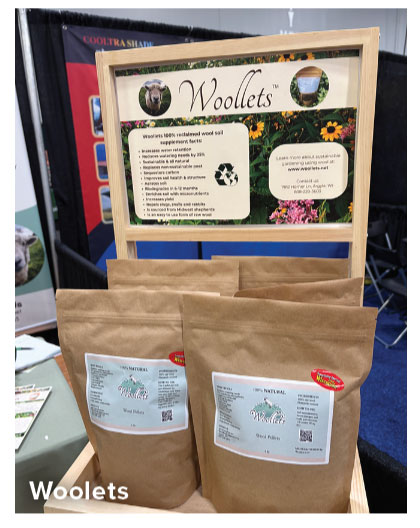 Woollets
This company is adding larger equipment and expanding production as demand grows for their 100% reclaimed waste wool soil amendment product. Co-owners Elaine Becker and Karen Mayhew said that right now they offer two retail sizes: a 1-lb. bag that covers about 30 sq. ft. and a 5-lb. bag that covers about 150 sq. ft. (although they’re looking to move to boxes instead of bags). The wool is sourced from farms in Wisconsin and shredded in a large machine, then put into the pellet mill for heat and pressure at 180 degrees to sterilize it and create pellets that are then cooled.
The pellets can be used to increase water retention, improve soil health and structure, aerate soil, and enrich it with micronutrients. The business is three years old and this year was their second at Cultivate.
Vykenda From Syngenta
This insecticide/miticide features Isocycloseram, a novel active ingredient in a new class of chemistry, IRAC Group 30, for use on ornamental plants. Vykenda features a unique mode of action that acts through contact and ingestion to quickly stop feeding and provide residual control of the most challenging insects, including mites, thrips, black vine weevil adults, red-headed flea beetles and more. It’s the result of 10 years of R&D. Vykenda can be applied on all ornamental crops, including edible crops such as fruit and nut trees, vines, small fruits and vegetable transplants grown for retail sales to consumers. Additionally, it’s an ideal rotation partner with Mainspring GNL insecticide, which controls sucking pests like whiteflies and aphids.
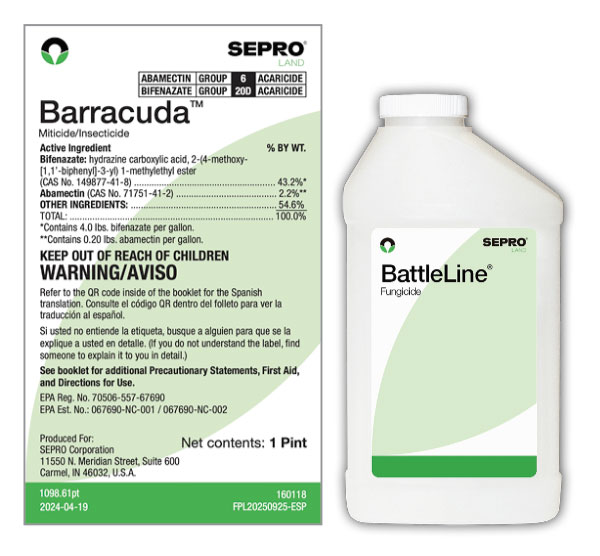 Barracuda & BattleLine From SEPRO
SEPRO launched both an insecticide/miticide and a fungicide at Cultivate. Barracuda combines two proven active ingredients to provide broad-spectrum control of mites and insects commonly found in greenhouse and nursery production. The dual modes of action provide rapid knockdown, translaminar activity and extended residual control. Barracuda controls spider mites, broad mites, cyclamen mites and rust mites, plus thrips, aphids, whiteflies and leafminers.
BattleLine delivers broad-spectrum disease control through locally systemic and contact activity, protecting your crops from foliar and root diseases. You can apply it in numerous ways, including foliar sprays, soil drenches, cutting soaks and chemigation. Both should be available from your favorite distributor starting in October.
Automation & Technology
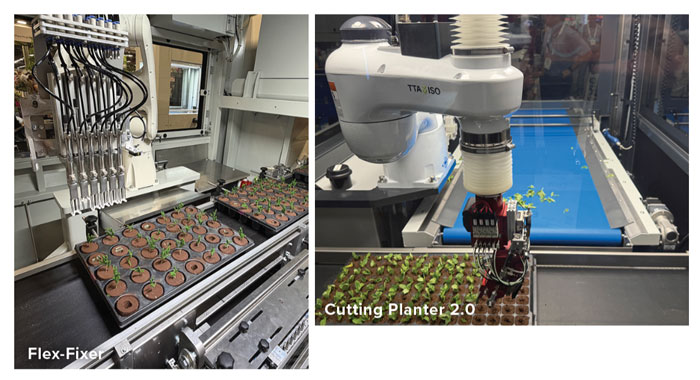 TTA-ISO
The new Cutting Planter 2.0 is a higher-output version of their original Cutting Plant. It features a much wider belt and a four-axis robot head to boost its sticking speed by 10% to 15%—up to 2,800 plants per hour.
The Flex-Fixer is a multi-purpose transplanting machine designed for three uses: patching plug or liner trays (anywhere from 512 to 50 size); fixing misses in finished bedding plant packs, flats or pots (instead of having a human standing behind the transplanter doing the fixing); or transplanting an extra color or variety into the center of a pot (such as a white impatiens planted into the center of four already-transplanted red impatiens). It has no blow-out unit built in, so if you want to patch plug trays, you’ll need to add that in line.
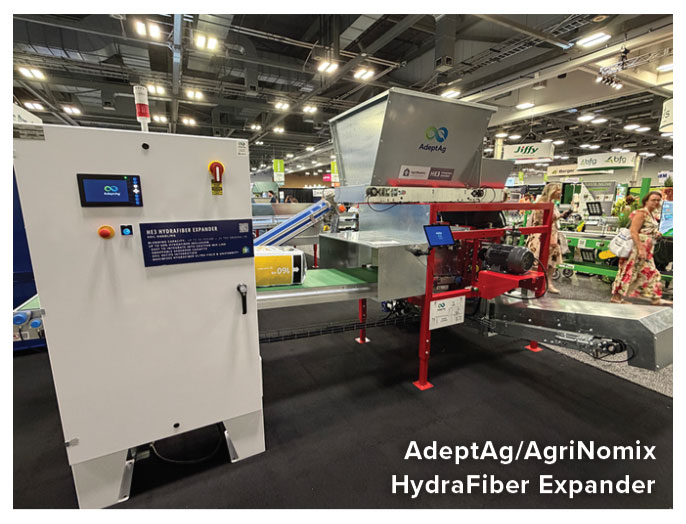 AdeptAg/AgriNomix HydraFiber Expander
More growers are using wood fiber, such as HydraFiber, in their potting mixes, so AdeptAg has upgraded their Expander to be twice as fast—processing up to 50 yards of finished HydraFiber/peat mix per hour. It’s also easier to maintain, with easy-access Zerk fittings and a slide-out, easy-change rotating knife/processing cartridge.
Other Inputs
Growscape ReTerra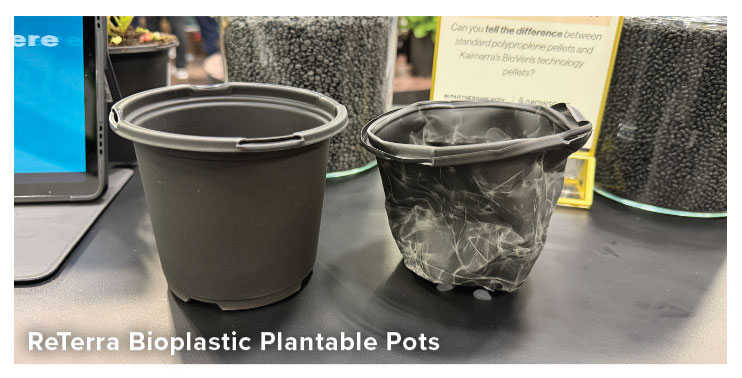
Grower and retailer container company Growscape thinks they may have cracked the code on biodegradable pots with their new ReTerra line of bioplastic plantable pots. What makes them different is the bioplastic: it’s a composite material, which makes it more easily broken down by microbes than a mono material. We were shown samples that were full of holes after just a few weeks in the soil. But don’t worry about them breaking down in storage or on your bench—it takes those soil microbes to digest them. They come in sizes from 4-in. to gallon and they look, feel, stack, unstack and perform just like plastic. GT