8/31/2026
The Sunfinity Sandwich: Culture tips to grow Sunfinity Sunflowers from Mother’s Day through Labor Day
Syngenta Flowers Technical Services
When Sunfinity Yellow Dark Center was introduced nearly a decade ago, it changed how many of us thought about ornamental sunflowers. Instead of a plant that delivered one spectacular bloom and was finished, growers now had a branching sunflower that continued producing flowers throughout the season. It gave retailers a product with exceptional shelf-life and garden performance and consumers a reason to buy it again the next year.
The question is no longer, “Should I grow Sunfinity?” It’s “Which Sunfinity should I grow and when?”
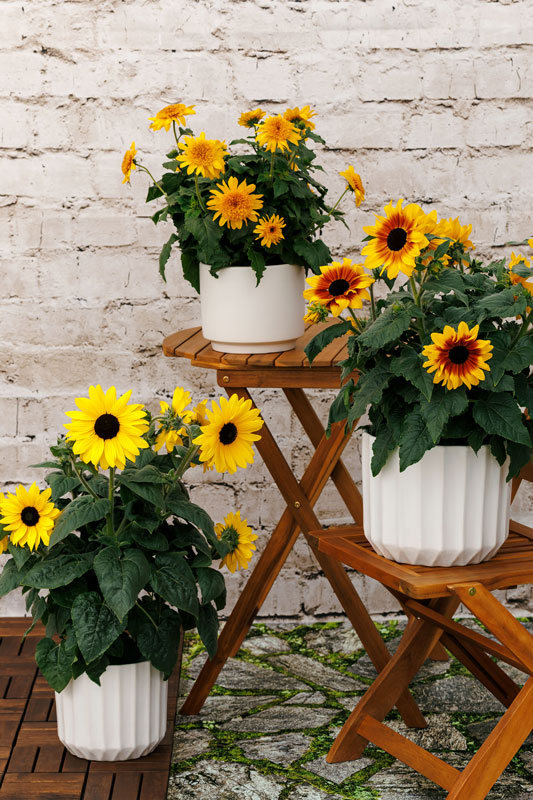
From top, clockwise: Sunflower Sunfinity Double Yellow, Yellow Red Bicolor and Yellow Dark Center.
As the collection has expanded to four distinct varieties, growers have an opportunity to build a program that evolves throughout the season rather than relying on one variety to carry the entire Mother’s Day through Labor Day sales window.
Think beyond one variety
Each Sunfinity variety was developed with a different role in mind. Sunfinity Double Yellow produces a more refined finished plant, reaching approximately 28 to 36 in. in the garden with a spread of 24 to 28 in. Its fully double flowers create a different look than traditional sunflowers, making it an excellent choice for the shoulder seasons when consumers are looking for something fresh, but may not be ready for a large landscape plant. The unique Double Yellow makes a great Mother’s Day gift item.
Sunfinity Single Yellow offers similar garden dimensions while providing production flexibility. Since unrooted cuttings are available through Week 26, growers can continue programming this variety well into the season to meet demand without relying exclusively on seed production.
The larger seed varieties, Sunfinity Yellow Dark Center and Sunfinity Yellow-Red Bicolor, are built for summer. Their larger flowers and mature garden size of 36 to 48 in. create tremendous visual impact at retail during June and July when consumers expect bold color and substantial landscape performance.
Rather than programming one variety to perform across five months of sales, each variety can be positioned where it naturally excels.
Introducing the “Sunfinity Sandwich”
One way to explain the collection is with what we’ve started calling the Sunfinity Sandwich.
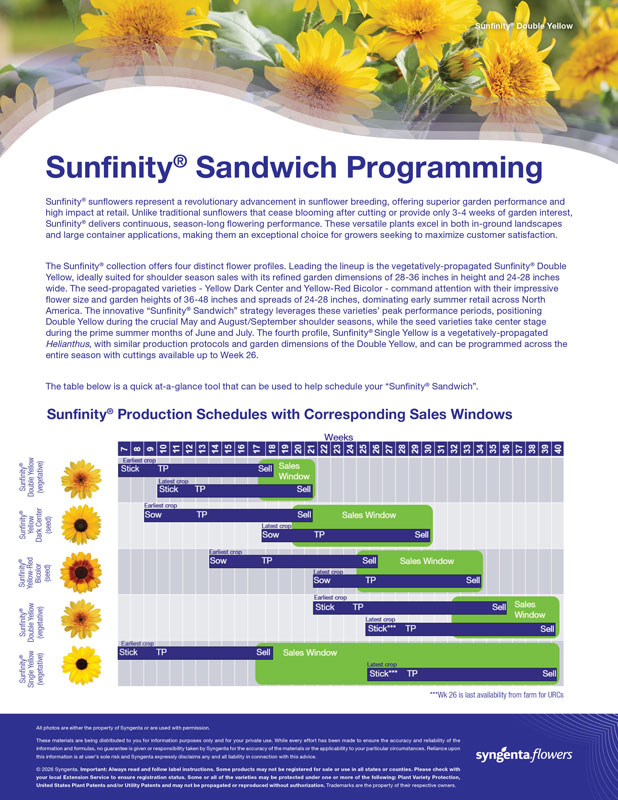 Think of Double Yellow as the bread. It anchors the beginning and end of the season, while Yellow Dark Center and Yellow-Red Bicolor become the centerpiece during the height of summer. Single Yellow adds flexibility throughout the season, especially for growers looking to extend production with vegetative material.
The accompanying production timeline illustrates how these varieties naturally fit together across a North American selling season (Figure 1). This is an example schedule and can be shifted or adjusted based on individual needs of target dates.
Figure 1. Sunfinity Sandwich tool to help schedule your Sunfinity crops to take advantage of all four varieties.
By rotating varieties across the season, retailers get a sunflower program that stays refreshed, while growers keep producing the plants with the strongest retail potential for that point in the season.
Production success starts during propagation
In many crops, finishing challenges often trace back to propagation. For the seed varieties, long days are one of the biggest factors affecting crop timing. Providing at least a 14-hour daylength during plug production accelerates flowering in finish. If plugs are propagated under short days, growers should expect flowering to be delayed by as much as two to four weeks. That’s a significant scheduling difference during spring production.
High light levels are equally important. Whenever possible, maintain a daily light integral (DLI) ≥ 12 mol.m-2.sec-1 and 68 to 75F (20 to 23C) average daily temperatures (ADT) throughout production. Sunflowers respond quickly to good growing conditions and providing sufficient light early pays dividends later in crop quality and flowering.
Don’t fight the vigor—Manage it
One of the characteristics that makes Sunfinity such an outstanding garden performer is also one of its biggest production challenges: it’s vigorous. In production, planning for and managing that vigor helps growers achieve the desired plant size for shipping and the retail spaces.
For seed varieties, the program starts with a Bonzi sprench shortly after sowing, followed by a properly timed hard pinch after five to six nodes have developed. Leaving four nodes helps control the height of the finished pot making it easier to fit on racks. This pinch also promotes branching, creating fuller plants and a showstopping presentation for the retail customer.
 After the pinch, monitor lateral development and base PGR decisions on crop vigor and environmental conditions, not the calendar. In warm summer production, higher light levels and heavier irrigation often increase growth, so additional regulation may be needed to maintain a retail-ready plant. A final Bonzi drench timed at color crack is often the application that makes the difference between finishing at an ideal retail height or ending up too tall to ship and merchandise efficiently.
Vegetative varieties require a slightly different approach. Pinching is optional and should be used primarily to manage vigor, plant height and retail presentation. While a pinch can further refine plant architecture and reduces height, growers should remember that it typically delays flowering by seven to 10 days, so scheduling should be adjusted accordingly.
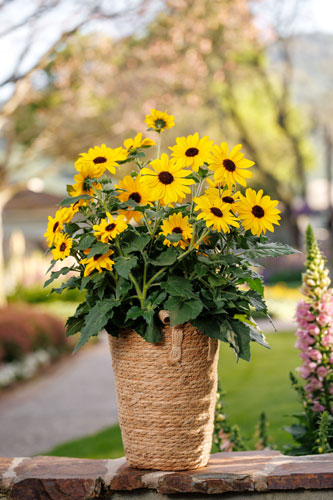
Sunflower Sunfinity Single Yellow.
Looking ahead
The 2027 season marks an exciting milestone, as Sunfinity Yellow Dark Center celebrates its 10-year anniversary. Over the past decade, it has changed expectations for ornamental sunflowers and has grown into a consumer-recognized brand. The mysunfinity.com website and branded tags and pots help home gardeners make sure they’re selecting a sunflower with the performance they’ve come to expect and equip them with the additional information and inspiration they need to make the most of it.
The best sunflower program isn’t built around one outstanding variety; it’s built around understanding when each variety delivers the greatest value to your production schedule, your retailer and, ultimately, the consumer to truly deliver endless blooms all season long. GT