8/31/2026
Resources Rooted in Research
Laura Barth
Many of you reading this are probably at the Plug & Cutting Conference right now or perhaps you’re just getting back. One of my favorite parts of this conference is the experiential tours, which offer a chance to see other production systems, ask questions and compare notes with other growers from across the country. There are always plenty of things rooting at this conference.
In that same spirit, I thought I’d use this article to take you on a quick tour of the American Floral Endowment’s free resources for plugs, cuttings and all aspects of young plant production. Whether you were at the conference or not, AFE offers practical tools to support your operation throughout the production process that you can access on demand at any time. From receiving and handling unrooted cuttings to managing irrigation, nutrition, substrates, pests and diseases, we’ve got you covered.
Protecting quality from the box to the bench
We all know that successful young plant production begins before roots are even visible. From the moment your unrooted cuttings arrive, decisions about inspection, handling, hydration, sanitation and other environmental conditions can influence rooting uniformity, timing and plant quality.
If you’re looking for general resources about handling and rooting cuttings, AFE’s free Grow Pro Webinar Series is a great place to start. Since 2021, Grow Pro has connected growers with researchers and industry experts for practical presentations on production challenges. Each webinar is recorded and added to our Grow Pro playlist on YouTube (youtube.com/@EndowmentOrg), creating an on-demand library that can also be used for employee training.
Some key webinars to check out:
- Successful Handling and Propagation of Unrooted Cuttings with Dr. John Dole
- Success with Vegetative Unrooted Cuttings with Dr. Jim Faust
- Creating a Culture of Sanitation with Dr. Rosa Raudales
- PGRs for Floriculture Production with Dr. Roberto Lopez
While you’re there, take some time to check out the other Grow Pro webinars in the playlist. We cover advances in LED lighting, greenhouse climate controls and specifics for crops like mums and poinsettias.
In addition to Grow Pro Webinars, you can find more information in AFE’s research report library, where we share results from completed AFE-funded projects. Growers can find studies on pre- and post-harvest treatments for cuttings, post-shipping treatments for unrooted cuttings, cutting durability and recovery, modified-atmosphere shipping, and stock plant management:
- Post-Shipping Cutting Dips Improve Cutting Rooting and Survival—J. Dole, I. McCall, B. Bergmann and J. Faust
- Pre- and Post-Harvest Treatments for Improved Cutting Durability and Recovery—J. Faust, U. Samarakoon and J. Dole
- Modified Atmosphere Use in Extending Unrooted Cutting Quality and Viability—W. Roland Leatherwood and J. Dole
- Effects of Temperature on Unrooted Cutting Post-Harvest Longevity—J. Faust, A. Enfield & K. Lewis
- Package Design & Cold-Chain Management for Unrooted Cuttings—J. Faust & S. Whiteside
- Ethylene Sensitivity of Unrooted Cuttings from 28 Genera and Effectiveness of 1- MCP to Prevent Ethylene Damage—W. R. Leatherwood and J. Dole
Although product labels and recommendations should always be checked for current use and regulatory compliance, these reports can offer useful insights into plant physiology, shipping stress and the cultural factors that contribute to successful rooting. All completed AFE research reports are available to the industry at no cost at endowment.org/research-report. Use the filters to sort by a variety of topics.
Managing the root zone and production environment
Once young plants reach the bench, attention turns to creating the conditions needed for uniform rooting and growth. Inputs and the production environment work together; even a small change in one factor can influence the rest of the production system.
Here are a few Grow Pro Webinars and research reports for you to check out during this stage of production:
- Preventing Undesirable Purple Coloration on Cuttings Propagated Under LEDs—Dr. Roberto Lopez, Michigan State University
- Fine-Tune Your Greenhouse Controls for the Young Plant Season—Dr. Paul Fisher, University of Florida
Reports:
- Use of Indicator Plants to Identify Ethylene Contamination in the Production Greenhouse—Michelle L. Jones and Nichole Edelman
- Geranium Leaf Yellowing: Causes and Solutions—James Faust, Vijay Rapaka and Kelly Lewis
Another resource worth bookmarking is “Fert, Dirt & Squirt,” a nutritional monitoring website developed by e-GRO with support from an AFE Educational Grant. It includes crop-specific fact sheets that cover all stages of production, instructions for testing substrate pH and EC, corrective procedures, and photos of common disorders. A searchable database provides recommended fertility, pH and EC information for hundreds of floriculture and edible crops.
 Start clean and stay ahead of pests
No tour of young plant production would be complete without a discussion of pest and disease management. Pest and disease problems can spread quickly in young plant production, making prevention and early detection especially important. Clean plant material, consistent sanitation, careful inspection and routine scouting all help reduce the risk of introducing or spreading problems throughout the greenhouse.
AFE offers resources on thrips, Botrytis, root diseases, biological control, sanitation and more. The Thrips and Botrytis Research Library (endowment.org/tb), available in both English and Spanish, is especially useful for employee training and quick reference. Together, these resources can help teams recognize problems earlier and make more informed management decisions.
The following are just a few of the many pest and disease resources that we have available:
- Start Clean by Dipping Unrooted Cuttings—Dr. Rose Buitenhuis, Vineland Research & Innovation Centre
- Grow Pro: Botrytis Update: Exploring Biorational Products and Tank Mixing—Dr. Jim Faust, Clemson University
- Grow Pro: Identification and Management of Root Diseases in Floriculture Crops—Dr. Francesca Hand, Colorado State University
 Consider where automation can help
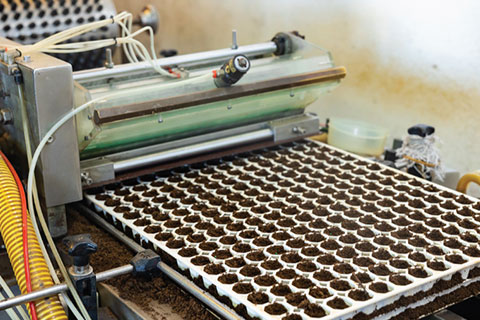
Automation can help young plant growers improve productivity, consistency and workflow, but the value of an investment extends beyond labor savings alone. Check out our Grow Pro Webinar, “Automation ROI: Tips to Maximize Profit, Company Buy-In and Worker Satisfaction,” with Chris Rocheleau of Phoenix Foliage. Chris shares real-world guidance for evaluating automation based on its effects on profitability, production capacity, crop quality and the employee experience. It’s a useful resource for growers looking to make informed investments in their operations and personnel.
I hope a few of these resources take root and are helpful for your business. AFE’s free tools are available whenever your team needs help training, troubleshooting or exploring a new production practice.
AFE, with the help of our generous donors and sponsors, invests in research and education so growers can access practical solutions to the industry’s most pressing challenges. By sharing these resources with the industry, we hope to help every operation—and every young plant—get off to a stronger start. GT
Laura Barth is Research Coordinator at the American Floral Endowment.