8/31/2026
A Practical, Compatible Strategy for Greenhouse Mealybug Management
Peilin Tan & Muhammad Z. “Zee” Ahmed
Mealybugs are one of the most persistent greenhouse pests. Some insecticides are effective in managing mealybugs, but several features of mealybugs—wax layers, protected feeding sites, overlapping generations and continuous crawler emergence—can reduce insecticide efficacy. As growers adopt integrated approaches, the question is no longer “biocontrol or pesticides,” but how to combine both without undermining either. Compatibility, defined as the ability to use chemical insecticides alongside biological control agents, is the hinge that makes integrated mealybug management possible.
Biological options
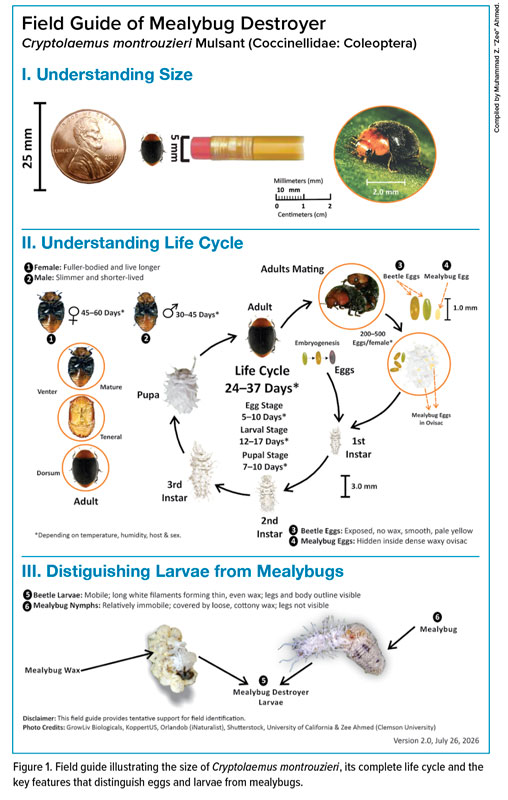
Across North America, the commercial biological control market for mealybugs is surprisingly limited. Only a few natural enemies are consistently available and their effectiveness is supported by greenhouse relevant data. A ladybird beetle known as the mealybug destroyer, Cryptolaemus montrouzieri, is the primary predator used in greenhouses (Figure 1). Nearly every biological control agent supplier offers it and decades of grower experience confirm its value. Adults and larvae feed aggressively on citrus, Madeira, and longtailed and striped mealybugs, especially when populations are moderate to high. It’s not a cure-all, but it’s the most dependable predator available to growers.
Chrysoperla species (C. rufilabris as a typical option) are also widely available. Lacewing larvae are generalist predators that feed on mealybug crawlers and other soft-bodied pests. They’re most useful when growers already rely on lacewings for aphids or whiteflies and want additional pressure on immature mealybugs.
Micromus variegatus, also a generalist lacewing, is available from a few suppliers and behaves similarly. The ladybeetle Hippodamia convergens may feed opportunistically on exposed mealybugs, but it’s not considered a primary mealybug predator.
Parasitoids such as Anagyrus pseudococci, Leptomastix dactylopii and Leptomastidea abnormis are effective in controlled greenhouse environments, though availability depends on time of the year and the vendor. Beauveria bassiana and Isaria fumosorosea can suppress exposed mealybugs when spray coverage and humidity are adequate.
These are the biological tools growers can realistically access. Anything outside this list may either not be commercially available or not be supported for greenhouse mealybug management.
Chemical options
Mealybug infestations often require chemical intervention. Many insecticides that work well against mealybugs belong to IRAC groups with broad neuroactive modes of action. Many of these chemistries kill mealybugs, but some of them can also kill Cryptolaemus, lacewings and parasitoids. Even dried residues can remain harmful when predators contact treated surfaces, particularly if residues persist or accumulate on waxy plant surfaces. However, not all neuroactive insecticides are incompatible; the risk depends on the specific active ingredient, rate, formulation and residue persistence. When growers apply these incompatible products without planning, they often undermine their biocontrol program for weeks or months.
Multiple ecotoxicology studies point to consistent patterns. Organophosphates (IRAC 1B), carbamates (IRAC 1A), pyrethroids (IRAC 3A) and neonicotinoids (IRAC 4A) often pose compatibility risks for biological control agents. These chemistries can cause high mortality or sub-lethal effects in predators and parasitoids, even at low rates. They should be used only when and where biological control is not practiced.
Fortunately, several selective chemistries offer alternatives. Insect growth regulators such as buprofezin (IRAC 16), pyriproxyfen (IRAC 7C) and S-kinoprene (IRAC 7A) are generally safe with Cryptolaemus, lacewings and parasitoids. Buprofezin disrupts chitin synthesis in immature mealybugs (and related scale insects and whiteflies) without harming adult and immature predators outside these target insect groups. Pyriproxyfen acts as a juvenile hormone mimic and is typically safe for adult predators, though it may affect immature stages. These IGRs are among the most reliable insecticides for integrated mealybug management.
Nerve-action chemistry also plays an important role. Flonicamid (IRAC 29) and afidopyropen (IRAC 9D) show minimal acute toxicity to predators and parasitoids. They may reduce feeding or fecundity in some predatory ladybird species, but they remain compatible with Cryptolaemus when applications use the lowest effective labeled rate, avoid repeated sprays and rely on spot or directed treatments that minimize predator exposure.
Other selective options include Spirotetramat (IRAC 23), which is effective against root mealybugs when applied as a drench. Cyantraniliprole (IRAC 28) isn’t typically used as a primary mealybug material in greenhouse crops, but when growers use it for other pests, research indicates it’s generally compatible with lacewings at labeled greenhouse rates. Data for Cryptolaemus are limited, so growers should use caution until more predator specific information becomes available.
Compatibility considerations
Growers often ask for a simple list of “safe” and “unsafe” products. The reality is more nuanced, but the pattern is clear enough to guide decisions. The most compatible insecticides with mealybug biological control programs include buprofezin (16), pyriproxyfen (7C), flonicamid (29), afidopyropen (9D), pyrifluquinazon (9B) and spirotetramat (23). These materials have repeatedly shown low direct toxicity to adult predators and minimal disruption of their feeding or development when used thoughtfully and at labeled rates. Broad spectrum neurotoxins—including acephate (1B), pyrethroids (3A) and neonicotinoids (4A)—frequently pose compatibility risks and should be avoided when predators are present.
Compatibility is not only about choosing the right products, but also about timing and placement. Growers can apply selective insecticides early, before releasing predators, to reduce mealybug pressure without eliminating future biological control agents. Predators perform best when mealybug populations are moderate rather than explosive. Spot treatments can be used instead of blanket sprays, avoiding spraying the entire plant to preserve biological control agents. If an incompatible insecticide is necessary, growers can spray and kill the target pests, then wait several days to weeks before reintroducing predators, depending on the product. Cryptolaemus, lacewings and parasitoids can be released after compatible insecticides have dried and when label directed re-entry intervals and residue considerations indicate low risk to the biological control agents.
A practical greenhouse roadmap looks like this: Early in the crop, when mealybugs first appear at low levels, use selective chemistries such as buprofezin or pyriproxyfen to suppress initial infestations. As mealybug populations increase and become more noticeable, introduce Cryptolaemus or lacewings, if needed. Throughout the crop, use spot treatments with oils or soaps when appropriate, and avoid broad-spectrum neuroactive chemistries. If a severe outbreak occurs late in production, growers may need a reset spray followed by predator reintroduction once residues have declined.
Mealybug management in greenhouses is never simple, but growers now have clearer guidance than ever before. Cryptolaemus remains the cornerstone predator, lacewings provide supplemental control and selective chemistries such as buprofezin, pyriproxyfen, flonicamid and afidopyropen allow growers to intervene without disrupting their biological control program when used appropriately.
The key isn’t choosing between pesticides and predators; it’s choosing combinations that work together. When growers integrate both tools thoughtfully, mealybug management becomes more predictable, more sustainable and consistently more effective. GT
Muhammad Z. “Zee” Ahmed is an Assistant Professor and Extension Specialist of turf and ornamental entomology at Clemson University. Peilin Tan is a Ph.D. student in the Turf & Ornamental Entomology Lab at Clemson University’s Pee Dee Research & Education Center. We thank JC Chong (SePRO Corporation) for his helpful comments.