7/31/2026
How to Scout—and Combat—Diseases on Hydrangea
Janna Beckerman, Ph.D.
Hydrangeas are perennial customer favorites and for good reason. Whether it’s bigleaf (H. macrophylla), mountain (H. serrata), oakleaf (H. quercifolia), panicle (H. paniculata) or smooth (H. arborescens) hydrangea, these flowering shrubs offer season-long appeal and strong market demand.
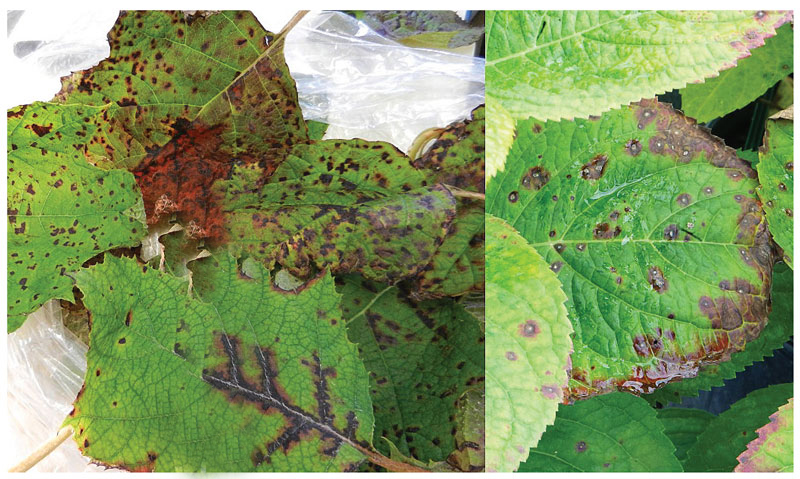
Figure 1. Xanthomonas bacterial blight in hydrangea (left) is often confused with Cercospora leaf spot, a fungal disease (right).
Photos by: Envu.
Unfortunately, hydrangeas have another fan club—one made up of bacteria, fungi and viruses. Unlike growers and customers, these admirers don’t bring compliments; they bring leaf spots, blights and other assorted headaches. The challenge for growers isn’t whether diseases will show up—it’s recognizing them before they become costly. Identifying the most common bacterial, fungal and viral diseases of hydrangea are a first step, followed by sound cultural practices and chemistry know-how to produce a healthy, high-quality crop.
Hydrangeas are a moisture-loving crop and watering practices have a lot to do with disease management. Whenever possible, avoid overhead watering, which drives a number of diseases. Other tactics include:
- Decreasing foliage wetness through proper spacing and air circulation. This includes pruning and thinning to open up the canopy and the use of horizontal air flow (HAF) fans.
- Prevent drought stress with consistent irrigation.
- Avoiding excessive nitrogen applications, especially ammoniacal N.
- Minimize handling or pruning when plants are wet.
- Remove heavily infected foliage when practical.
Bacterial leaf spot (Xanthomonas campestris)
Bacterial leaf spot disease typically develops during periods of warm, wet weather. The first symptoms usually appear on lower leaves within the interior canopy, where humidity remains highest. Lesions are characteristically black and angular on both leaf surfaces (Figure 1) and may be surrounded by a yellow halo. One of the most common diagnostic mistakes is confusing bacterial leaf spot with Cercospora leaf spot, particularly on oakleaf hydrangea. While symptoms can appear similar, laboratory testing is often required for a definitive diagnosis.
Management: Although bigleaf, smooth and oakleaf hydrangeas are frequently affected, all hydrangea species are considered susceptible. The bacterium spreads readily in splashing water and enters plants through wounds or other injuries.
Copper-based bactericides are labeled for management, but often fail to provide consistent control. Where aluminum sulfate is used to encourage blue flower color, copper-related phytotoxicity may become a concern. We’ve seen good success with the rotation of Teclera (formerly Aliette) and mancozeb; Postiva has also shown control against Xanthomonas in trials.
 Botrytis blight (Gray mold; Botrytis cinerea)
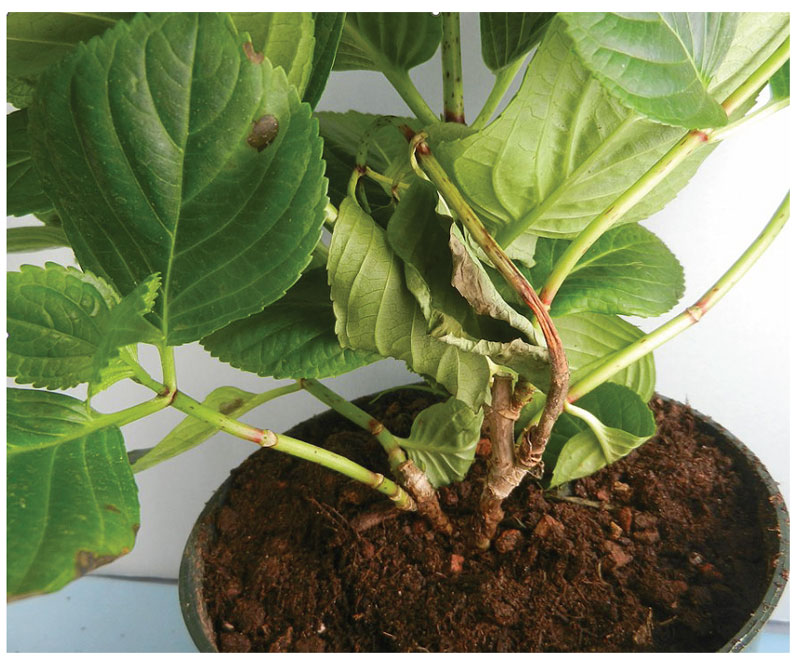
Botrytis blight is most noticeable on flowers and decorative bracts. Initial symptoms appear as tan to brown blotches, which may become covered with fuzzy gray fungal growth under humid conditions. When environmental conditions favor disease development, the fungus can move from infected blossoms into stems, resulting in shoot blight and dieback (Figure 2).
Figure 2. Botrytis can blight flowers, foliage and cause crown rot.
Photo by: the Purdue Plant and Pest Diagnostic Lab.
Management: Overcast days, coupled with cool, wet weather drives Botrytis outbreaks. Disease severity is often increased by excessive nitrogen fertilization, frequent overhead irrigation or physical injury to plant tissues. Bigleaf hydrangeas tend to be especially susceptible, although most hydrangea species can be infected.
Botrytis is a challenging disease to manage due to fungicide resistance. Rotate Broadform and other 7+11 fungicides (Orkestra, Mural) with Decree (FRAC 17), mancozeb or chlorothalonil (FRAC M), Affirm (or other polyoxin D fungicides-FRAC 19), Chipco (FRAC 2) or Medallion (FRAC 12). Applications should be timed carefully and avoided during bloom whenever possible to minimize impacts on pollinators.
Cercospora Leaf Spot (Cercospora hydrangeae)
Cercospora leaf spot is one of the most common foliar diseases of hydrangea. Symptoms generally begin on older leaves near the base of the plant before progressing upward.
On bigleaf hydrangea, lesions are typically circular with tan to gray centers surrounded by distinctive reddish-purple borders. Oakleaf hydrangea often develops more angular reddish-purple lesions (Figure 1). As disease severity increases, affected leaves may yellow prematurely and drop. Unlike many foliar diseases, Cercospora can become particularly problematic on plants growing in full sun.
Management: Proper site selection is among the most effective management strategies, along with the use of resistant cultivars. In regions with intense summer heat, hydrangeas generally perform best when provided afternoon shade.
Preventive fungicide programs can be effective, although they often require repeated applications throughout favorable weather conditions. Broadform and other 7+11 fungicides (Orkestra, Mural) provide control and should be rotated with mancozeb or chlorothalonil (FRAC M) and FRAC 3 fungicides like Eagle, Avelyo and Terraguard. Applications should target foliage rather than flowers whenever possible.
 Powdery mildew
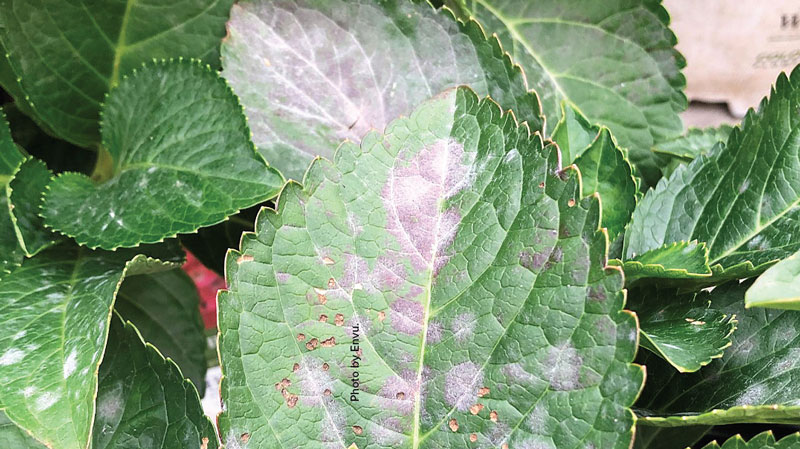
Powdery mildew is caused by several fungal species, including Golovinomyces, Erysiphe and Microsphaera and is usually easy to identify. Early symptoms appear as small white, powdery patches on the upper leaf surface (Figure 3). Close inspection reveals masses of fungal threads growing across the leaf surface. Later in the season, small black fruiting bodies form within the white growth. These structures allow the pathogen to survive adverse winter conditions and initiate infections the following year. Severe infections can lead to yellowing, premature leaf drop and reduced plant vigor.
Figure 3. The white cast of powdery mildew makes this disease easy to diagnose in hydrangea.
Photo by: Envu.
Management: Bigleaf hydrangeas are particularly susceptible to powdery mildew, while oakleaf hydrangeas generally exhibit greater resistance. Cultivars resistant to powdery mildew have been identified.
A solid fungicide rotation will include Broadform and other 7+11 fungicides (Orkestra, Mural) rotated FRAC 3 fungicides like Eagle, Avelyo and Terraguard. If outbreaks are particularly severe, include Seido (FRAC 50) or Pipron (FRAC 5-greenhouse use only).
Viral diseases
Hydrangeas are known hosts of at least 17 different viruses, as well as aster yellows phytoplasma. Viral symptoms can vary considerably, but may include chlorosis (yellowing), ringspots or mottles, distorted foliage, stunting, and even virescence, in which floral tissues revert to leaf-like growth.
Not all viruses cause severe symptoms. Some remain latent within the plant and produce little to no visible damage. Others, including tobacco rattle virus and tomato spotted wilt virus, can significantly affect both appearance and overall plant health, in addition to being spread to nearby plants in the nursery or landscape.
Management: Unlike fungal and bacterial diseases, viral infections cannot be cured. Accurate diagnosis is therefore essential before making management decisions. In many cases, removing and destroying infected plants may be the most practical option for preventing further spread. While this can be a difficult decision, it may protect other susceptible plants in the nursery or greenhouse from becoming infected, like in the case of aphid-vectored potyviruses, thrips-vectored tomato spotted wilt virus or nematode-vectored tobacco rattle virus.
The bottom line
Most hydrangea diseases become problematic only when environmental conditions favor infection and plant stress is high. Proper media selection, good sanitation, adequate spacing and thoughtful irrigation practices remain the foundation of disease management. Combined, the use of culture controls, resistant cultivars and fungicide when needed will help growers produce healthy hydrangeas and abundant blooms year after year. GT
Janna Beckerman, Ph.D., is Green Solutions Team Specialist for Envu.