6/30/2026
Shining the Spotlight on Muhly Grass
Kerstin Poehlmann

Ornamental grasses as a category are incredibly versatile and diverse, but when it comes to individual genera, not many have as much to offer as muhlenbergia, commonly known as muhly grass.
While the name comes from a Pennsylvania botanist of German heritage, muhlenbergia is a tried-and-true North American native plant, making it very versatile for landscapes and gardens. With over 150 species, it’s an extremely diverse genus.
Emerald Coast Growers has selected four of the best species and a number of outstanding varieties to offer to growers in the United States and Canada. All are heat and drought tolerant, and easy-to-care-for additions to gardens and landscapes.
Muhlenbergia capillaris
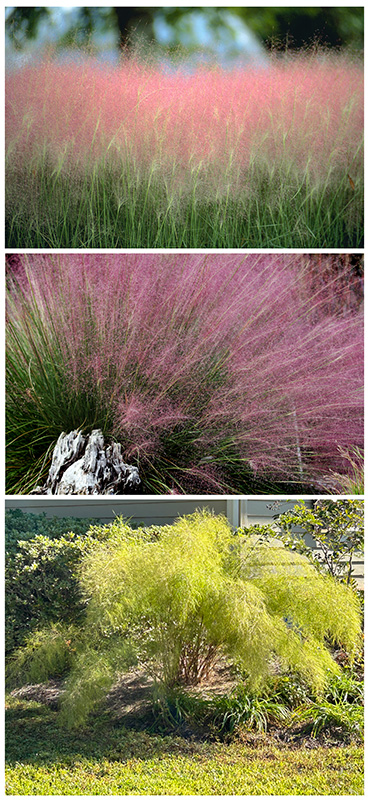
Muhlenbergia capillaris is arguably the best-known species, thanks to its show-stopping display of delicate pink blooms that appear to float above the foliage like soft pink clouds. The billowy, rich pink panicles rise high above the foliage in late summer and early fall. Its mounding green foliage is fine and narrow, and easily moved by breezes. M. capillaris grows to a mature height of 36 in. and is hardy in USDA Zones 6 to 10.
 In addition to the species, Emerald Coast Growers offers the following varieties:
- M. capillaris Fast Forward is an Emerald Coast Growers selection. Flowering begins in August (late July in warm climates), which is significantly earlier than others in the species. Glowing delicate sunlit purple flowers dance over symmetrical, compact mounds of fine foliage. It’s more refined in shape than any other muhly grass.
- M. capillaris Pink Cloud is open and airy like the species, but taller with a mature height of 48 in. and more uniform in bloom. Its dense glittering clouds of vivid pink flowers are long-blooming and the plant is drought-tolerant.
- M. capillaris Ruby is a wonderful grass for mass plantings with its rich pink plumes that dazzle in the sunlight. Grows to 36 in. mature height.
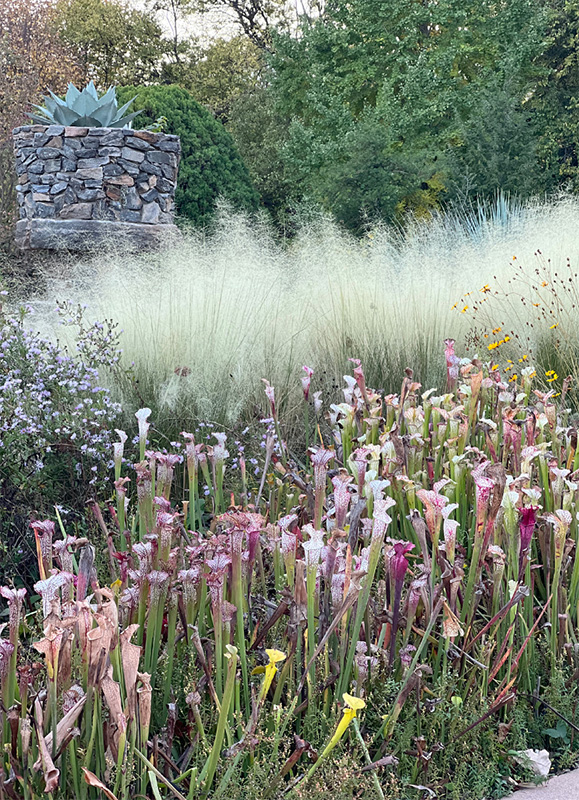
- If pink is not your “thing,” reach for M. capillaris White Cloud. Fluffy white panicles rise over thin green foliage from late summer through winter. Slightly taller than the species with 48 in. at maturity. In addition to heat and drought, it also tolerates humidity.
Top: Muhlenbergia capillaris.
Middle: Muhlenbergia capillaris Fast Forward.
Bottom: Muhlenbergia dumosa.
Muhlenbergia dumosa
Speaking of diverse! This species has a very different look and form than M. capillaris. It has soft, light green, fine foliage on arching stems that resemble bamboo, giving it its common name bamboo muhly grass. With its non-spreading and clump-forming habit, it does well in-ground in warmer climates or in containers on patios. Hardy in USDA Zones 8 to 10, but colder climates can overwinter their patio pots inside. Shows lots of movement in light breezes. Mature height is 48 in.
Muhlenbergia lindheimeri
This grass is a heat-loving Texas native. Its fine blue-green leaf blades create a stunning mound that supports thick, white plumes that emerge in September. Similar to the mounding habit of M. capillaris, M. lindheimeri is slightly more upright and has thicker flower plumes that are white. It also grows taller, with a mature height of 60 in. Hardy in USDA Zones 6 to 10.
Muhlenbergia reverchonii Undaunted
As the name suggests, not much fazes this superb variety. With its showy glistening flower spikes, it makes a great “see-through” planting. Hardier than most of the genus, it can survive winters as cold as USDA Zone 5! Native to Texas and Oklahoma, it blooms slightly earlier than M. capillaris and appears slightly more compact in that the panicle cloud is held closer to the foliage. A Plant Select introduction for drought tolerance, Undaunted grows to 36-in. tall.
All of these muhlenbergia selections perform best in full sun and good drainage, but tolerate part shade and consistent moisture. They’re available from Emerald Coast Growers as 38-cell or 72-cell liners, depending on the species or variety.
 Cultural information
Potting: If starting from 38-cell or 72-cell liner trays, plant two 72-cell liner per pot or one 38-cell per pot. Recommended finish size is 1-gal. pots.
Growing media: Muhlenbergia does best in well-draining commercial potting mix with a soil pH of 5.8 to 6.2 and a soil EC of 1.0 to 1.5. In the garden and landscape, plant in well-draining soil.
Right: Muhlenbergia capillaris White Cloud.
Growing temperature: Daytime temperatures can range from 75 to 95F (23 to 35C) and nighttime 65 to 75F (18 to 23C).
Finish time: If planted from March through June—12 to 16 weeks depending on day/night temperatures. Very slow rooting. Will see new growth before roots emerge.
Growing info: In the garden and landscape, remove spent foliage and flowers by trimming to 6 in. in fall or late winter, before new growth emerges in the spring.
Fertilizing: Incorporate or top dress with a CRF (four- to six-month release). In the garden and landscape, little to no fertilizer is required.
Moisture level: Keep evenly moist soil in pots for the first six weeks or until established. Once established and rooted, can handle some drought stress. In the garden and landscape, muhlenbergia is drought tolerant once established.
Pests and disease: Root rot can be an issue if overwatered. Mealybugs can also become a problem if not treated at first signs.
Vernalization requirements: Can overwinter. Will start to go dormant below 50F (10C). Can push out of dormancy above 60F (15C). Supplement with liquid feed fertilizer weekly for four weeks when new growth emerges.
Supplemental lighting: None required.
Growth regulators: Not required.
For more information or to order, visit ecgrowers.com, call (850) 944-0808 or email sales@ecgrowers.com. GT
Kerstin Poehlmann is president of Pen & Petal, Inc., a marketing communications firm for the green industry. She can be reached at kerstin@penandpetal.com.