6/30/2026
The Lowdown on Lofos
Lowell Halvorson
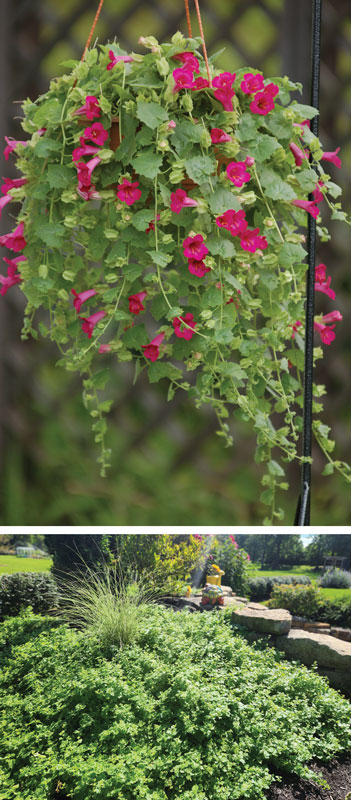 For all the variety in the basket market, certain cultivars do best for high-volume production. This produces a sense of sameness and IGCs react by seeking out niche-y alternatives to petunias and New Guinea impatiens.
Top: Notice the short vine lengths of Lofos Compact Rose.
Bottom: Lofos Compact White works as a landscaping groundcover.
Known as creeping gloxinia, lophospermum isn’t something you’ll likely find in the mainstream. Dig around the independents, however, and you’ll be surprised how often you see it. Suntory gave the category commercial viability with the release of the Lofos series back in 2011, so it’s known among the cognoscenti, but not among the general masses.
Distinctly vertical
First of all, this plant is a vining product. It drapes long and hard in the style of Dichondra Silver Falls. Foliage comes across almost like grape leaves cascading in a fairy-tale, so the plant itself is attractive. As for the vine, it’s thicker and sturdier than an ipomoea, but not as tough and leathery as an English ivy. The closest equivalent would be a thunbergia vine.
If you’re hanging a bunch of Lofos baskets side-by-side, the vines will grab each other to form a living wall. They have a bit of a prehensile quality, a deep-seated desire to wrap themselves around any structure they encounter.
Lophospermum flowers are huge pollinators for hummingbirds down in the plant’s home base of central Mexico. As a result, its performance in summer heat is pretty good. Flowers emerge in various shades of red or white, dotting the green canvas and lasting a long time. Green-to-color ratio is somewhat similar to mandevillas, but significantly easier to bring to market and keep alive on the porch.
The long and the short of it
Lofos comes in two styles. Wine Red and White are the robust varieties—the flower is a large trumpet and the caliper of the vine is thicker. Vine length runs out to an impressive 6 ft., somewhere in Rapunzel territory.
More refined are Compact Rose and Compact White—their vines stop at about 2 ft. The flower is half the size of the standards and Compact Rose is on the pink side of red. Compact varieties were bred specifically to behave better in smaller baskets, window boxes and retail pots.
Of the four, you’re most likely to see Compact Rose because red sells, and the compact version is easier to produce and easier to get into the car. Compacts can also be used pretty much like you would use a lysimachia.
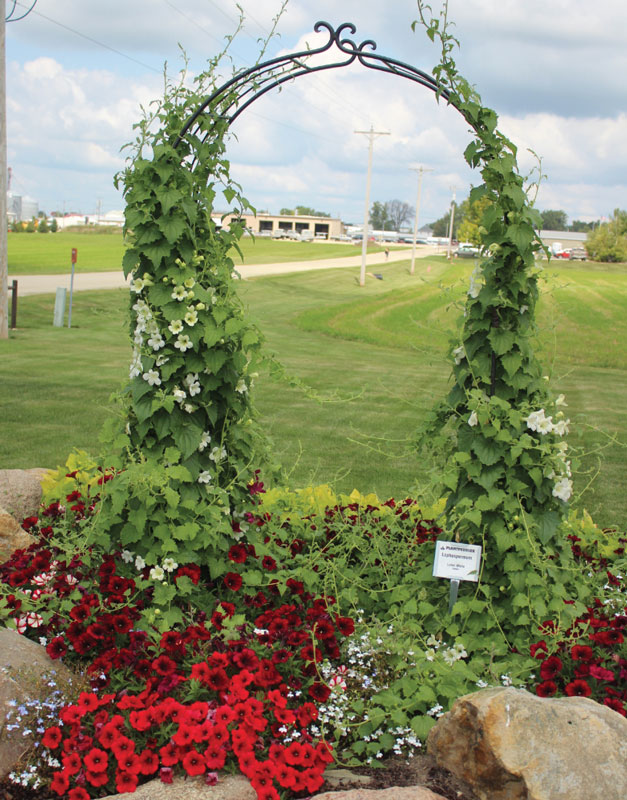 On the other hand, the standard long version finds its home in commercial landscaping where the venues are bigger, the vistas are wider and more fervent drama is required. Two-story atriums, an oversized lobby, second-story balconies at resort hotels, Main Street lamp posts, archways at entertainment parks and convention center plazas—we’re talking big pieces for big places. Plus, you can deliver it all in a truck.
Left: Vines of Lofos Wine Red and Lofos White have no trouble reaching the top.
Garden centers who pride themselves on creativity will be interested in Lofos’ ability as a crafting plant. It either climbs or trails, depending on how it’s trained. Long stems branch off to weave a canvas of green and the base of the vine becomes woody with age so the final product holds its shape. If you look, you’ll find interesting examples of Lofos climbing up, trailing down and even twisting into a topiary (which kinda looks like Cousin Itt from “The Addams Family”).
Growing it out
Lofos is a pretty quick crop to grow—about 10 weeks and you’re out the door with a 12-in. hanger. Dominik Neisser (Vivero Internacional) points out that it needs a certain volume of leaf structure for the plant to flower. Lofos grows best in a big pot with a trellis or a basket with enough space around it to expand. The plant starts to flower after night temperatures reach over 70F (21C) and daylight length exceeds 13 hours. Once the plant starts growing fast, it needs a high dosage of 15-5-15. Rates should be on the high side (350-plus ppm N) to keep the foliage dark green.
A source for both liners and finished baskets, Doug Cole (D.S. Cole Growers, Loudon, New Hampshire) stresses the importance of grooming with Lofos. He recommends pinching before the baskets are hung, then at least once again afterward. Cut the vines to the bottom of the pot, then give it another trim a few weeks later. At that time you’ll be trimming to encourage and maintain an attractive appearance. Each shear should occur after the last point of pinching and, of course, no PGRs. The length is the point with this crop.
Suntory (the breeder) does note that Lofos exhibits regional behavior. It can handle full July sun in Michigan, but needs some shade protection when spending July in Miami. GT
Lowell Halvorson is a consultant and writer in Fairfield, Connecticut, for retail and wholesale horticulture, specializing in business development. He also covers the breeding community for GrowerTalks magazine. You can contact him at (203) 257-9345 or halvorson@triadicon.com.