6/30/2026
A Shot in the Dark
Jennifer Zurko

You’ve probably heard about Firefly, the petunia that glows in the dark.
But it’s more complicated than just a petunia. And so is the story of how it came to be.
It’s about the collaboration and partnership it takes to get a completely unique product through an unprecedented breeding program and into a market that’s skeptical and a bit stubborn. Mix that with the fact that the product doesn’t meet the industry’s typical standards and you’ve got a rather steep hill to climb.
But Susie Raker, Jim Devereux and Casey Stanton were willing to climb that hill—not just to fulfill personal goals, but to show the industry that we can put the work in to create something really cool and unique. And that it’s okay to take risks … even if you think you may fail.
The first phase of Firefly
Dr. Keith Wood began his career in the 1980s at the start of what is now the modern molecular biology field. Early on, he became interested in the concept of bioluminescence and how it could be used in genetic engineering. He started by isolating the specific bioluminescent gene that makes fireflies light up, learning how it worked and testing it with different organisms. One of the test subjects was a tobacco plant, which Keith and his team were able to genetically adjust to make it glow.
The findings were extraordinary and they sent information out to the press showing the plant side-by-side next to a firefly.
At the time, there was a lot of excitement about this new technology—the breakthrough was on the cover of Time magazine and Johnny Carson even mentioned it on his show.
But the results were so-so. Yes, it did glow, but it was very dim and it only lasted for a short period of time.
“The concept was there, but the practical feasibility was still lacking,” explained Keith.
The project was shelved, but Keith continued to build a career around being an expert on using bioluminescence in other products for the pharmaceutical industry and in research laboratories. Over the years, he made a name for himself in the life science field.
Then a colleague reached out to say that a new bioluminescence pathway had been discovered in luminous mushrooms and that there were certain biochemical features within the mushrooms’ system that looked compatible with plant metabolism.
 “We thought that this long-standing desire to make luminescent plants could actually be realized with this new technology,” said Keith.
Soon after, Keith and his colleague joined forces, where they continued to work with the technology, experimenting and trialing. A few years later, they created their company, Light Bio, in 2019.
Left: Casey Stanton (left) and Susie Raker of Rooted inSolutions with Firefly (as it looks in the daytime).
“Even when we had the concept, even though we understood where the science was going, it took us a long time to actually create something that was going to get to the market,” said Keith.
Over his decades-long career, Keith has worked with many bioluminescent organisms—not just fireflies, but deep-sea shrimp, jellyfish and others. All of their systems were different, so it was difficult to incorporate their bioluminescent genes into a plant. But when those mushrooms were identified, it was the much-needed breakthrough they were looking for. They needed something with a similar metabolism and gene makeup as a plant.
Light Bio scientists experimented with a bunch of different plants during the second phase of the process, but the only one they still had the most success with were tobacco plants. But who needs or wants glow-in-the-dark tobacco? The closest relative to tobacco is the petunia, so Keith and his team started trialing with an open-patent variety and they were seeing some very positive results. They continued to work on perfecting the strength of the bioluminescence in the petunia, but they knew they needed other experts to help them get it into the right market if they wanted to eventually get it into homeowner’s hands.
“We’re really good at getting the genes into the plants, but we’re not expert breeders,” said Keith. “So we had a choice from a commercial point of view of trying to hire breeders and develop that part of the company or we go out to breeders who are already well-established, who already know their art, and see if they would have an enthusiasm for doing something new and exciting for the industry.”
 Keith reached out to the R&D folks at Ball Horticultural Company to gauge their interest and to get a crash course into how the breeding and supply chain process works in our industry. At the time, Ball wasn’t ready to take on the project, but they knew someone who might.
Taking a chance
Susie Raker, president of Raker-Roberta’s in Litchfield, Michigan, remembers when Keith and representatives from Ball came to show her this new bioluminescent petunia. It was the fall of 2023, right after USDA concluded the modified petunia was not subject to regulation.
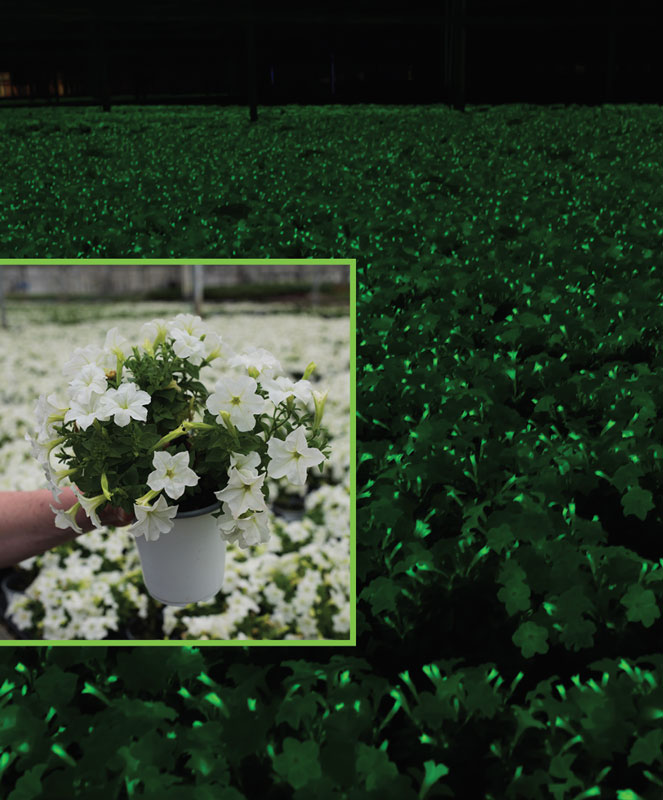
Background: Firefly in the greenhouse at night. Foreground: How Firefly looks during the day.
“Well, first off, he comes in with, like, eight of the ugliest petunias I’ve ever seen,” said Susie, with a smile. “Then he said, ‘These glow in the dark,’ and Casey and I just looked at each other. I thought it was neat. I thought was interesting. But I really didn’t think much about it.”
Casey Stanton is the Production Manager at Raker-Roberta’s, and he and Susie have been working together for years. He also had dubious feelings about this weird new plant. But Keith’s ask was small: Can Raker-Roberta’s help them create an online sales program? They already do a robust online business with QVC, so it wouldn’t be too difficult to pull off.
Susie and Casey agreed to produce a small amount at first—30,000 units in 4-in. pots sold through Light Bio’s website for a price point of $39.99. They sold out within two weeks.
They then doubled their production, increasing their stock while learning the characteristics of the plant (more on that in a bit). As they continued to sell out, they continued to increase, selling 110,000 units of Firefly plants through Spring 2024.
“We have success and then all of a sudden my wheels start turning and I’m like, all right, we took a risk with this—how can I protect Raker and make sure that I’m a part of this game moving forward?” said Susie.
She approached Keith with multiple options and a question: Where do you want this to go? He could license it out, sit back and collect the royalties. He could sell the genetics to Firefly. Then Keith turned it around on Susie and asked her what she thought.
“I didn’t know it at the time, but I realized he was interviewing me,” said Susie. “I said, well, it’s a very different product and it deserves a market solution that’s different than what’s been done.”
So Susie and Casey, along with Jim Devereux from Green Fuse, created a company they call Rooted in Solutions that’s completely separate from their regular businesses to help support the initiatives with Firefly. Light Bio developed and owns the bioluminescent technology and Firefly Petunia platform. Rooted In Solutions supports wholesale distribution, grower coordination and commercial market development through authorized channels. It’s a true collaboration, with Susie handling the sales side, Casey working on production and Jim continuing to improve the plants with a special breeding program.
Having a separate company allows them to do things differently and have the luxury of taking more risks with their decision-making. Case in point, Firefly entered the market as a first-generation category-creating product. The glow was the breakthrough—the next challenge was building the horticultural platform around it.
They got a few growers that Susie is close to (Wenke in Michigan and Moss in Idaho) to help them with production and to service some of the independent garden centers willing to take the risk.
“We developed this network and they have been great partners,” Susie explained. “They understand what we’re trying to do and they are, for the most part, true partners. They’re willing to work through the production issues that come with this plant. And we had a pretty decent season. We sold four times as many as we sold the first year.”
Then Jim told Susie that Home Depot got wind of Firefly and was interested, so they all thought, why not? Susie said they were upfront about how the plant performs and Home Depot grower partners are helping to develop the production playbook needed for this first-of-its-kind crop. This spring, it was in about two-thirds of the Home Depot stores across the country.
“We have been non-stop sprinting since we started,” said Susie.
It’s not just a petunia
Susie and Casey mentioned that when they first saw Firefly, they were less than impressed. The habit wasn’t like modern petunias and they learned very quickly that it didn’t act like the petunias they’ve been used to growing in production. So to their grower partners, Home Depot and the IGCs they were selling to, they had to be very honest about what they were getting themselves into. Communicating this has been a bit of a challenge.
“There are some insufficiencies with Firefly; it’s not your traditional commercial petunia,” said Susie. “You really need to monitor your pH and EC and you shouldn’t plant it in a wood-based media.”
Although getting people to change their mindset when they’re growing Firefly has been difficult, it’s just one of the hurdles Rooted in Solutions has had to overcome as they’ve been bringing it to market.
“It’s a generation one product and it’s built on the chassis of an early ’90s petunia,” said Susie. “Petunia breeding has come a long way since then, so for me, obviously, because I am a grower at the core of who I am, I was worried about commercial viability.”
That’s why she needed someone who was a veteran plant breeder to help improve the overall plant, but who also wasn’t afraid to take risks. So she sent Jim a box of what he thought were pretty gnarly petunias. But when he saw what they could do, he was in. Susie introduced him to Keith and they started talking about the science behind Firefly.
There’s been a huge learning curve with Firefly, both with breeding and production. And Jim has had to shift his typical approach to the breeding techniques he’s been used to for decades to something completely different. So he learned that Firefly and its relations are happiest propagated as unrooted cuttings and he’s working on developing the mother stock at his facility in California.
“This is the hardest breeding program I’ve ever done,” stated Jim. “I do all my breeding in the dark.”
Although the way to get the bioluminescence into the plant has been established, the transference is very small. In large trials, only a small fraction meet both the criteria for strong, stable bioluminescence and commercial-quality plant habit.
So that’s the first hurdle—the next is once you do get one that glows, you want it to last the life of the plant. Strong bioluminescence can influence plant vigor, so the breeding challenge is selecting plants that balance luminosity with robust plant quality. Jim is constantly working toward finding a balance between stable bioluminescence and a good plant.
“Normally, I can breed a petunia and know that after six weeks in a pot I know what the plant’s going to do six months from there out of all my selections in the greenhouse,” said Jim. “[With Firefly], I’m holding them from six, eight, nine months to make sure the bioluminescence maintains. It’s a labor of love.”
Which is why Jim is doing this. He thinks the concept is really cool. Plus, it’s a new challenge, doing something he’s never done before.
“For our real first year in commercialized sales, we learned a lot, but we also saw how excited a lot of the people are to get their hands on it,” said Jim. “While we have a lot of great possibilities, we also have a bunch of bumps and hurdles to get everyone on board. We’re trying to sell an expensive glow-in-the-dark petunia during the day.”
Sure, the team at Rooted in Solutions would like the overall plant to be better—they want it to look good and grow well. But that’s not really the point. The goal of Firefly is not to make it look and act like other petunias—the goal is to make it glow so bright that it knocks your socks off.
“We as a horticultural community know what petunias are supposed to do. So when this one doesn’t respond the way a petunia responds, we get all in a tizzy about it,” said Jim. “We say it’s a poor product. But if we look at it as a bioluminescent plant, it will rock your world every time.”
The future of Firefly
And that’s what the Rooted in Solutions team wants for Firefly—to open the door to create a whole new category of ornamental plants. So their wish is that, within 20 years, we’ll have annuals, perennials, foliage/tropicals, shrubs, trees … and bioluminescent plants.
And that may not be so far-fetched a wish. The breeding for Firefly has been in warp speed since the original was introduced with a new pink and two bi-color varieties under the Firefly umbrella already on the market. And they continue to work on introducing new varieties, while conducting breeding trials on other genera.
“Breeding takes time. Light Bio is starting from a new point and it’s going to take time to catch up,” said Keith. “But what you’re seeing is that every year the quality of the plants is getting better. We’re bringing more colors. We’re bringing more growth habits. We’re bringing in more robust, reliable performance.”
As any researcher who’s experimented and trialed something they’ve never done before knows, there are as many failures as there are successes. For the Rooted in Solutions team, they’ve jumped into this initiative with both feet and their eyes wide open. And they take the approach that even if Firefly isn’t successful in one market, it doesn’t mean that it’s a complete failure. Having the flexibility to pivot with a completely new, untested product allows them to cross off what doesn’t work and move on to the next thing. In this case, the small wins are counted with extra points.
“We’ve tripled to quadrupled sales every single year since we have been here,” said Susie. “The fact that we continue to grow tells me that there is interest in this. I try not to compare this to anything because it’s not like anything else, either. So it’s okay to have some mistakes as long as we have more wins than losses.”
Jim said that they’re going to continue working on the breeding, with the objective of creating a full line of garden plants, along with a line of houseplants, too. That’s the plan, and the goals are lofty. So it’s a good thing that Susie, Casey and Jim are passionate, motivated and a little stubborn—they all need to be on the same page to make collaborating on this crazy project work.
“I’m always asking Jim and Casey questions like, ‘Are we stupid? Like, is this real? Are we gonna make it?’” said Susie. “And we always come back to the same answer. This is hands down the coolest thing the three of us have ever seen. So it’s worth fighting for and it’s worth working for.” GT