6/1/2026
Managing Your Environment
Erik S. Runkle
One of the most critical decisions in the production of greenhouse crops is determining at what temperature(s) to grow your crops. The day and night temperature, and its average over time, influences crop timing, height and quality. Greenhouse temperature also influences energy costs for heating, as well as the amount of water vapor that air can hold, which affects humidity.
Average daily temperature (ADT)
Temperature is the primary factor that controls the rate of plant growth, and thus, crop timing. If plants are ahead of schedule, decreasing the 24-hour average ADT can slow down growth. Conversely, increasing the ADT can accelerate crop development and decrease production time ... to an extent.
All plants have a base temperature (Tbase) and an optimum temperature (Topt). Tbase is a relatively low temperature (32 to 52F/0 to 11C for most floriculture crops) at or below which plants don’t develop. In contrast, Topt is the temperature at which a crop develops as fast as possible, assuming other conditions aren’t limiting. The Topt also varies from one crop to another and typically ranges from 65 to 85F (18 to 29C). In most cases, growers should deliver temperatures above the Tbase and below the Topt for the crops grown.
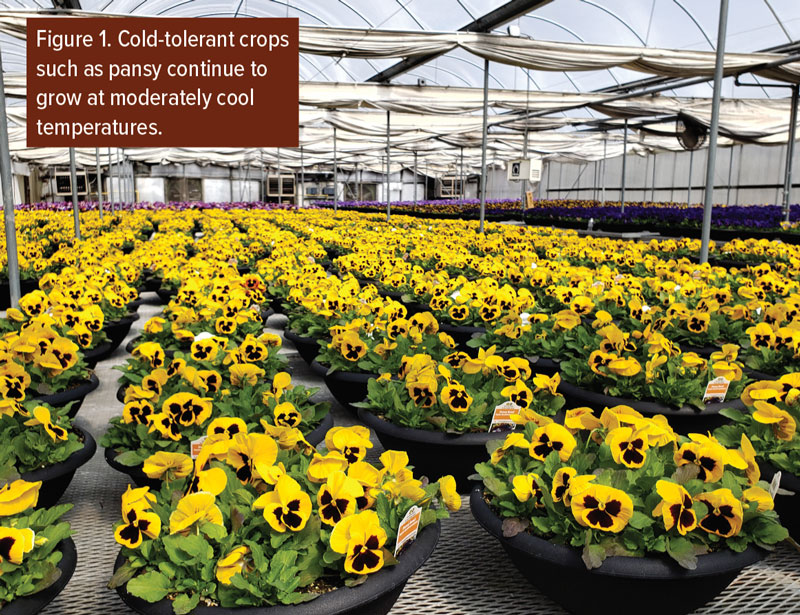
We define cold-tolerant crops as those with a Tbase of 39F (3C) or lower. This includes alyssum, calendula, cosmos, dianthus, diascia, heliotrope, marigold, nemesia, osteospermum, pansy, petunia, snapdragon and verbena (Figure 1). In addition to these bedding plants, several flowering potted crops are cold tolerant, including cineraria, cyclamen, primula and regal geranium.
At the other end of the temperature spectrum are cold-sensitive crops, which are those with a Tbase of at least 46F (7C). Examples of cold-sensitive bedding plant crops include angelonia, blue salvia, browallia, celosia, gerbera, globe amaranth, hibiscus, pentas, portulaca, torenia, vinca and zinnia. Noteworthy potted flowering plants (African violet, phalaenopsis orchid and poinsettia) and vegetables/herbs (basil, pepper and tomato) are also cold-sensitive crops. Decreasing the ADT will increase production time of all crops, but will have a larger effect on cold-sensitive crops than cold-tolerant ones.
DIF (day/night temperature)
The “DIFerence” between the day and night temperature influences elongation growth of many floriculture crops. A positive DIF (+DIF) exists when the day temperature is warmer than the night and generally this promotes the elongation of stems, making plants taller. In contrast, a cooler day than night creates a negative DIF (–DIF), which suppresses extension growth and creates more compact plants. Responses increase as the magnitude of DIF increases. For example, plants will be more compact at a –10F (-23C) DIF than at a –5F (-20C) DIF.
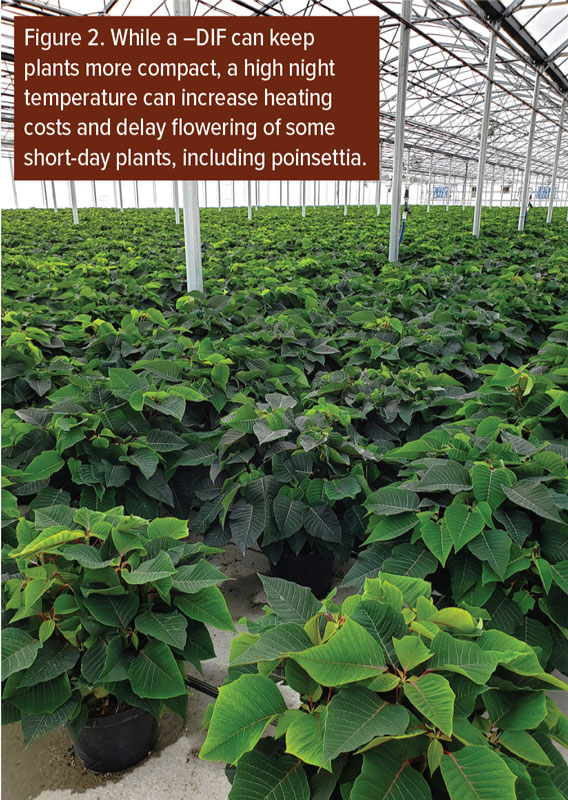 Some commercial growers, particularly in northern latitudes, use –DIF as a method to control plant height. However, decreasing the day temperature without an offsetting higher night temperature decreases the ADT, which increases production time. A high night temperature (such as 73F/22C or higher) can also delay flowering of some floriculture crops, especially short-day plants such as chrysanthemum and poinsettia (Figure 2).
Finally, a warmer night temperature increases plant respiration, or the burning of sugars generated through photosynthesis, which can negatively influence overall plant growth. Therefore, consider how the day and night temperature contribute to ADT, DIF and potential consequences of –DIF.
Temperature and heating costs
While a –DIF can decrease the use of plant growth regulators, it typically also increases heating costs. Heating a greenhouse is most expensive at night, therefore, elevating nighttime temperatures to achieve a –DIF usually increases fuel consumption. Some back-of-the-envelope calculations indicate that, compared with no DIF (day and night temperature is the same), a –10F (-23C) DIF in the spring can increase heating costs by 5% to 19% in Michigan and by 9% to 26% in North Carolina.
On a daily basis, growing crops at a relatively low ADT decreases greenhouse heating costs. However, a low ADT also increases crop production time. In some cases, heating costs on a per-crop-basis are higher when grown cool than if crops were grown warmer for a shorter period of time. Growing cooler and longer also translates into higher overhead costs for the crop (i.e., the number of “square foot weeks” increases). The dynamics between crop timing and heating costs are very situational and depend on the crop, time of year and location.
Temperature & humidity
As temperature decreases, the amount of water vapor that the air can hold also decreases. Thus, cool nights and low ADTs can result in high humidity (low vapor-pressure deficit). When the humidity gets too high, uptake of water and nutrients such as calcium and boron is slowed, which can suppress growth. Condensation can also occur on the greenhouse glazing, which decreases light transmission and causes dripping onto crops below.
In addition, high humidity can increase the pressure of some plant pathogens, such as fungi, water molds and some bacteria. Therefore, be mindful of the effect of lowering the temperature on humidity.
 Temperature & greenhouse shading
Except for shade crops, the primary reason we use shade curtains or whitewash is to help manage the greenhouse temperature during periods of intense sunlight. In many cases, decreasing sunlight by 40% to 50% is sufficient to mitigate temperature rise in a greenhouse while still giving crops enough light to maintain crop quality.
Temperature & crop quality
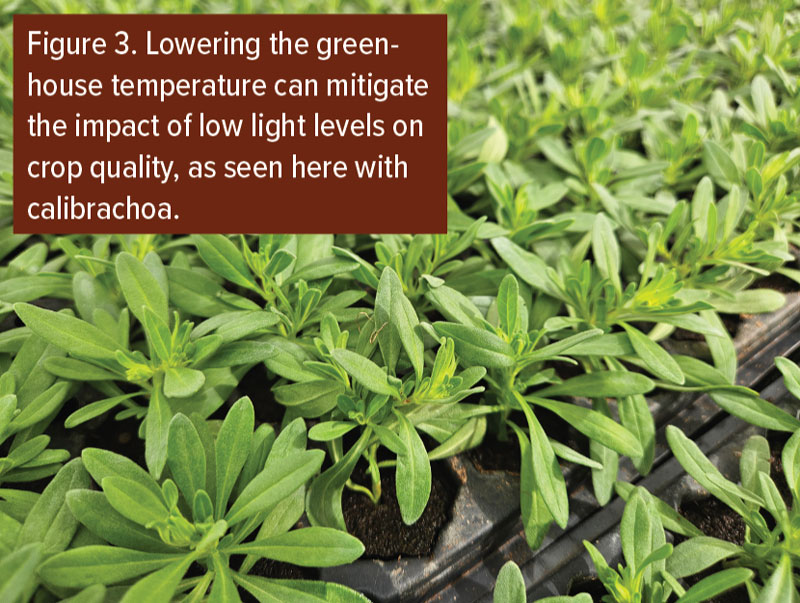
ADT and the average daily light integral (DLI) interact to regulate crop quality. The highest-quality crops are usually grown under high light at a relatively cool temperature. When the DLI is low (such as less than 10-12 mol∙m–2∙d–1), crop quality can be maintained by decreasing the greenhouse temperature (Figure 3). Of course, this also lengthens production time.
Ideally, the greenhouse ADT should be partly based on the average DLI. Crops can be grown warmer when the DLI is high and cooler when light is limiting. A sophisticated greenhouse environmental control system can integrate both environmental parameters to determine the production temperature. However, when light levels are low for a prolonged period of time, the low ADT will increase production time. GT
Erik Runkle is Professor and Floriculture Extension Specialist in the Department of Horticulture at Michigan State University. He can be reached by at runkleer@msu.edu.