6/1/2026
History of Growing Media in North America: 2000-2025
Dr. Brian E. Jackson
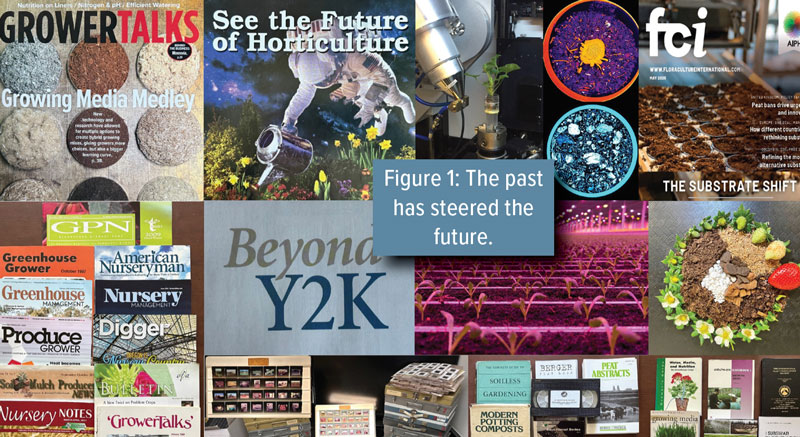
The 21st century welcomed us without realization of the dreaded fears of Y2K and ushered in a period of unparalleled advancements in technology, science, automation, digitization and artificial intelligence.
The horticulture industry evolved with these innovations, while also embracing a changing customer demographic (Millennials) by rebranding and transforming the way plants are grown, marketed and used. Resources used for the basis of this history series are evidence as to how news and media platforms have changed over the past century—from black-and-white print to 35-mm slides and projector carousels, and from the earliest books on growing media to the most current print and digitized releases (Figure 1). Growing media companies once offered technical support and product marketing pitches via VHS tapes (“Be Kind, Please Rewind!”), CDs and DVDs before the current use of websites, podcasts and YouTube videos. The most longstanding, impactful and direct dissemination of industry news, events and educational content was (and still is) delivered via the numerous trade magazines representing every aspect of the horticultural production industry.
The past 25 years has also seen many significant events that have changed horticulture and the public’s view/awareness of it:
■ The founding of Seed Your Future (2014), an initiative promoting horticulture and its many career opportunities
■ The legalization of cannabis across much of the U.S.
■ A pandemic that changed us all and exposed supply chain vulnerabilities
■ Consequences of geopolitics on policy decisions
■ Tariffs and regulatory threats, including BCAP (2008), which directly threatened the growing media industry
■ The rise of plant factories (vertical farms)
■ A shift of field-grown fruits to soilless production
■ New technologies (sensors, robotics, AI) to enhance plant science and substrate research
■ Broader publicity of growing media in the public spotlight helped reshaped how many people thought about substrates and their value (Figure 1).
This time period also saw the unfortunate ending of American Nurseryman Magazine (1904–2018) and the Southeast Greenhouse Conference, as well as the Southern Nursery Association (SNA) trade show and annual research conference. In 2012, the American Nursery & Landscape Association (ANLA) and OFA merged to form AmericanHort (2014)—an organization that continues as a major advocate for the horticulture production industry today in conjunction with the Horticultural Research Institute (HRI).
The growing media industry in North America today is as diverse and strong as at any point in our past. Hundreds of companies producing and selling hundreds of growing media products from coast-to-coast have (and are) continuing to evolve, innovate and respond to the ever-changing industry landscape.
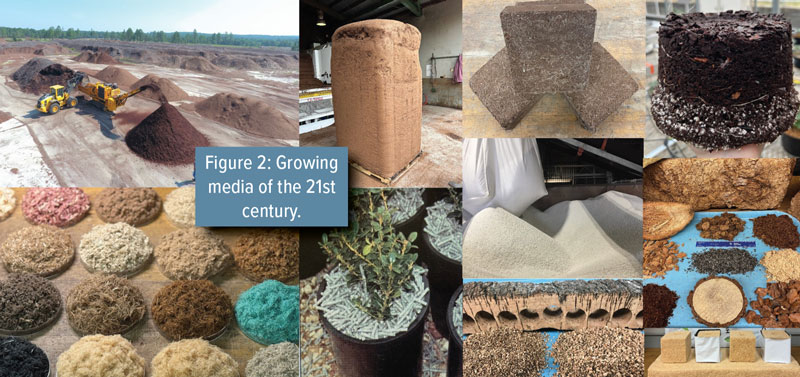 Research on engineered wood substrates resumed in the early 2000s (Virginia Tech and Auburn Universities) after first being investigated in the 1980s. Emphasis was placed on loblolly pine (Pinus taeda) as the main species of interest due to its widespread availability across the southern U.S., but many other species were also trialed. Researchers utilized hammer mills to create these wood products—a technology that some growers across the country adopted themselves to make their own substrates.
Over the past 15 years, the number of commercialized wood products produced in North America has increased from one to nearly 10, not including the wood products sourced and used by growers from sawmills. Globally, the number of commercial wood products exceeds 50 with over 120 processing facilities worldwide (Figure 2). Wood fiber has been blended with coir and compressed into blocks, sold as a pure product in compressed bales, and formulated into slabs and blocks for greenhouse and hydroponic crops. Beyond wood, bark products remain a critical substrate used in nursery, greenhouse and retail mixes, as have coconut coir materials.
Despite many peat alternatives being developed and adopted, peat moss remains the predominate material used across the industry. Peat is often, rightfully so, referred to as the “great enabler,” as its inclusion in any non-peat material improves the properties, function and usability of the mix. Similarly, perlite remains a key component in substrates across the plant production spectrum. The practice of layering different substrate materials (or particle sizes) in containers, referred to as stratification, gained momentum as an approach to improving water and nutrient distribution in nursery crop containers. The practice has gained substantially more interest as an effective approach to reducing peat-based substrates by filling some portion of the bottom of containers with a cheaper material (Figure 2).
The past decades also saw an increased focus on understanding microbiology in substrates, practical efforts to reuse and recycle growing media, the use of container coverings (mulches) to improve water retention, and an acute awareness of the sustainability and renewability of substrates, with a particular interest in increasing domestic production of these materials.
Some other substrate materials developed in, or introduced to, the U.S. market included Pittmoss (recycled paper), Teamoss (spent tea biomass), banana fiber, PalmPeat (from palm residues) cork granules, miscanthus and switchgrass, seaweed, distilled cedar, hemp hurd, cotton and corn stalks, wulpak, hydrocks, calcined clays, shells and husks (hazelnut, almond, pistachio, peanut, pecan, etc.), and a litany of biological additives, biochar and activated carbon products.
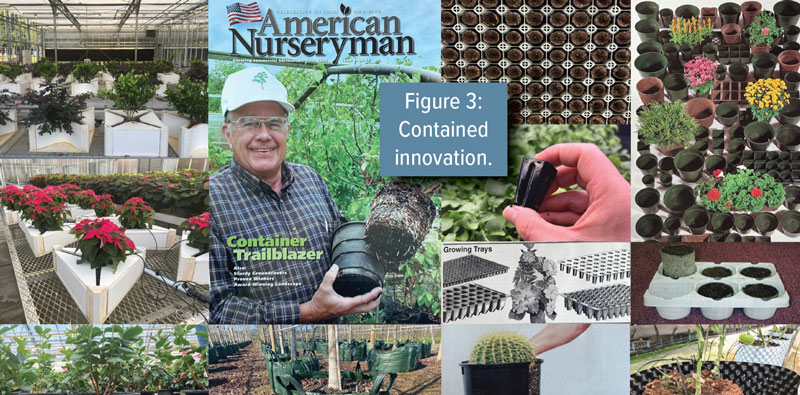 Planting containers continued to rapidly evolve through the first quarter century with new types, designs and functions: zipper pots (unzip to free the plant), spin-out pots, air containers and trays, knit fabric bags, injection molded configurations, and numerous other designs (Figure 3), many of which aimed to enhance and control root growth and development.
Dr. Carl Whitcomb, a former professor at Oklahoma State University and founder of Lacebark Inc., created, tested and promoted dozens of container designs, including RootMaker, RootTrapper and RootBuilder.
Ellepots, introduced in the 1990s were (and remain) very popular products that helped standardize young plant production.
Several prototype containers were designed as research tools to observe and study plant root growth in nondestructive ways. Among them, the Rhizometer, Horhizotron and Mini-horhizotron were developed by scientists at Virginia Tech, Auburn and NC State with applications for studying and improving root development in greenhouse and nursery crops.
One of the newest substrate innovations developed and introduced to the North American market in 2025 was Jiffy Gel, a bio-based and biodegradable gel (black plug in Figure 3) that’s purchased as a powder, homogenized in a reactor onsite at the grower’s operation and then cured (allowed to take shape) in whatever tray cell size desired. Many other propagation products gained attraction across the industry included Selecta’s RCS 2.0 (paper bags), GrowCoons and Fytocell, among nearly 50 others.
“Necessity is the mother of invention”—this age-old phrase probably best describes the many catalysts over the last century that led to our current plant production technologies. That and the growing belief by many—as I’ve heard quoted by the VanWingerden family, “If you aren’t automating, you’re stagnating”—encapsulates the rationale behind our current pursuit of innovations that will undoubtedly steer the future of the horticulture industry over the next century. Our industry’s history is not only worth celebrating, but it should also be respected. After all, the past is our only real guide to the future. GT
Dr. Brian E. Jackson is a Professor and Director of the Horticultural Substrates Laboratory at North Carolina State University. He can be reached at Brian_Jackson@ncsu.edu.