6/1/2026
Redefining Phlox
Chris Fifo
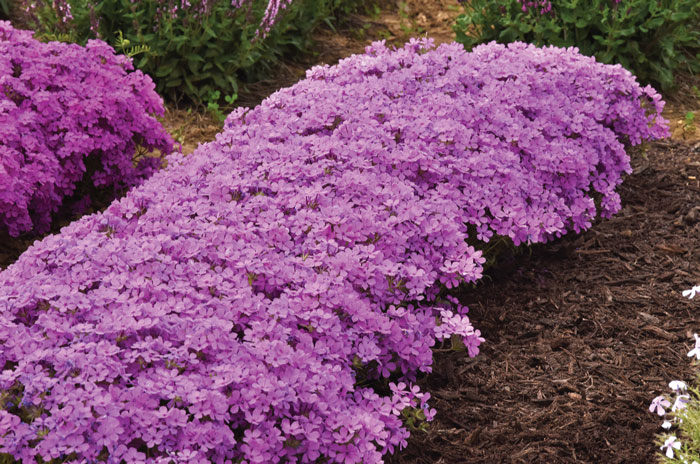
This spring seemed much cooler than normal for us here in Chicagoland. We didn’t really have any late freezes or anything; Mother Nature just seemed to take her own sweet time to warm up. I’m not complaining, though. The heat will no doubt set in quickly.
Phlox Candy Cloud Pink
One bonus for the cool spring is that those early spring-flowering perennials enjoyed a longer flowering period. Not only did we get to enjoy our creeping phlox in the landscape longer, but it also made it easier for growers to hit the market in full flower. Too often, it warms up too quickly and blows these crops out of color before the foot traffic really gets going at retail.
To combat this, growers sometimes move their Phlox subulata outdoors or apply PGRs to try to slow the flower fade. Unfortunately, these are just temporary, and not real, solutions.
This is when we call on the breeders for a solution. And their creativity has delivered!
Enter Phlox Candy Cloud. This hybrid mounding phlox dispels many of the challenging attributes of the old creeping phlox types:
- Flowers later
- Flowers longer
- Grows quickly in containers
- Highly mildew and leaf spot resistant
- Attractive glossy green foliage throughout summer.
Phlox Candy Cloud is Zone 4 hardy (Zone 3 trials pending) and comes in four colors, each of which has its own distinctive characteristics, which makes it more of a collection than a true series.
- Pink and Dark Pink are the most compact at 12 to 14 in.
- Blue is a bit taller and is the only one that’s fragrant. It can be cut back for re-flowering.
- Lavender is the tallest at 16 to 18 in. and is strongly fall flowering, as well.
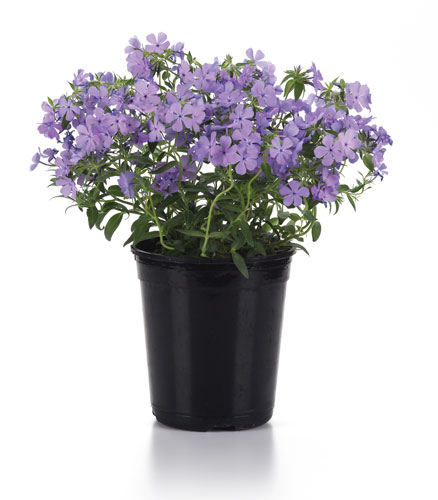 One of the keys to success with Candy Cloud is in the species the breeders are working with. Though they won’t tell me exactly what’s in there, I do know there’s some P. stolonifera in it from its foliage, habit and timing.
Right: Phlox Candy Cloud Blue
The other key to Candy Cloud’s success is its ease of growing. These are a no-brainer for both propagation and finishing.
A primary factor to keep in mind with Candy Cloud is that vernalization is recommended. Though we do see strong first-year flowering performance (to the point where we may add this to Firstyearfloweringtool.com with more data), we do recommend fall planting into finished containers.
Another option that works well would be a spring plant from a vernalized liner. This doesn’t work well for some early spring species because they go right to flower before they put body on the plant. But Candy Cloud grows as it flowers so it’ll still fill a gallon container from a dormant 50 plug or larger.
Propagation
Candy Cloud can be rooted in anything from a 128 or larger liner size. Use standard best practices, including an IBA treatment. Since cold treatment is recommended, propagation occurs in the summer heat. Avoid excess water in the media and rooting should be easy (compared to P. subulata). If you do struggle with summer propagation, callused cuttings are available, which can reduce time and increase success.
Candy Cloud grows relatively fast and isn’t a heavy feeder, which is a huge benefit over P. subulata. Pinch once in the liner (or twice if you prefer) and liners will be ready for transplant in six weeks from a 128 or eight weeks for a 50 cell.
 Growing on
After the pinch(es) in the liner, no additional pinches will be needed. Candy Cloud branches and fills out containers very well.
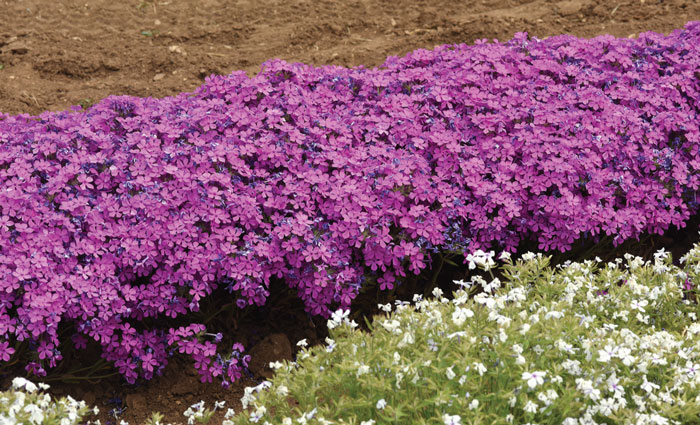
Left: Phlox Candy Cloud Dark Blue
As for container size, I’ve been seeing a single plug fill out 2-gal. containers with proper scheduling. These are a bit large for quart pots, but it can be done with the most compact colors.
As mentioned before, this type of phlox grows and fills out much quicker than creeping phlox, so you don’t need most of the summer to get them to fill out. A standard gallon pot will fill out in eight weeks and a 2 gal. in about 10 weeks under full sun conditions.
Regular feeding with 150 ppm of a well-balanced fertilizer works well (personally, I like 17-5-17). Controlled-release fertilizer is also a good option. But, as always, read your plant; it’ll tell you if it’s hungry. The goal will be to cover the pot and no more. The main thing will be to avoid overly soft and lush growth, which will lead to trimming in the fall.
 Scheduling
What’s great about Candy Cloud is that it can be planted after the bulk of the summer heat has passed. As I mentioned before, these are showing a strong will to be first-year flowering. Case in point: A Miami grower transplanted Week 44 and had them flowering in January.
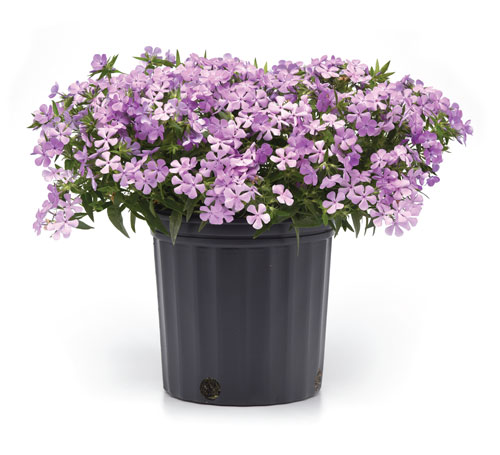
Right: Phlox Candy Cloud Lavender
With this in mind, scheduling and overwintering conditions need to be considered together. For Northern growers who can get a true cold treatment, I’d be transplanting gallons early to mid-September. Again, a little longer for 2 gal. and a little less for quarts. By early November, containers will be full and ready for chilling.
Candy Cloud will be evergreen through the vernalization period, so it’ll be important to keep them as cold as possible (just above freezing) to keep them from continuing to slowly grow and think about flowering too early. With this scheduling, we see retail readiness around Week 17/18.
If you don’t expect to be able to keep them cold, I would push the scheduling back by up to four weeks. Even four weeks at 50F (10C) is enough to achieve full flowering—timing of which will be a factor of temperature and likely earlier than Week 18.
For Southern growers and outdoor production, transplant Candy Cloud at a time when you’ll still get several weeks of warmer temperatures to get rooted in. (Maybe mid to late November?) Once rooted out, the cooler nights and warmer days will provide the slow growth and progression to flowering.
Timing these for your particular region will take a little fine tuning. If it’s unusually warm or these are greenhouse grown, you’ll be able to transplant mid- to late December and still get enough cooling for retail readiness roughly 12 weeks after transplant.
Now, what to do if Candy Cloud begins to flower too early? Keep them cold and let them go! Candy Cloud flowers and remains retail-ready in containers for a minimum of six weeks (eights weeks for landscape) without getting overgrown or tired looking.
I’ve found that Blue and Lavender can benefit from a Sumagic spray at flower development, and maybe the pinks when grown under cover. And I should note that Blue, in particular, can be cut back over and over and re-flowered.
The spring perennial market is always going to need creeping phlox early. But now you can extend the phlox season with Candy Cloud on the benches well into May and Mother’s Day. GT
Chris Fifo is a Product Representative for Darwin Perennials.