6/1/2026
The Strategies Behind Fall IPM
Lowell Halvorson
Phil Gerry walks a field of mums one hot August morning in New Hampshire. The crop stretches for an acre and a half, one of several he‘s walked already. Everything looks good.
“There’s a point in the game where you switch your strategies,” said Phil. He’s the Northeast Ornamental IPM Consultant for Koppert, the global biologicals company, and he’s checking in with one of his clients.
For mums, it’s staging, he explained. When mums are pot tight, all the plants touch. That’s when you broadcast bottles of predatory mites like Swirski-Mite (Amblyseius swirskii) over the top of the crop. No gaps exist between the plants, so every predator is in play. “It’s one of the best bangs for your buck,” he said.
Outside is different. On drip tape and emitters, chrysanthemums chew real estate. So much broadcasted material falls into the space between each pot; it makes no sense. Coverage falls outside the economic window. Winged predators like Thripor-I (Orius insidiosus) and Aphipar (Aphidius colemani) solves this problem.
“Now, the sheer volume of mums grown outside in acres and acres needs a thing with a wing. Something that can fly when released,” said Phil. Thripor-I flies from centralized distribution sites. Growers can cover large areas quickly without touching each plant. At the end of the field, Phil turns toward the office. The air game wins the day.
Planning the tune-up
Strategy begins before the game. For fall crops, discussions happen in April or May because growers start or receive their material by June.
“We go over the area, the volume they plan to grow, spacing and time,” said Phil. “Then we get strategies in place and line up the orders. If they are doing insecticides—a lot of growers do drenches as an extra layer of protection—then we make sure the compatibility and timing of the drenches line up.”
 Yearly tune-ups are common among IPM programs, even the long-running ones. Although fall crops have a very consistent market, there’s no consistence in growing them. Texas might focus tightly on spider mites, while New Hampshire deals with scheduled sprays for white rust. Growers with space constraints might be finishing calibrachoa baskets, as they root out their mum cuttings underneath. State regulations change, crops shift in popularity and timing protocols receive updates.
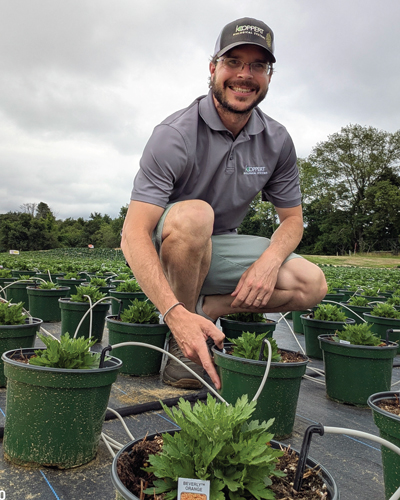
Phil Gerry of Koppert Biological Systems inspects field mums as part of a regular tune-up to catch anything unexpected.
Growers like to line up a biological supplier for both product and advice. They appreciate a willingness to walk the site, discuss the crop, view the fields, and provide the technical knowledge that can’t be poured out of a bottle. A good vendor does all that.
It sounds custom and it is. Early on, when sites first incorporate biologicals, more hand-holding occurs. Over the next couple of years, the routine becomes very predictable.
Hybrid strategies
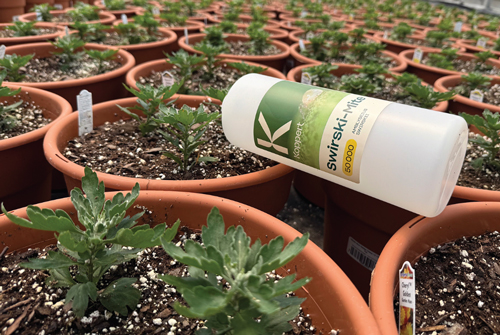
A hybrid mix of biological and pesticide controls is common among fall IPMs. Many of the softer chemicals aren’t chemicals, but products like entomopathogenic fungi (EPFs) such as Isarid (Isaria fumosorosea [strain FE 9901]). It’s a popular product for poinsettia growers because it’s easy to apply and very effective on whiteflies.
Strategically, Isarid is important because it saves the active ingredients for an emergency, according to Heidi Doering, National Ornamental IPM Specialist for Koppert.
 “Active ingredients have restrictions on application per crop cycle,” she said. “You don’t want to use them up before the crop is shipped.”
Heidi has a history of blending the two together, first as an independent grower, then as a technical product manager for Syngenta before moving to Koppert a decade ago.
For hot weather growing, Swirski-Mite attacks thrips, whiteflies and spider mites during summer growing while mums are still pot tight. Best bang for your buck.
Lay down a protective screen of biologicals. Anything that squeaks through, hit with pesticides out of your limited supply of chemical opportunities. By inundating them with beneficials in that early state when plants are pot tight, the cost for bios is lower because the footprint is smaller. The cost for pesticides also drops because you don’t have to fight so many pests later. It’s simple, straightforward and cost-effective.
The decision to grow indoors or outside has a major effect on planning. Whiteflies, for example, don’t plague outdoor chrysanthemums as much as they do poinsettias. Closed off in a house, poinsettia production more closely resembles sealed monoculture, where the grower provides every need and battles every mistake. Outdoor production covers a much larger area that’s not enclosed, so natural predators come in and help the IPM, as well.
Scouting above all
Scouting for everything is the most important aspect of fall IPM—not just for pests but for pathogens, nutritional deficiencies, early initiation or anything that might endanger retail quality.
 “If it’s too cold, the plant will start to flower and it won’t get up to size,” said Phil.
Scouting goes beyond crops in production to inherited material shipped from a supplier. Spider mites often ride in on material from outside sources.
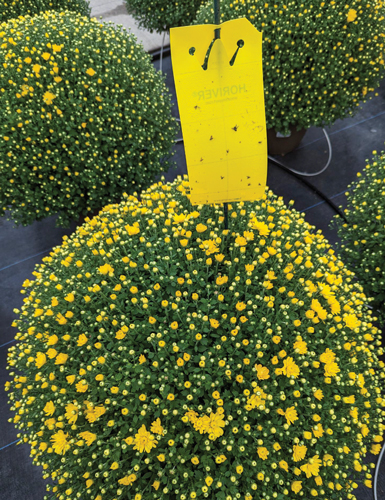
Horiver cards provide a visual record of pest pressure in the crop. Compare the cards week over week to detect trends.
“It can happen overnight with mums,” said Phil. “Something takes a hold and suddenly you have a whole bay of affected plants that are no longer saleable.”
Heidi agreed. “You have to be proactive with garden mums, scouting with hanging sticky cards and monitoring them weekly to know where you are,” she said. “Thrips can do a lot of damage to the flowers when the buds are very tiny. Thrips can infest the crop before the grower even notices they are there. By the time the flower opens, it has already been destroyed three or four weeks ago.”
Planning in advance and paying close attention through scouting pay off in the end. GT
Lowell Halvorson is a consultant and writer in Fairfield, Connecticut, for retail and wholesale horticulture, specializing in business development. He also covers the breeding community for GrowerTalks magazine. You can contact him at (203) 257-9345 or halvorson@triadicon.com.