6/1/2026
The Automaton Greenhouse
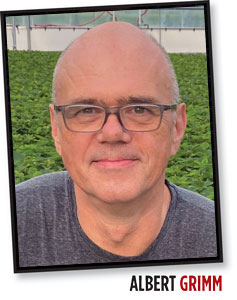
Albert Grimm
There’s a memorable line in one of Douglas Adams’ books: “These are machines that plant potatoes for you, they harvest potatoes for you and then they eat the potatoes for you, thus saving you the bother of doing any of this yourself.”
I’m reminded of these words as artificial intelligence gradually infiltrates farming. I certainly believe that advanced technology is beneficial, but I’m an old farmer, and work has always been an important part of my life. Being a farmer has defined how I lived my life. When intelligent machines are now being tasked with stipulating what it means to be a farmer, it feels as if they’re trying to do my living for me, too.
It’s hard to shake a sense of absurdity when our industry defines its operating mode predominantly around the needs of autonomous production. I wonder what this means for the perspectives of a generation that’s just entering our professional field. Automation will certainly make life easier for young growers, but what will it do to the sense of professional identity that is indispensable for success? What will be the incentive to adopt farming or horticulture as a lifestyle if machines dictate all aspects of what we do? My generation didn’t merely have to learn how to work on a farm; we had to learn how to BE a farmer. Our profession was rewarding exactly because we were required to make work a central part of our lives. What motivation could there be for newcomers to accept the necessary inconveniences when machines replace farmers with industrial employment structures?
I started out in agribusiness by growing vegetables in hot-bed frames. Those were low profile “greenhouses” covered with simple glass frames, and they were heated with composting sheep or horse manure that we dug in by hand below the root horizon. It was about as low tech as it gets, but we were satisfying customer demand with a wide variety of market garden vegetables and climate-adapted annuals, many of which you can no longer find on store shelves. During the 45 years since then, our industry has steadily embraced increasingly efficient automation. Mechanization has demanded rigorous streamlining of production and we’ve arrived at a point where practically all crops and all methods are tailored solely to the needs of automation and mass marketing. Crops must satisfy the needs of systems, rather than systems being tasked with catering to the needs of crops and consumers.
Let me explain with an example: The selection of vegetables that you find in a typical grocery store isn’t defined by what consumers might want to taste and eat. The spectrum of modern commercial produce genetics is determined by its potential for mechanized production and distribution, and the market is held to a paradigm that it may only demand what can be produced with systematic automation. Don’t get me wrong—I don’t object to mass production of food. But artificial intelligence will almost certainly become increasingly involved in autonomous farming and this will even further increase the pressure to streamline what we grow in our greenhouses.
It’s here where I do see opportunity and potential for young farmers and greenhouse growers. It’s difficult for entrepreneurial growers to compete on the stomping ground of automated mass production, but there are many crops—both ornamental and edible—that don’t lend themselves to robotized automation. The old low tech, low capital methods are still available. If autonomous systems require crops designed to suit their needs, I think that they’d struggle with crops that resist such adaptation.
Yes, we may have to revive some forgotten markets because young consumers don’t even know that these crops ever existed. Growers will certainly have to dig out old horticulture knowledge to produce them. In our time of total mechanization, however, such crops come with one advantage that shouldn’t be underestimated: For the foreseeable future, they’ll require the know-how, the physical skill and the passion that makes life as a grower such a worthwhile experience. GT
Albert Grimm is head grower for Jeffery’s Greenhouses in St. Catharines, Ontario, Canada.