4/30/2026
Fascinating Colors, Forms & Sizes
Wendy Komancheck
This article was almost called “Beyond the Red” for 2026 poinsettia trends, but I scratched that: Red is still a hot color for poinsettias.
Traditional reds still capture the consumer’s eye, as well as newer versions. For example, InBlume is introducing four new fashion reds for 2026.
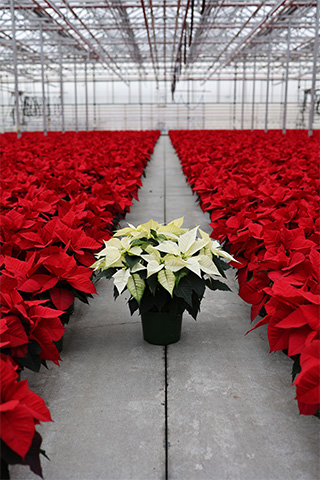
A whiter white among red poinsettias. Photo: Selecta One.
“Eighty-five percent of the market is still red,” said Rebecca Siemonsma, director of InBlume. “Our focus is always on reds that are grower friendly or solve a problem for the grower or retailer. We’re also working on whiter whites … there’s been feedback over the years from retailers and consumers that they would like a white that shows less green or tan—a white that maintains that bright white color under low light conditions or colder finishing.”
Tradition still stands
Traditional white and red poinsettias are the best sellers in retail. Other breeders have noticed the demand for reds and whiter whites, as well. QiuXia Chen of Dümmen Orange sees the same trends.
“Our main color choices for the holidays are still red, leading the market—it’s still the color that consumers gravitate toward,” she said. “We’re always looking at incorporating better traits into our core reds.”
QiuXia explained breeders have been working for the past five years to produce crisper, pure white poinsettias. “We’re moving away from the traditional kind of cream tone that you would see in some of the older genetics that were brought out for poinsettias,” she said. “Now, we’re trending toward breeding more of this pure white look. When we say it’s a white variety, the end consumer will recognize it as a white and not so much like a cream-yellow variety.”
 James Doukas is a territory manager and poinsettia technical rep for Selecta One North America. He also sees the same trends that Rebecca and QiuXia noticed.
“Reds are still the primary market focus because of the volume of sales associated with that color, but a secondary focus is the newer ‘true’ whites,” he said. “I’m excited to marry together true white poinsettias with their growing partner, red, making a red-and-white combination in the future.”
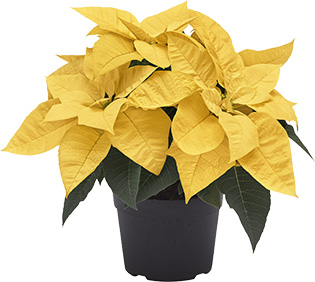
Golden Yellow Poinsettia from Selecta One. Photo: Selecta One.
Additionally, he explained that the poinsettia color is where the innovation is happening. “Different shades of red pop under different retail lighting environments. Who could have predicted that changing over to LEDs and various spectrums would have affected what we view as a ‘good’ red?” James said.
Premium poinsettia trends & novelties for 2026
James also noted that painted and glittered poinsettias have become their own niche market, distinct from the usual novelty ones.
“Consumers like some unique novelty interest to go along with their yearly dose of Christmas nostalgia. Glitters function as a good fit for a consumer who wants a semi-traditional look of a red poinsettia, but doesn’t want a carbon copy of the previous 30 Christmasses,” James said.
Rebecca stated that, in addition to a brighter white, her company has noticed retailers prefer a traditional, stronger pink rather than the hot pink that recent breeding has produced.
“It can look like a faded red at retail and more consumers want a traditional pink,” she explained.
Rebecca also said there’s been a resurgence in domestic cut-flower production and that poinsettias are well-suited for cutting. This is a very small segment of the market, so it’s not a breeding focus, but it’s an opportunity to help growers diversify their offerings using varieties already on the market.
“It’s more about education for the grower, how to do it, how to market it,” she said.
InBlume’s new varieties in 2026 focus on fashionable reds:
- Glamour Red—An early-season, traditional red with large, smooth bracts and abundant cyathia. Strong, upright branching is resistant to stem breakage, and habit and vigor make Glamour versatile for use in all container sizes.
- Dark Velvet—An early-season spin on the burgundy poinsettia. Dark Velvet has rich, dark-red bracts and dark foliage for a dramatic effect. Branching is upright and strong.
- Stiletto Red—A mid-season variety with rich red bracts and extremely upright branching. Strong vigor makes Stiletto a good choice for larger, premium pots. Resistant to heat delay, this variety works in all regions of North America.
- Timeless Red—A traditional mid-season red with vibrant bracts, dark foliage and high cyathia count and full centers. Timeless is a good choice for larger premium pots in peak selling weeks. Strong, upright branching is resistant to stem breakage.
Dümmen Orange’s FabYULEous line’s 2026 introductions include FabYULEous Pink, along with FabYULEous Red, which has been on the market for the past few years.
 “We have a duo for the 2026 season,” said QiuXia. “You can put them together into a mixed combination of red and pink. We also have new novelties within that family series that we’ll be bringing out in the future.”
Additionally, Dümmen Orange is introducing a bright white poinsettia in its 2026 collection.
“Moni White is part of the pure white group—what I call our White 2.0. It’s got that bright white bract shape and a great mid-season eight-week response time. It has a medium to medium-high vigor compared to the traditional cream whites we have in our program,” QiuXia said.
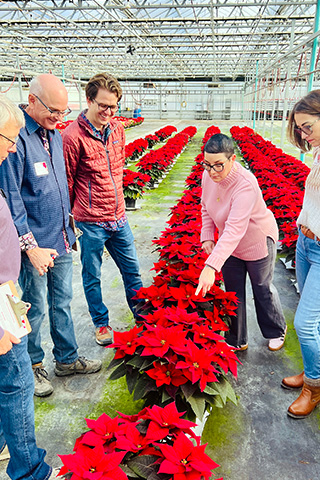
Looking at Timeless in the greenhouse. Photo: InBlume.
James has a different take on what growers have been asking of breeders over the past year or two.
“Poinsettia growers are asking for increased greenhouse and in-store shelf life. Selecta One is breeding varieties that are quicker to develop bract color, while cyathia development is delayed,” he said. “We’re also breeding naturally finishing early season varieties, as the goal has shifted to make plants within those ship windows more durable and longer-lasting.”
He also noted that growers are asking for a strong plant structure with a normal V-shape.
“Wider plants that can’t withstand the abuse of packing and shipping are quickly becoming a thing of the past, as little to no shrink is a goal of any grower—large or small—with poinsettias,” James said.
Here are the three introductions for 2026 from Selecta One:
- Poinsettia Christmas Royale, which is a modern poinsettia chassis, standard V with strong stems in a classic dark-red color.
- Poinsettia Sky Pink, which forms the sky pattern from cooler production temperatures.
- Poinsettia Golden Yellow, which is a rich, gold novelty that can be added to any poinsettia program.
- Poinsettia Christmas Aurora Princess, which James said, “is ideal for December poinsettia sales. Their upright, narrow habit makes them easy to sleeve. They color early, yet are late to flower, providing outstanding shelf-life at retail and long-lasting consumer enjoyment.”
 Why reliable poinsettia varieties remain on the market
QiuXia said that there’s always interest in novelty poinsettias, which keeps the poinsettia market as a whole at the forefront of customers’ minds. However, growers like to work with tried-and-true poinsettia varieties, so branching out to new varieties can be risky for them.
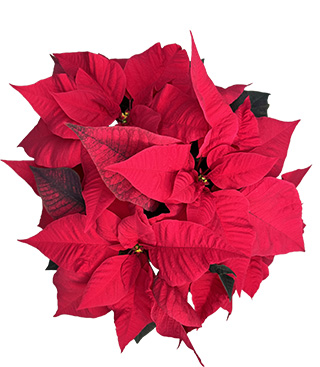
Dümmen Orange’s FabYULEous Red. Photo: Dümmen Orange.
“Growers are habitual creatures and poinsettias are a very technical crop compared to other things we grow,” Rebecca said. “It’s a long crop, too. Once growers learn a variety and one that works well for their region and their production style, they tend not to change.”
Rebecca also shared that there are varieties that are in her catalog from nearly 30 years ago. And these late-1990s varieties still have a good following because they’ve worked well in certain conditions, such as extreme heat or low light.
“We discarded three varieties this year—there are reasons why we get rid of varieties, such as they’re not performing well at the farm level,” she said.
Dümmen Orange also keeps established varieties on the market because it’s grower-dependent.
“We want to be able to satisfy some of our customers’ needs because they’re the ones driving the wallet,” said QiuXia. “But we also need to pay attention to what our growers are asking for—even if we have this amazing, great variety and its color is an absolute wow. If our growers can’t grow it, then it’s never going to get to the consumer level.” GT
Wendy Komancheck is passionate about plants and the business of growing them. You can learn more about her at landscapewriter.com or email her at wendy@landscapewriter.com.