3/31/2026
The Importance of Water Quality
Nick Flax
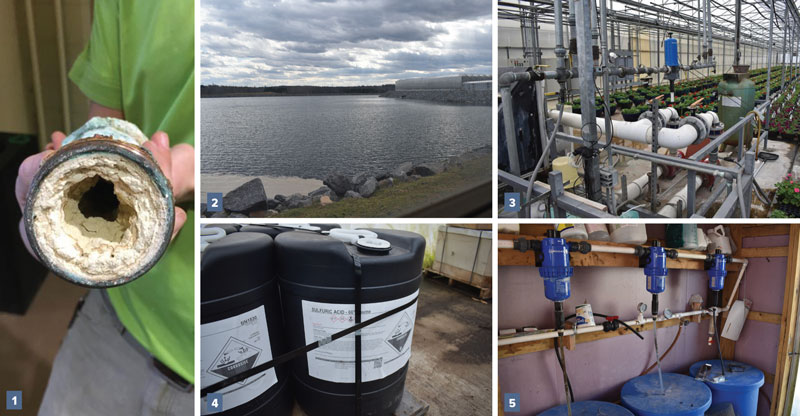
Water quality affects fertilizer choice and the need for various growing media amendments, changes the availability of mineral nutrients applied to your crops, and even influences the efficacy of plant growth regulator applications and pesticides. So when growers come to our technical services team with questions on problem crops that they struggle with for months each year, suboptimal water quality is often the culprit and our first question is always, “Did you have a recent irrigation water analysis?”
- Alkalinity is one of the most critical water quality parameters to monitor and manage. If left unchecked, both your crops and greenhouse infrastructure face potential problems.
- Surface water sources and retention ponds present a unique set of challenges. Test these types of water sources frequently to address changing water quality throughout the year as water levels go up and down.
- Flood floors and other types of subirrigation systems that utilize in-ground cisterns require regular monitoring and occasional “refreshing” to keep water quality consistent over time. Check pH and EC at least once a week to catch sudden changes and have a full water quality test done at least once a month to keep ahead of longer-term water quality concerns.
- Sulfuric acid is a common acidifier used to correct low to moderate levels of alkalinity in irrigation water.
- Many growers use a combination of acid injection and fertilizer formulation selection to manage alkalinity in their greenhouses. Centralized systems where acid and fertilizer injection are plumbed in-line work very effectively to keep alkalinity under control and prevent soil pH from drifting up or down.
High- and low-pH-loving crops often bear the brunt of misunderstood or unmanaged water quality, but ultimately no plant is safe when water quality is out of whack. Mineral nutrient deficiencies and toxicities are often the most common result of water quality concerns, but the need to correct issues like these during production should be avoided at all costs.
The type of water test counts
All water quality tests are not created equal. Submit a water sample to a lab that provides agricultural water quality testing services—not standard drinking water quality tests. Depending on the lab, specific categories such as “greenhouse/nursery” water testing may be available. Whenever possible, choose the type of water test that’s more directly applicable to what you do.
Drinking water tests often offer a small handful of mineral nutrient concentrations (often calcium, magnesium, iron and sodium) and/or “hardness,” all of which can indicate water quality concerns. However, these values only provide a partial picture of water quality.
Agricultural water tests (sometimes as specific as “greenhouse/nursery” water tests) are far superior to standard drinking water tests. These include alkalinity, pH, most macro- and micronutrient concentrations, nitrate and ammonium levels, electrical conductivity (EC; sometimes TDS), and sodium absorption ratio. This broad view of your water quality facilitates targeted water management decisions.
Water testing frequency
Best practice is to test your water source(s) at least once per year. Depending on your operation’s water source, more frequent testing may be advisable.
Municipal water sources tend to be very stable throughout the year, with the exception of municipal water collected from reservoirs in arid climates, on occasion. An annual agricultural water quality test is strongly encouraged and often provides ample information to stay on top of what’s coming out of your hose.
Well water quality often changes more frequently than municipal water. Testing at least twice per year and additional times shortly after extreme weather events is advisable to avoid seasonal or sudden water quality changes, respectively. If you have multiple wells on your property, the quality of water coming out of each can be drastically different, so test ALL wells—even if one of them is only used seasonally or as a backup.
Surface water sources often provide the greatest number of challenges to greenhouse growers. Rainfall, snow, drought, temperature fluctuations and unforeseen events that push contaminants into your water source necessitate frequent water testing if you irrigate from sources like a river or retention pond. Ideally, water from these types of sources should be tested monthly (at minimum) or more often if severe weather or changes to the water level/flow occur.
Understanding alkalinity
When you send water samples off for testing and results come back, you need to know what to do with that information. The long list of water quality parameters that labs report can seem daunting when you receive the readout—starting with alkalinity, arguably the most important water quality parameter to monitor and manage for floriculture producers who grow crops in soilless media.
Alkalinity core concepts: Not to be confused with the term “alkaline” (meaning a pH above 7.0), alkalinity is a measure of your water’s buffering capacity—its ability to neutralize acid. Alkalinity is most often reported as ppm CaCO3 (sometimes written as mg/L; 1 ppm = 1 mg/L) or meq/L. This value indicates the concentration of calcium, magnesium and sodium carbonates and/or bicarbonates present in your water. Keep the following in mind as you review alkalinity on your water report:
- The top take-home message is … too-high alkalinity often means more crop challenges
- About 50 ppm CaCO3 = 1 meq/L (milliequivalent)
- Ideal alkalinity levels for greenhouse growers range from about 50 to 75 ppm CaCO3
- Alkalinity greater than 75 ppm often makes high-quality young plant production challenging. Alkalinity between 75 and 150 ppm is often workable for finished plant production simply by using an acidic fertilizer formulation. Minimal intervention is generally needed, but low-pH-loving crops (like petunia and calibrachoa) may develop iron (Fe) deficiency later in production if alkalinity is on the higher end of this range.
- Alkalinity greater than 150 ppm often requires raw water to be acidified through a separate injection system before blending with WSF.
Sulfuric acid is one of the preferred acids among growers, as it’s relatively easy to source and doesn’t heavily alter the nutrient balance of your fertilizer solution. Phosphoric and nitric acids are other options commonly used to manage alkalinity. However, these will increase the total phosphorous (P) and nitrogen (N) levels (respectively) in your feed.
Too-low alkalinity (less than 40 ppm CaCO3), while less common, presents its own set of unique challenges. Think of your target soil pH like a lane in a bowling alley and appropriate amounts of alkalinity in your water like bumpers.
- Alkalinity helps keep your soil pH in the correct range by neutralizing various acids in the media.
- To replenish your buffer, small doses of alkalinity need to be added to the media at each irrigation.
- Since low-alkalinity water doesn’t replenish much buffering, it becomes easier for soil pH to spike or crash as your media’s lime charge depletes. In turn, this causes nutrient deficiencies and toxicities to induce very quickly as the soil pH swings up and down, especially as the crop matures and acidic reactions (such as respiration and cation uptake) in the root zone occur in greater quantity.
- When alkalinity in your water is excessively high (ex. greater than 250 ppm CaCO3), acid injection alone may not be enough to correct it without being cost-prohibitive or causing nutrient imbalances in your feed program.
- In this situation, use of reverse osmosis (RO) is often necessary, despite the typically high cost of installing and maintaining these types of systems.
- Blending RO water with raw water can reduce alkalinity to acceptable levels for good crop growth or make it feasible for acid injection and fertilizer selection to “do the rest.” GT
Nick Flax is a Technical Services Specialist for Ball Seed.
Alkalinity is a critical parameter, but understanding water test results involves many more. Here are some more helpful resources, including tips for understanding water pH, sodium adsorption ratio, soluble salts, macro- and micronutrients, acid injection, elevated EC and more.