3/31/2026
History of Growing Media in North America: 1950-1975
Dr. Brian E. Jackson
“Each soil has had its own history. Like a river, a mountain, a forest or any natural thing, its present condition is due to the influences of many things and events of the past.”—Charles Kellogg
Substitute “soil” for “soilless” and let’s explore some events of the past that significantly changed growing practices—forever.
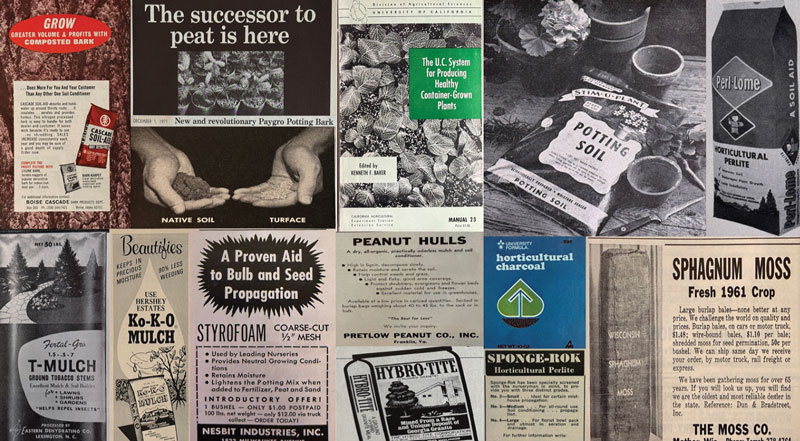 Growing media offerings
The first (broadly adopted) soilless media for commercial production and application was developed by researchers at the University of California in the 1950s. Known as the UC system, this growing media revolutionized container plant production by developing a scientifically based, standardized approach to growing plants, outlined in the seminal 1957 publication “The U.C. System for Producing Healthy Container-Grown Plants” by Kenneth F. Baker (Figure 1). This technique—using a mixture of sand, peat moss and fertilizer—enabled growers to produce containerized plants more efficiently, reducing crop losses from disease and setting industry standards for growing practices.
A selection of growing media components and additives in the 1950s-1970s.
Photo credits: Brian Jackson and American Nurseryman Magazine.
The 1950s also saw the passing of L.H. Bailey (“the Father of American Horticulture”), the commercial use of soil wetting agents (surfactants), the first plastic pots, the use of automated potting machines and the establishment of several prominent organizations, including the International Plant Propagators’ (Production) Society (1951) and the Southern Nursery Association (SNA) Annual Research Conference (1956)—two grower-focused organizations that provided venues for growers and scientists to gather annually and share advances, experiences and data on plant production research. This is also the decade that Miracle Gro (1951) was founded.
Though not in North America, one major innovation in growing media was taking place in Denmark that North American growers would soon begin to utilize. The origin of what we know today as stone wool (also called mineral wool) was derived from volcanic glass fiber, first documented in 1849 in Hawaii following volcanic eruptions. When the molten lava was spewed into the air, it dried as long, thin, golden-brown strands of glass that were often seen covering the ground (called Pele’s hair). The simulation of this process and eventual development of stone wool as a commercial growing medium didn’t occur until over a century later. In 1968, Danish horticulturist O. Bagge Olsen met with ROCKWOOL Group employees to discuss using their stone wool thermal insulation as a growing media. The next year Grodan was founded (1969) and produced stone wool products, brand name Rockwool, as a substrate for the horticulture industry.
In the 1960s, growing media advancements continued based on the work of Cornell scientists James Boodley and Raymond Sheldrake, who’s research led to the development of the Cornell Peat-Lite Mixes, which came to be known simply as Cornell Mix. These soilless mixes were based on peat moss (for moisture retention) and perlite and/or vermiculite (for aeration) combined in various proportions with limestone, fertilizer and other ingredients to match the needs of different greenhouse crops—a practice that transformed the greenhouse industry for decades.
As the popularity and use of peat in growing media increased through the 1960s, so did the demand for the product. Peat was predominantly being sourced from producers in Canada and Germany, as well as some domestic sources in the U.S. Based on the growing demand of peat coupled with a few wet summers that limited peat extraction and supplies (sound familiar?), concerns over peat availability and cost were present in the 1960s, which simultaneously led to the development of other non-peat growing media materials—the first “peat alternatives” across the U.S.
 The use of processed conifer bark (pine and fir) as a media began in the late 1940s and escalated over the next two decades with many commercial products available to growers, one of which proclaimed itself “The Successor to Peat.” Hardwood bark materials were also evaluated in the late ’60s and early ’70s. Other commercially available materials used by growers included perlite (ex. Sponge-Rok and Perl-Lome) and pumice, sawdust, redwood shavings, rice hulls, peanut hulls, ground tobacco stalks, charcoal, Hadite (clay), Turface, Hybro-Tite (granite dust) styrofoam and bagasse fiber (Figure1).
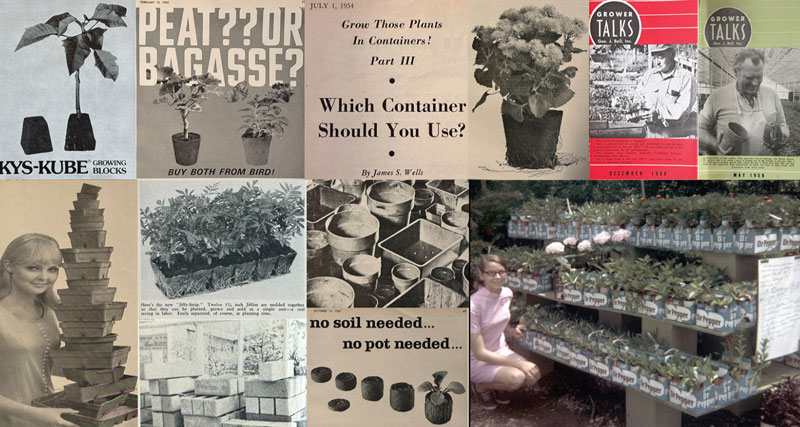
Left: Some of the containers introduced in the 1950s-1970s.
Photo credits: Buddy Lee, GrowerTalks, American Nurseryman Magazine.
The 1970s also presented growers with production challenges not seen since WWII due to the U.S. energy crisis, which caused severe petroleum shortages (affecting fuel availably and the production of plastics) and sky-high prices created by the 1973 OAPEC embargo and further exacerbated by the 1979 Iranian Revolution. On a brighter note, this decade also saw the creation of the National Bark Producers Association (1972, currently the Mulch & Soil Council), as well as the establishment of The Garden Centers of America (1973).
 Evolution of containers
Regarding the continued advancements in planting container technologies and industry adoption occurring since the 1950s, Vic Ball offered this perspective in GrowerTalks in 1969: “Technology has arrived in the world of growing containers and it isn’t through changing things by a long way! Dug and wrapped plants are gone—you don’t grow them in the field, you grow ’em in containers. One thing this all says to the grower: I’d better keep up to date on what’s new in this fast-changing field.”
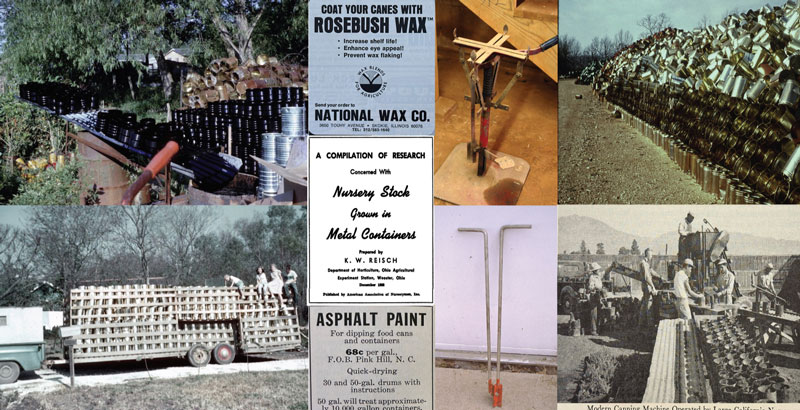
Metal cans, coatings and cutting devices used in nursery production in the 1950s-1970s.
Photo credits: Buddy Lee, Dr. Jim Robbins, American Nurseryman Magazine.
The development of containers for greenhouse crops was extensive, with more than 65 found in my literature search. Container types included plastic, aluminum, galvanized metal, plasticrete, clay, peat and bagasse fiber, wood and wire baskets, tar paper, veneers, paper mâché, polyethylene and, yes, if you can believe it—asbestos! Most interesting, to me at least, was the re-use of soda cans to grow annuals—the six-pack cardboard carriers included (Figure 2)!
The metal cans used since the 1950s were successful in nursery production, but they would often rust, leading to the common practice of coating them in RC-1 asphalt or wax materials to extend their usability, a practice first reported in California in 1904 (Figure 3). The dipping of cans, as well as the manual hole punchers and can openers (splitters), began steadily going away in the 1970s when plastic containers were more advanced and widely available.
Other than new container types on the market, university and on-farm research accelerated to address many “new” questions relating to the production of plants in containers. The frequency of published works steadily increased into the 1970s on topics including irrigation, nutrition, over-wintering, media sterilization (Vapam, Methyl-bromide, Formaldehyde), media temperature, weed control, container disposal, transport efficiency, economic modeling and market forecasting on container-grown plants—all new challenges/adjustments compared to field-grown crop production. GT
Brian E. Jackson is a Professor and Director of the Horticultural Substrates Laboratory at NC State University. Brian can be reached at Brian_Jackson@ncsu.edu.