3/31/2026
From Breeding to Beauty: Connecting the Ornamental Pipeline
Dr. Kate Santos
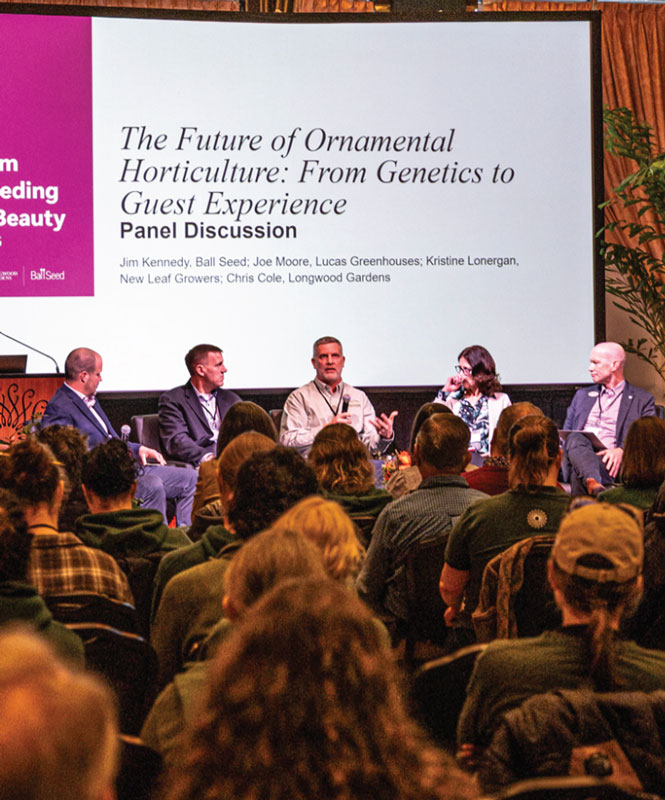
Some ideas arrive quietly, but are persistent enough that eventually they demand action. That’s how From Breeding to Beauty, a two-day symposium held in February at Longwood Gardens in partnership with Ball Seed, began for me. Having worked across multiple facets of the horticulture industry—from academia to the largest grower in the country to one of the world’s largest floriculture breeding companies and now at one of the great public gardens—I’ve seen firsthand how interconnected our work truly is. Yet I also saw that opportunities for regular exchange between public gardens and other segments of the industry are limited. Public gardens offer unique environments for testing, demonstrating and experiencing plants at scale, creating meaningful opportunity for exchange that can strengthen outcomes across the ornamental continuum.
What began as a conversation with breeders quickly grew to include growers, independent garden centers and other Mid-Atlantic public gardens—bringing a broad range of industry perspectives into one room. Twenty-six presenters participated over two days, representing global breeding firms, as well as networks of independent breeders and plant suppliers. More than 160 annuals, perennials, tropicals, foliage, cut flowers, bulbs, shrubs and flowering trees were highlighted. Some introductions were new; others were existing genetics viewed through a different lens—emphasizing performance, resilience, visual impact and long-term garden contribution. In several cases, plants positioned for color or novelty were reconsidered through the lens of durability, heat tolerance or multi-season structure—reframing how they might serve not only as the impulse purchase, but for sustained performance.
Presenters shared their selections around six themes: climate-ready performance; statement plants that define a garden; container plants that shape space; innovations that surprise and inspire; dynamic bloom performance; and plants with meaningful stories. Where possible, regional performance data supported those choices—including durability under heat, cold, humidity and water stress; pest and disease resistance; container versus in-ground reliability; and long-term suitability across public gardens, home landscapes and retail production. The framework moved the conversation beyond novelty, advancing plants that meet the practical demands of modern gardens while preserving the inspiration and visual impact that make them compelling.
The dialogue extended beyond presentations. A cross-sector panel explored how decisions at every stage—from breeding priorities and production realities to retail strategy and public garden performance—shape what reaches landscapes, homes and floral markets. Emerging themes included resilience, input efficiency, commercial viability, consumer influence and the need for stronger feedback loops across sectors. A panel on day two examined these same dynamics within the cut flower industry, underscoring that its resurgence is similarly dependent on coordinated action across the pipeline.
A central theme was that garden identity is scientific before it’s aesthetic. It begins with genetics, is shaped by environment, refined through technique and revealed over time. The plants highlighted reflected that continuum: breeders expanding what’s possible, growers translating that possibility into reliable performance, gardens evaluating and demonstrating plants at scale, and retailers translating aspiration into access. Viewed through that lens, the future of horticulture isn’t defined by any single sector, but by how intentionally we work across them.
While the symposium’s focus was firmly on plants, the deeper outcome was connection. Conversations surfaced shared challenges: climate volatility, labor pressures, shifting trends and rising costs, along with—more importantly—potential solutions. Stronger alignment across the pipeline is less an aspiration and more a practical necessity. Transparency and communication proved powerful catalysts. Understanding deepened. Ideas formed. New relationships began.
From Breeding to Beauty was conceived as a bridge. The depth of engagement and candor suggest that creating regular opportunities for cross-sector exchange may be one of the most valuable investments we can make in the future of ornamental horticulture—not simply to introduce plants, but to strengthen the system that brings them to life. GT
Dr. Kate Santos is Associate VP of Science at Longwood Gardens.