3/31/2026
Break It ’til You Make It
Art Parkerson
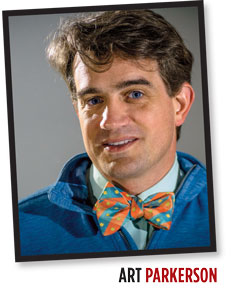
In a recent interview, I asked a prospective employee, “Tell me about your workplace—what’s your boss like?”
She rolled her eyes. “They’re out of touch. They have these meetings where they tell everyone that failure is a good thing!”
I chuckled, but I was laughing at myself and not her silly boss. I can imagine my employees repeating things I’ve said as if I were totally bonkers. “Don’t listen to your customers!” “Never say you’re sorry!” Nuance, subtlety and clever context are often lost in translation. I suppressed a laugh and moved on, amused at how I must sometimes play the fool.
It’s healthy to feel foolish sometimes.
Most of us learn things the hard way. Last week, my wise friend Lloyd Traven (of Peace Tree Farm) told me that once an earnest young grower asked him for guidance and instruction. He told him, “Get into a greenhouse and start killing some plants.”
The only way to get really good at something is to screw it up first. Then screw it up a few more times in different ways. Good growers learn from failure; bad ones don’t.
Maybe there are some industries where the motto “Fake it ’til you make it” is good advice, but it certainly has no place in ours. I mean that absolutely—the only place where faking flowers is acceptable is in aisle six of Michael’s. As the scheming Vizzini from “The Princess Bride” warns us, “Never go against a Sicilian when death is on the line!” With plants, death is always on the line. Faux rain is called irrigation. Faux irrigation is called poison.
You can’t fake pruning, spacing, pinching or potting. You can’t fake roots. You can’t fake inventory or availability. Why stop at the greenhouse door? Can you fake HR, payroll, marketing and payables? Maybe, but why would you want to?
Faking doesn’t work because practice doesn’t make perfect. Practice makes permanent. It matters how you exercise. If you’re trying to fake it, you’re practicing fraud and that’s what you’ll get good at.
What evidence is there for the evolution of faux to real? Show me the missing link. It’s the stuff of fiction.
“Generally, by the time you are Real, most of your hair has been loved off, and your eyes drop out and you get loose in the joints and very shabby,” said the Skin Horse to the Velveteen Rabbit.
“Prove yourself brave, truthful and unselfish, and someday you will be a real boy,” said the Blue Fairy to Pinocchio.
It was Aristotle who first observed that virtue is learned by acting as if you were already virtuous. Habits are powerful things. “Doing the virtuous thing”—even when it’s not natural—isn’t “faking it.” It’s simply doing the right thing.
Some people think they’re pretty good at faking. Thankfully, they’re usually easy to spot. Listen for the brag and bluster. Observe the callow nod and smirk. Beware: Snide goeth before a fall.
But the tricky ones are the humble con-artists, the adept and unassuming pretenders. Those folks don’t need your permission or encouragement to be phony. They need to be told, “Let’s not settle for anything but the real thing.” Conversely, those who can’t “fake it” shouldn’t try; they’re better off just breaking stuff until they figure out how to make stuff.
The absolute worst outcome you could wish on someone is for them to discover that “faking it” works for them. If you’re any good at “faking it,” what incentive do you have to ever make it?
When people say, “fake it ’til you make it,” they make a fatally bad assumption: they think you’ll magically know when you’ve suddenly “made it.” This is seldom true. Nobody is going to say to you, “Hey! You made it! You can stop faking now!” Successful people are driven. That means they never feel as if they made it. Success is more an attitude than a destination.
The big secret nobody shares is that we’re all faking it, to some extent. What you see isn’t who we really are. We edit our thoughts. We hide our faults. We subtly hint at half-formed strengths, hoping others will infer their robust completion.
Impostor syndrome is real. Most of us feel it from time to time. We all assume it’ll go away with age and experience, but it doesn’t. People think we know what we’re doing. What would they say if they realized how often we had no clue! But we do know this: the emphasis is always on “make it,” not on any word that happens to rhyme.
Don’t fake it, but feel free to break it. That’s honest work. I didn’t give that interviewee a job, but she was correct about one thing: failure isn’t good. We shouldn’t pretend otherwise. Failure is always unacceptable, but it’s also correctable. Things that are broken can be fixed, but things that are fake will always remain fake. And that makes our blunders far better than deceit could ever pretend to be. GT
Art Parkerson works at Lancaster Farms, a wholesale nursery in Suffolk, Virginia. He’s also the creative director of PLANTPOP, a horticultural cinema studio that makes documentary films about people and plants. To say hello, write to art@lancasterfarms.com.