3/31/2026
Solid Strategies for Expanding
Jennifer Zurko
Like the ubiquitous chicken and the egg, many growers have been faced with the same conundrum around growing structures: Do you build a greenhouse around the crops you grow or do you grow crops that work for the greenhouse you already have?
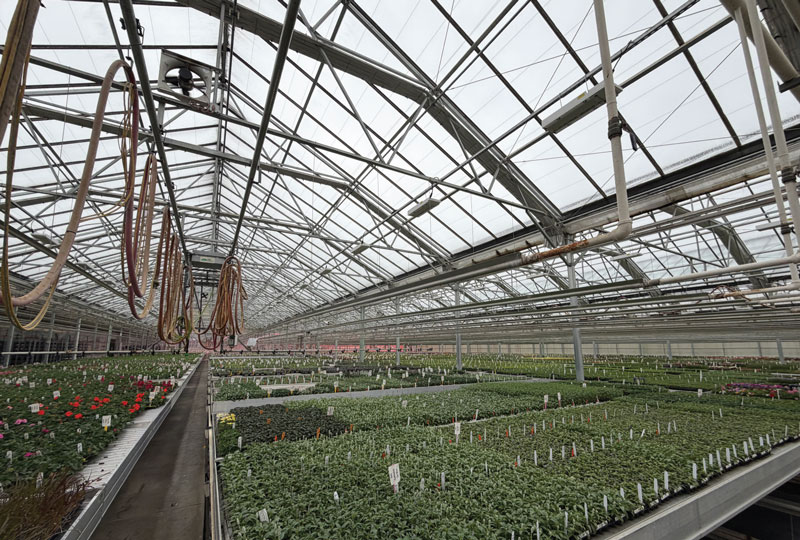
Plantpeddler’s production greenhouse consists of two zones with Dutch container system benches and LED lighting. This is where most of their young plant production happens.
Because building a greenhouse is such a large investment, you have to go into the decision with a long-term plan to ensure you’re setting your business up for realizing the best ROI on your growing structures.
Mike Gooder, owner of Plantpeddler in Cresco, Iowa, is someone who looks at every angle when making a major investment for his business, from changing inventory to adding automation to, of course, building a new greenhouse.
I happened to be at Plantpeddler in early March while they were in peak production, so I sat down with Mike, his wife Rachel and his son John to ask them how they decide why and when to add on a new structure.
Intentional investment
In 2002, Plantpeddler opened the first phase of their Young Plant production site (they have the original production site in Cresco, along with a retail garden center). Since then, they’ve been through two additional major greenhouse expansions. The original production area is a large Nexus greenhouse that consists of two zones with Dutch container system benches where most of Plantpeddler’s young plant production happens. They added what Mike calls “the Rough houses” with four zones in 2005, which also includes the container system fitted for young plant propagation. And then in 2019, they added three more zones of DeCloet greenhouses, where much of the finished product is laid out on permeable floors with boom irrigation before it’s shipped out.
The two greenhouses—phase 1 with the rolling benches and phase 2 (the DeCloet greenhouses) where the plants are placed on the ground—are very different because they’re used for different stages of production. But how did the Gooders decide what type of greenhouse they wanted when they were planning to add on?
 “I think probably the biggest question we ask ourselves is, ‘Can we fill it year-round?’” said John. “You may see other greenhouse operations that will throw up some space for a few months out of the year. But for us, it’s planning to utilize that square footage throughout the year as best as possible.”
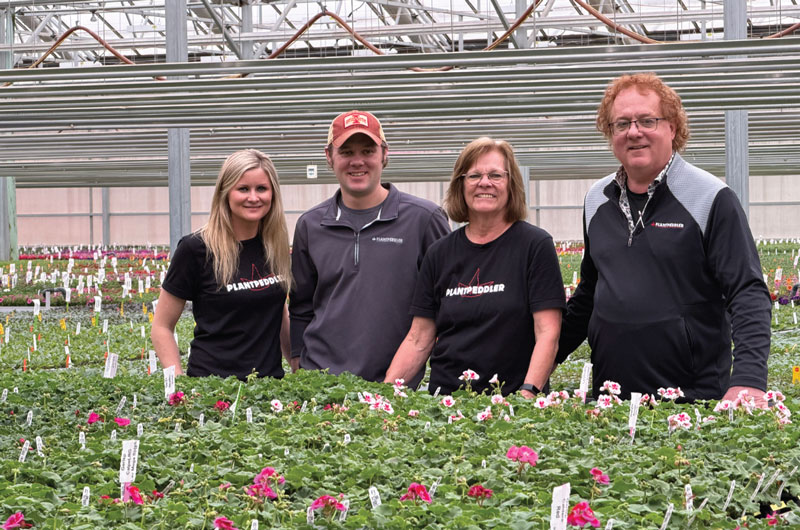
The Gooder family, owners of Plantpeddler. From left: Molly, John, Rachel and Mike.
Even during the times when the greenhouses are close to empty, you have the option to keep product running through it at all times. The Gooders’ feel that your structure should allow you to have that luxury.
“We’re never not in production, but we are rarely less than 90% capacity,” explained Mike. “Since we founded the company, we knew that turns equal income and that you need to cover overhead 12 months of the year because you accumulate overhead 12 months in a year. But there’s a balance. Though founded in wholesale, based on demand, the young plant division is now the primary focus we’re looking at investing.”
And that doesn’t necessarily mean you have to build a whole new greenhouse. Mike said they often look at how they can upgrade the current structures they have based on what they’re growing. That can include new container systems, LED lights or other equipment, like the ISO sticking machines they purchased a few years go and are in the process of adding additional robotics.
Avoiding “square foot-itis”
Some growers play a game with themselves that Mike refers to as “square foot-itis.” (He wrote an article about this for the Ball RedBook.) It’s when you get too bogged down with trying to figure out square footage costs for every crop you grow. Plantpeddler’s philosophy is to look less at the revenue per square foot and more on how many turns they can get within that space all year round. The Gooders and their growing team squeeze out as many turns during spring production as possible, with product continuously moving out the door. Then they jump right into mum and fall crop production, which rolls into poinsettia season. Within that are also multiple crop rotations of vegetative ornamental young plants. And the cycle continues.
“We’re turning and burning as fast as we can,” said Mike. “We used to have a little bit of downtime in October, but we never really find a low spot.”
And even with the space they have, sometimes it’s still not enough to fulfill all of their customers’ orders, so they have a set of contract growers they can tap into to help them with the overflow. This also ensures that every square foot of their own greenhouse real estate is being used. Keeping the space constantly filled is how you get the most bang for your buck.
Mike told a story about when he and Rachel first started Plantpeddler’s wholesale division in 1984. Back then, the first greenhouses were designed with smaller zones and they’d just installed a BioTherm system that was very cutting edge at the time. When they moved to their current location, they intentionally kept both places so they could keep specific crops separate to allow for better production.
“We built that facility to do 52-week potted flowering production and there were a lot of smaller irrigation zones,” Mike recalled. “It worked out ideally when we flipped to young plants because Rachel has the complicated crops at that facility. When you walk through there, it’s just a maze of genera and species and varieties. But that facility, because the way we built it, was really adaptable to that part of the process.”
When they built the young plant greenhouses at the second (now main) location, Mike said it was always meant to be for young plant production. And it was never going to be a one-and-done project—when the decision was made to build a new greenhouse range, the Gooders strategized a three-phase plan that would be implemented over time that not only included more growing room, but also any other future investments they would want to include. As of today, all of phase 1 and over half of phase 2 has been completed; site development of phase 3 is underway.
“Phase 2 has a couple more zones to complete. Then there’s phase 3, which is John and Molly’s [John’s wife] problem,” Mike joked. “But we are following a very scripted master plan. I think one of the most important steps for anybody is you need a strategic plan when you start. If you’re going to build a facility that has the efficiencies you need to be profitable, it starts with developing a master plan and using the resources of the industry.”
That means tapping into greenhouse manufacturing experts (especially the National Greenhouse Manufacturers Association), climate control systems suppliers, and other industry professionals who can help you come up with the best plan for your business.
“We had a team of guys and women and challenged them by asking, ‘Okay, what does it look like? What is a comprehensive master plan, a facility that can grow within itself?’” said Mike. “And we’ve done nothing but follow that master plan since 2000. We speed up or slow down based on what the company’s customer demands are.”
Always planning for the future
Because there’s no such thing as a crystal ball to tell you the future, part of your greenhouse plan has to leave room for inevitabilities, which almost always means new automation and technology. From lighting to climate controls to transplanting machines, you have to keep what may be coming in the back of your mind.
“I knew that if we were going to grow the facility in phases that we had to have the core infrastructure,” said Mike. “What’s going to come down the road in future equipment automation? Is there enough room to put more robotics in? You can’t see where you’re going to go as far as the industry is going to take you, but you definitely have to leave yourself pathways to get to that point.”
And every time you go through a construction project you learn something that you can take into the next one, whether that’s adding new equipment, retrofitting or with a completely new build. Those lessons should serve you well as you continue to plan and invest in your business.
“I think with the DeCloet build—and John was very instrumental in it—it was probably the cleanest build we ever did,” said Mike. “We took what we had learned and we built all the utilities within that facility. It’s all super clean. It’s online. All the exhaust venting, electrical, gas delivery—everything that was done in that facility was very thoughtful. And just now, we incorporated what we learned in that project within the new garden center build.”
As the Gooders look toward the future—which will include a time when Mike and Rachel will eventually step back and John and Molly will be running Plantpeddler—they’ll keep crunching the numbers and looking at sales trends to see where they can make improvements that will help them continue to grow the business.
“We look at the performance indicators, with a focus on driving profitability,” said Mike. “We look at labor costs per revenue dollar, labor costs as a factor of profit. It’s a guidepost for us to figure out how to increase efficiency, so we’re always looking at a dashboard to understand them.
“You can make a decision strictly on demand—like somebody’s knocking on the door and they want to buy more stuff from you, so I better build. A lot of times you’re not building for the right reasons versus the financials driving you with good reasons to build, and that’s the approach that we’ve tried to take.” GT