1/30/2026
Bios to the Rescue
Jeremy Webber
When perusing the interwebs or attending talks in search of information on BCA implementation strategies, it’s common to hear a phrase that sounds something like, “Bios only work preventatively.” I think it’s the “only” part that gets my hackles up. This implies that they’re not up to the task of cleaning up serious pest infestations. I hear this implication of lightweight efficacy on a regular basis, and I do my best to not go full bug-nerd and reply with a “Well, actually” statement.
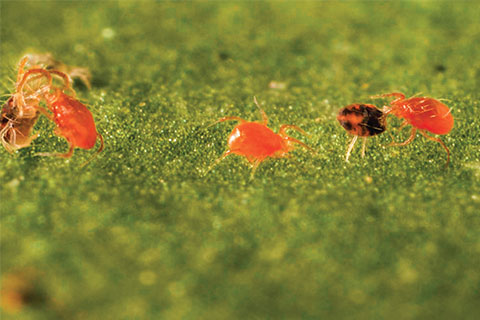
It’s a mite mosh-pit! A pair of spider mites are surrounded, outnumbered and out-gunned by P. persimilis. There’s no need for a fair fight when your crop is on the line.
While there certainly are pest/BCA relationships that this broad-stroked statement applies to, there are many common ones where it’s a flat-out fallacy. There’s no spider mite population that can’t be cleaned up with predatory mites on their own. Caterpillars can be eliminated with nematodes with a nearly 100% kill rate from a single application. Like, all of them—dead, tonight—though they may not actually know it yet.
And western flower thrips—don’t even get me started! Pesticide options there have been problematic for decades and we’ve had to figure out better solutions with a living toolbox.
I think a statement that makes the most sense from an IPM expert’s standpoint sounds something more like: “All IPM works best from a preventative approach, but there are lots of living and chemical solutions for knockdown depending on what you’re up against.”
Thrips!
There are more active pest thrips species in the U.S. than you can count on your fingers and toes, and the control recommendations for each one can vary wildly. That said, let’s focus on the main one for most growers nationally and globally: Frankliniella occidentalis, or western flower thrips (WFT). One of the biggest revelations I had 14-ish years back when I started doing the bio consultation thing fulltime was that control over this pest gets easier the hotter it gets. This was the opposite of what I knew before my bio-awakening, when I was on a never-ending treadmill of active-ingredient rotations to keep them suppressed as their lifecycle sped up with increasing temps in the spring and summer.
BCAs—Swirski-Mite in particular—play by the same rules: The hotter it gets, the faster they work, and the gap between their predation/reproduction and WFT’s reproduction only gets more advantageous with increasing temperatures.
Regardless of the details, the bottom line is that there isn’t a WFT population that can’t be completely decimated in three or four weeks with the proper combination of predatory mites, mass-trapping, nematodes and a good myco-insecticide like Isarid. Yes, sometimes there are chemical pesticide options that can help here, but resistance is a key factor with this pest, and increasingly more often, we don’t go there or even need to. Show me the worst WFT situation you can find, seriously, and that aforementioned approach can nearly wipe it out inside of a month. You could have maybe said that about Measurol back when this pest first came on the scene, but there isn’t a combo of chemicals available at this point with that level of confidence. This is just looking at things through the lens of efficacy, but improvements to worker safety, overall crop health and REI restrictions are legitimate factors as well.
 Spider mite cleanup
I can honestly say that I love dealing with spider mites. Compared to WFT—or all thrips species, I suppose—spider mites don’t have wings. It’s a considerably more straightforward control strategy when the pest can’t relocate as easily as a flying insect. Yes, they can blow about on the wind and run all over greenhouse structures to propagate their colonies, but they can’t fly.
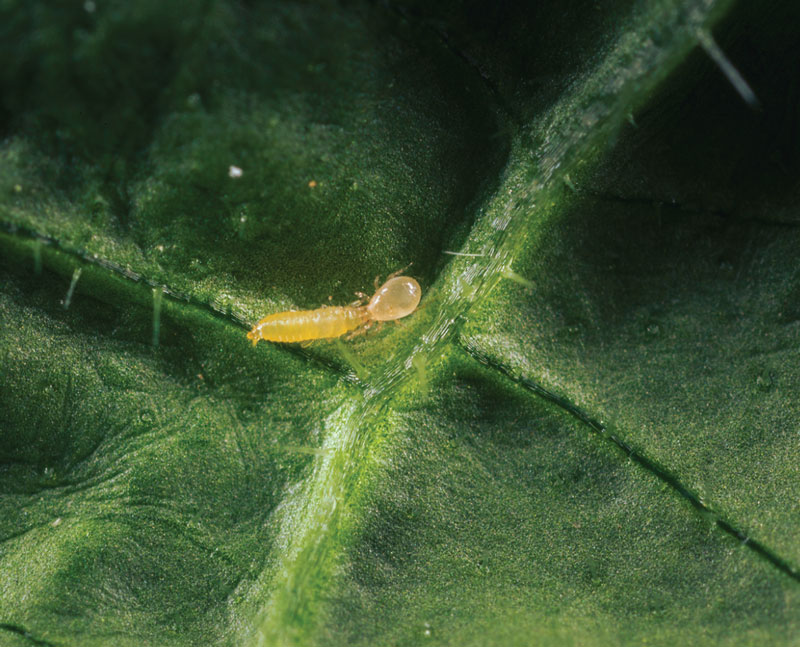
Talk about dealing with things head-on! A. swirski attacks a WFT larvae directly, going for the face.
Maybe as importantly, the predatory mites that we use to control them eat everything. Phytoseiulus persimilis will consume all life stages of spider mite. You have to take apart a WFT population with multiple agents, at least one for each life stage. Spider mites? It’s basically just Neoseiulus californicus and P. persimilis. It’s just a numbers game; plus understanding how the pests are getting into the crop, what the temperature and humidity are doing, and refining how the predators go into the crop. Assuming we have a pesticide residue-free crop, there’s no spider mite population that we can’t absolutely destroy in just a few weeks’ time (or less).
Ironically, the main reason pesticides are recommended for spider mite knockdown is because of other pesticides. When there are long-lasting residues active on the foliage already, and the bios can’t go in yet, well, we must recommend more pesticides to flatten the curve until we can use the predatory mites. It’s SOP for Koppert to submit crop foliage to a lab for residue analysis before we start any new ornamental bio program. It’s also very common to find something that will be an issue.
Bifenthrin is seemingly everywhere. That one will kill every BCA you put on the crop until it’s undetectable, so while it’s breaking down (which takes up to 12 weeks), pesticides with less or no long-term residual get the nod on our recommendations. Once the crop is clear, however, it’s just refining the details, which really come down to which BCAs you’re introducing, how often and how evenly they’re being blown into the crop. If residues aren’t in play, chemistry isn’t required.
Very hungry caterpillars
These are maybe the most dramatic example of a pest that’s best controlled with a BCA. Steinernema carpocapsae (probably not the one you’re using in prop for fungus gnats) is an absolute beast versus this wide range of leaf-munching pests. While good contact with the target assures control, our internal studies have shown that the nematodes can lie in wait on the foliage for up to one week and can even kill the pests when they’re ingested as the pest eats the foliage. Simply put, there’s no better control agent, biological or otherwise, for this problem. Under cover, spray away, as your greenhouse is protecting them from UVA and UVB light. Out in the field, however, take more precautions to spray in the evening or on very cloudy days for the best results. GT
Jeremy Webber is the Ornamental Crop Team Manager for Koppert U.S. Feel free to shoot him an email at jwebber@koppert.com if you have a pest population that needs to take a hike.