1/30/2026
Know Your Enemy
Dr. Luis Cañas
Pest management is a critical component of the production of high-quality plants grown in greenhouses. Pest outbreaks in the middle of the production season risk reduced plant quality and profits. The development of a successful integrated pest management (IPM) plan requires critical steps that include sanitation, cultural practices, sampling, development of a biological control plan and the development of an insecticide rotation program (if it applies to the production system) among others.
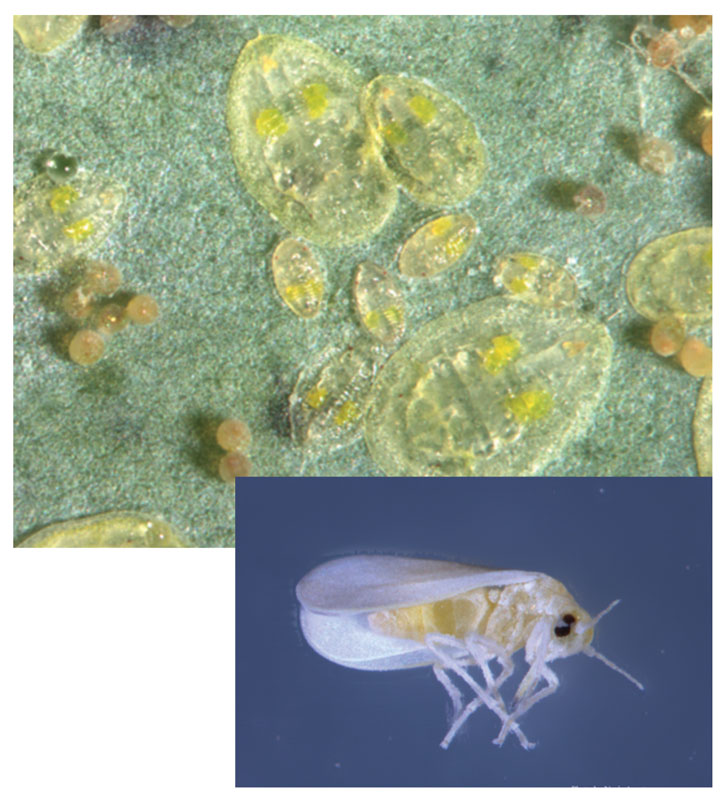
Figure 1. Sweetpotato whitefly adult (below), eggs and nymphs (top).
But all of this relies on obtaining the data necessary to make decisions appropriate for the control of the target pest. IPM tactics that are especially impacted by the quality of the sampling data included the development of a biological control program and the development of an insecticide rotation program. If the data isn’t reliable, it’s difficult to make decisions of control that impact those practices.
Identification & sampling
Correct pest identification is crucial to selecting the best management practice for a particular crop. Misidentification of a pest can lead to incorrect selection of the biological control agent to release. Furthermore, it may lead to improper selection of insecticides for the rotation program.
One way to identify pests properly is to have trained personnel. Experienced workers are very helpful in detecting pests quickly. However, pest knowledge is always evolving and is complicated by the fact that new pests arrive from time to time. Thus, it’s important for personnel to continue their training to accurately identify pests. When there are doubts about the pest found, it’s important to send samples to diagnostic clinics, such as The Ohio State University (ppdc.osu.edu), and consult with your extension educator. Please make sure that all recommendations are followed to send samples that can be processed adequately.
Weekly sampling is an important step to detect pests early and monitor their population growth over time. Common recommendations include doing visual inspection once a week and complementing them with the use of sticky cards that are deployed bi-weekly (if both sides can capture flying insects). General recommendations for the use of sticky cards include setting traps with a grid pattern to make them easier to count and using one trap per thousand square feet, orienting the trap so its bottom is even with the top of the crop canopy. The trap can be oriented vertically, although sometimes it can be oriented horizontally, and each trap needs to include the date when the trap is deployed and a code identifying the zone or the area that’s being sampled.
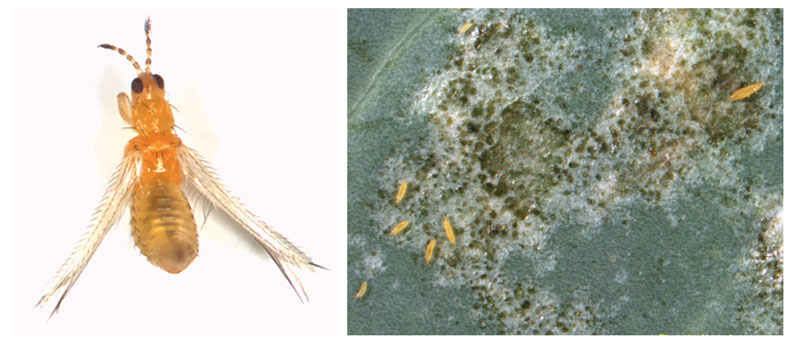
The most common color is yellow because it captures many different types of flying insects, including whiteflies, thrips, fungus gnats and aphids (Figures 1 to 3). With aphids you only capture winged aphids that often come when there’s already an outbreak happening nearby. Thus, it’s important to confirm and find the outbreak as quickly as possible.
Other sticky card colors can be useful, such as blue when the main insects to be captured are thrips. When evaluating sticky card data, it’s useful to share with employees pictures of the pests and of the biological control agents that are being released. This will make the job easier. In some facilities, employees are given a color card with pictures of insect pests and of biological control agents.
 The importance of data collection
Identifying insects correctly and sampling them periodically is very important, but what do you do with the data that’s collected? As you’ve probably experienced, maintaining a good database from the sampling data is very important; however, it’s also tedious and labor-intensive. At a minimum, the person doing the sampling can enter the weekly data from the visual and sticky card sampling into an Excel or Google spreadsheet, and this can be connected to an automatic graphic that can track pest population growth over time. Setting up the database takes some time, but once set is fairly easy to use.
Figure 2. Western flower thrips adult showing its characteristic fringed wings (left) and thrips nymphs on leaf tissue showing damage
This is a critical step to have valuable information throughout the year. For example, when I have conversations with growers experiencing insect problems, after discussing control measures, I usually recommend preventive steps and I ask them what they’ve seen in previous years. In these cases, go into your database and find out when an outbreak occurred in previous years to facilitate the planning of prevention measures that are deployed next year.
For those working on nurseries and trying to anticipate when pests will be present, a good tool to use is the phenological calendar developed at The Ohio State University (weather.cfaes.osu.edu/gdd). Using this calendar, you can match the flowering of specific trees with degree day accumulation and with the potential advent of pests.
New ways of sampling
While sharing data and information has been possible with the use of smartphones and cloud servers, and it can be done without external apps (Note: I was able to see some dedicated networks developed in different countries), using a dedicated app makes set up, integration and follow-up a little bit easier. However, as you can expect, there are costs involved.
Fortunately, industry and research groups have developed automation tools and apps that may be deployed in greenhouses to identify, sample and collect insect data. Some of these tools are available commercially. There are different examples in the market, but here I provide a few examples of these tools:
- Koppert’s Natutec Scout (koppertus.com) allows for flexibility and helps to enter observed data into the phone app that’s connected to a database. The app allows for automatic detection of some insects—for example whiteflies. Then the data is captured and visualized in graphs and maps. Thresholds can be set up, and when one is triggered, messages of alert are sent so that action can be taken.
- Another example is Biobest’s Crop Scanner (biobest.com/products/crop-scanner). This app also allows for fast entry of scouting data. Notes and low-res photos can also be attached and shared with the pest control advisor. The data is sent to a central database in your facility for decision making.
- The Trap-Eye (biobest.com/products/trap-eye) system allows for full automation of identification and counting of some insects captured on sticky cards. According to their information the following insects can be monitored: whitefly, thrips, Liriomyza and other insects, including some biological control agents. This tab recommends 40 units per hectare (17 per acre) and one Gateway (central database). Each unit has a magnetic base for easy installation on metal beams and a solar-powered digital camera that reads the sticky card.
Of course, the advantage of these tools is the collection of pest data in real time. The data is then delivered to a system accessible by the manager of the facility, leading to improved pest management decision making. While not every tool can be applied everywhere, it’s useful to evaluate the different options to find something that fits your needs.
 Potential new technologies
I believe in the coming years we’ll see deployment of other automation techniques that will simplify the collection of pest management data. For example, in my laboratory we published a research paper about the development of environmental DNA techniques to identify pests in control environments (Jonathan Lee-Rodriguez et al. 2024). This technique uses the DNA left behind by organisms (cast skins, honeydew, etc.) to identify particular species. Because of the use of specific machines to handle DNA, I expect that such techniques will be useful in pest diagnostic facilities or in large operations.
Figure 3. Rice root aphid adults (both left) and nymphs feeding on roots (right). Photos taken by Nuris Acosta, Entomology, The Ohio State University.
Another technique is the use of near infrared sensors (NIR) that can detect plant stress. This technique in association with others that detect and identify pests will provide a more complete picture of the challenges impacting the plants. I also think that the use of artificial intelligence (AI), advanced sensors, drones and potentially robots will help improve the efficiency of pest management in controlled environments. GT
Dr. Luis Cañas is an Associate Professor in the Entomology Department at The Ohio State University.