1/30/2026
Controlling Insects on Foliage & Tropicals
Andrew Britten
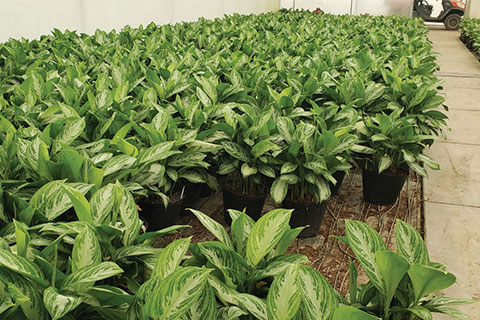
It’s the middle of winter and snow is falling. The urge to head to a warmer climate tugs at you. Life is too busy in the greenhouse to get away, but you can bring the feel of the warmer climate to you. This comes in the form of a truckload of tropical and foliage plants out of Florida. Unfortunately, you know that it’ll likely also bring you some insect populations. You don’t want this population to grow or to spread to your other crops, which you’ve worked hard to keep clean.
Luckily, there are many products out there that can help you. This comes both in the form of beneficial insects and other biocontrols, as well as chemical controls.
Aphids
Aphids are truly fascinating insects. They have a 30-day life cycle. They come in many different colors, such as green, yellow, black, red, white and brown. Aphids can reproduce sexually, as well as asexually. (Asexually they can produce 12 offspring per day!) They’re soft-bodied, sap-sucking insects. They feed using needle-like mouth parts called stylets, which are inserted into the phloem of the tissue to suck out the sugary sap. Aphids can spread disease as they feed off the plant. If food levels drop, they can grow wings to move to an alternative food supply. Aphids will seldom kill a plant, but they often cause leaves and flower buds to drop, while stunting the shoots of the plant. As they feed, they create honeydew, which can develop into sooty mold.
Biocontrols
- Botanigard—16 oz./100*
- Aphidius colemani
- Chrysopa carnea
Chemical controls
- M-Pede (UNM)—1 gal./100
- Flagship (4a)—8 oz./100
- Endeavor (9b)—5 oz./100
- Mainspring (28)—8 oz./100
- Aria—(9c)2 oz./100
Spider mites
Spider mites are tiny insects; magnification is generally required to see them. They predominantly live on the underside of the leaves. To feed, they pierce into the plant cells and suck out the contents. This will result in damage that looks like small dots within the leaf that can turn yellow or brown.
If the population grows large, they’ll produce fine silk-like webbing. This is often the first symptom most people see on their plants. Unfortunately, by this point, you already have a large population. Spider mites thrive in hot and dry conditions. The life cycle of a spider mite is one to two weeks in optimal conditions. They start as an egg laid on the underside of the leaf or in the webbing, and hatch into larvae with six legs, but rapidly develop into nymphs. They molt a final time, becoming adult spider mites. The females can lay dozens of eggs within their lifetime. You typically won’t see spider mite populations within propagation due to the high humidity levels.
Biocontrols
- Phytoseiulus persimilus
- Amblyseius andersoni
- Amblyseius californicus
Chemical controls
- Pylon (13)—5.2 oz./100
- Sultan (25a)—13.7 oz./100
- Avid (6)—8 oz./100
- Floramite (25)—8 oz./100
- Sanmite (21a)—9.6 oz./acre
Mealybugs
The life cycle of mealybugs is only a few weeks. They start off as an egg, become nymphs and then molt into their adult stage. Female mealybugs can lay hundreds of eggs in white egg sacs that can be located on leaves, stems or roots. Female adults are wingless, but continue to feed through their entire life cycle. The males, on the other hand, will molt into winged adults with a brief life. These male adults no longer feed. The female adults feed by sucking out the plant sap. There are over 170 species of mealybug. And like aphids, they secrete honeydew. Mealybugs can attack the stem, leaves, flowers and roots of the plant, and are covered in a powdery wax, which does make them more difficult to control.
Biocontrols
- Chrysopa carnea
- Cryptolaemus montrouzieri
Chemical controls
- Mesurol (1a)—8 oz./100
- Orthene (1b)—10 oz./100
- Tristar (4a)—2.7 oz./100
- Rycar (9b)—6.4 oz./100
Thrips
Thrips go through six stages in their life cycle: egg, two larval instars, prepupa, pupa and adult. These six stages are completed in three to four weeks, being as short as seven to 10 days in warm conditions. The females lay their eggs inside of the plant tissue. Once the eggs hatch, they feed on the leaves until dropping down to the soil for the non-feeding stages of prepupal and pupal stages. They then develop wings. Thrips feed by puncturing the epidermal layer of the plant and sucking out the cell contents. This type of feeding can spread viruses. When the contents of the cells have been removed, the plants will develop scar tissue, as well as distorted growth.
Biocontrols
- Orius laevigatus
- Amblyseius cucumeris
- Amblyseius swirskii
Chemical controls
- Kontos (23)—3.4 oz./100 drench
- Mainspring (28)—10 oz./100 drench
- Mesurol (1a)—16 oz./100
- Overture (UN)—8 oz./100
Whiteflies
Whiteflies aren’t truly flies at all—they’re actually in the hemiptera order. They have a three- to five-week life cycle, including egg, crawler, nymph and adult stages. This cycle can go down to 18 days with warmer temperatures. They’re sap-sucking insects that cause yellowing or death of leaves. Whiteflies are typically found on the underside of the leaves, but in high populations can be found all over the plant. Just like aphids, they secrete honeydew. Whiteflies are capable of transmitting viruses.
Biocontrols
- Encarsia formosa
- Eretmocerus eremicus
- Amblyseius swirskii
Chemical controls
- Avid (6)—8 oz./100
- TriStar (4a)—2.7 oz./100 drench
- Mainspring (28)—8 oz./100
- Kontos (23)—3.4 oz./100 drench
- Altus (4d)—3.7 oz./100 drench
You don’t need to be fearful of bringing plants into your greenhouse. With a committed strategy in place, you should be able to keep populations under control, if not eliminate them altogether. Once the weather warms up, you need to be extra committed to your strategy, as new insects will be coming in from outside your greenhouse. For all these insects, coverage of your spray applications is critical. Many hide on the underside of the leaves and won’t be controlled unless your chemicals are reaching the underside of the leaf. Commit to a strategy and you’ll have lots of enjoyment with these warm-loving plants. GT
Andrew Britten is Technical Sales Manager–Foliage and Tropicals for Ball Horticultural Company.