1/30/2026
Assessing Root Rot Diseases in Wood-Amended Substrates
Dr. Brian E. Jackson & Dr. Anissa Poleatewich
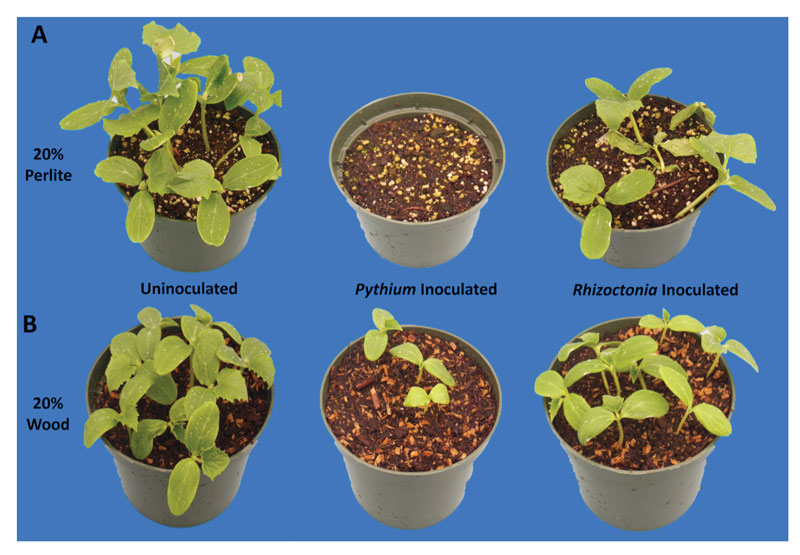
While many growers have adopted substrates containing engineered wood components over the past few years, a change in substrate can be very disruptive to a grower’s production system, affecting everything from water and nutrition to pest and disease control. Wood components have unique properties compared to other substrates, such as peat moss, which may affect the activity of pathogenic and beneficial microorganisms in the rootzone.
Figure 1: Cucumber plant growth inoculated with Pythium or Rhizoctonia when grown in peat amended with 20% A) perlite; or B) hammer-milled wood chips.
Some findings
Pythium spp. are some of the most common and persistent pathogens in greenhouse crop production, and almost all greenhouse crops are susceptible to one or more species of Pythium, including P. aphanidermatum and P. ultimum. In addition to Pythium, Rhizoctonia solani is also an aggressive species that causes damping off, root rot, stem rots and blights.
To better understand substrate disease potential, several projects have been conducted to assess if peat-reduced substrates containing wood components are disease-conducive or disease-suppressive.
Dr. Garret Owen conducted a series of experiments back in 2011 at North Carolina State University to evaluate peat substrates amended with hammer-milled loblolly pine wood chip (Pinus taeda) aggregates on suppressiveness to P. ultimum and R. solani on cucumber seedling growth. Cucumber seeds were sown in substrates formulated to contain either 10%, 20% or 30% perlite or pine wood chips and were inoculated with no pathogen (control), 0.1 g L-1 P. ultimum or 0.05 g L-1 R. solani isolates.
In this study, the P. ultimum inoculum concentration of 0.1 g L-1 didn’t cause damping off in any substrate treatment, while R. solani severity of damping off was generally similar among perlite treatments, while less disease was observed in plants grown in substrates containing pine wood chips across all amendment rates (Figure 1).
In a second experiment, cucumber seedlings were sown in substrates formulated with either 20%, 30% or 40% perlite or pine wood chips and were inoculated with 0 (control), 1.2, 2.4 or 3.6 g L-1 P. ultimum isolates (increased concentrations from the first experiment). Disease severity of cucumber seedlings was similar across inoculation rates and among all substrates amended with pine wood chips.
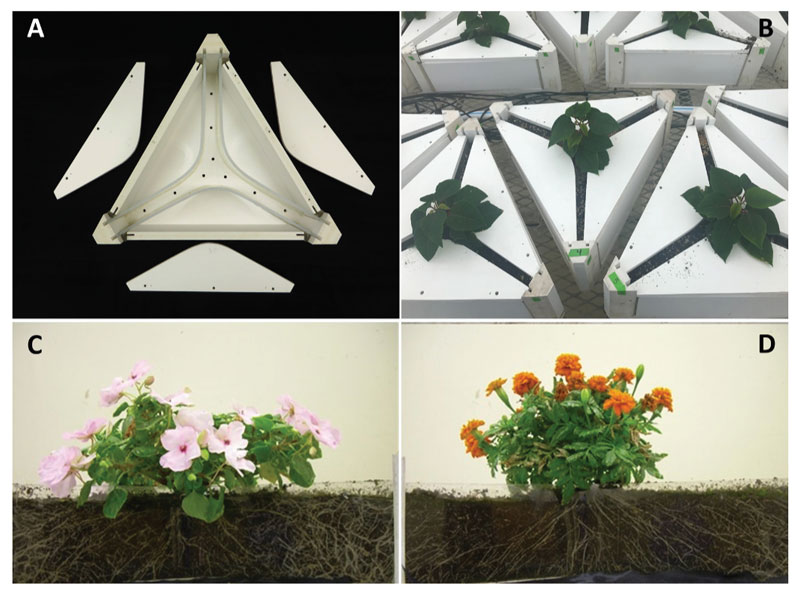
In 2013, Laura Barth conducted studies using a Mini-Horhizotron to investigate the disease severity of P. ultimum, P. aphanidermatum and R. solani on bedding plants grown in peat-based substrates containing 20% or 30% hammer-milled loblolly pine wood, and a commercially available substrate (Fafard 4P) that didn’t contain wood. Plants evaluated in these studies included snapdragon, impatiens, vinca, marigold, begonia and poinsettia (Figure 2). The clear sides of the Mini-Horhizotron provided the abilty to visually assess and measure root growth rate and development, as well as disease occurrence and severity of plant root systems in a non-destructive manner.
The results from these experiments concluded that disease severity of Pythium and Rhizoctonia was equal and often less prevalent in substrates amended with wood components compared to the commercial substrate, which offered additional evidence of the viability of pine wood materials to be used in peat substrates without risk of increased disease pressure.
 Assessing substrate type and source
Are plants grown in peat-wood substrates more or less susceptible to disease, and does wood type and source matter? Those were the questions we aimed to investigate in 2021 when we conducted several experiments to evaluate three wood substrate products for potential natural suppression of damping-off disease on radish caused by R. solani. In these experiments, sphagnum peat was amended with a hammer-milled wood material (loblolly pine), a refined wood fiber (Forest Gold, Pindstrup), an extruded fiber (GreenFiber, Klasmann) or perlite at 10%, 20% or 30% (by volume). Radish grown in the wood blends tended to have lower disease and higher above-ground plant growth compared to plants in the peatlite control.
Figure 2: Mini-Horhizotrons (A) used in disease experiments with B) poinsettia, C) vinca and D) marigold.
Results from these studies suggest that the inclusion of engineered wood products, regardless of blend ratio or type, may lessen the severity of damping off, and crown and root rot caused by R. solani. We evaluated wood components for effects on R. solani on radish, but we don’t know if the trends we observed hold for other plant species or other pathogens.
In 2022-2023, we conducted follow-up research to investigate if peat-wood substrate blends are disease-conducive or disease-suppressive against R. solani on two floriculture crops (geranium and impatiens). The same three wood products tested in the previous study were used in this experiment at 30% amendment rate.
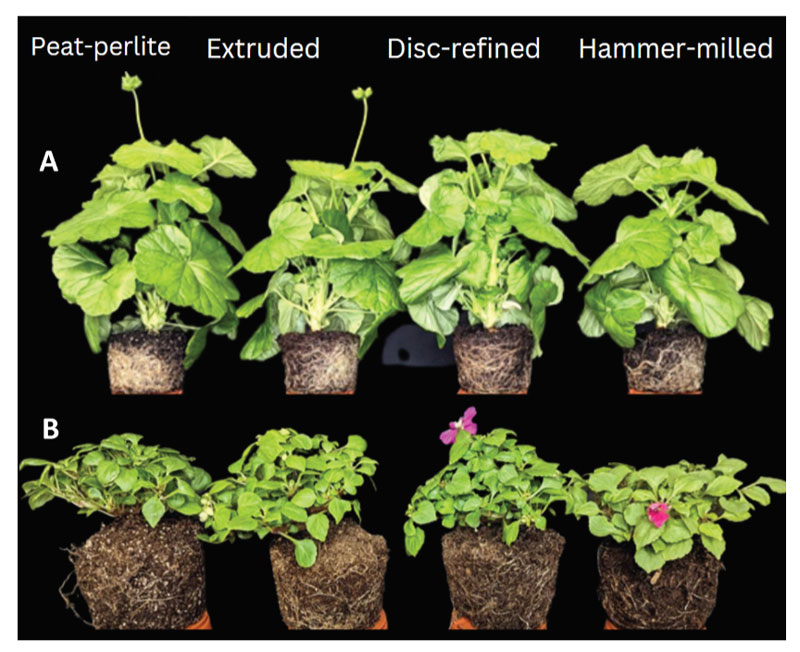
For geranium, there was no effect of wood inclusion on R. solani crown and root rot disease severity, and impatiens plants in the wood-amended substrate had lower disease severity compared to those in peatlite (Figure 3). These initial findings provide evidence that the inclusion of wood components may lessen, or at least have no negative effect on, crown and root rot on some floriculture crops.
 In summary, results from these and other research trials offer similar findings across multiple plant species, wood types and amendment rates that rootzone disease severity is at least equal to traditional peatlite substrates, with growing evidence of some disease suppressiveness in substrates containing wood products. (Details on these projects are available in the listed citations below.)
Figure 3: Geranium (A) and impatiens (B) grown in substrates amended with three engineered wood products.
Continued research projects on root-zone diseases in peat-reduced (wood fiber) substrates has recently been conducted at the University of New Hampshire in the Department of Plant Pathology with results forthcoming. Ongoing projects at NC State University funded by USDA are focusing on assessing disease threats and biofungicide efficacy in wood substrates, as well as other projects funded by the Horticultural Research Institute (HRI) to evaluate substrates for suppression of Phytophthora root and crown rot on greenhouse ornamentals. GT
Owen et al., 2019. Assessing the severity of damping-off caused by Pythium ultimum and Rhizoctina solani in peat-based greenhouse substrates amended with pine wood chip aggregates. Acta Hortic. 1266:27-34.
Kaderabek et al., 2019. The Mini-Horhizotron as a tool for assessing disease severity in container grown annuals. Acta Hortic. 1266:381-388.
Poleatewich et al., 2022. The Effect of Peat Moss Amended with Three Engineered Wood Substrate Components on Suppression of Damping-Off Caused by R. solani. Agriculture 12(12).
Poleatewich et al., 2025. The effect of peat moss amended with three engineered wood substrate components on suppression of crown and root rot in floriculture crops. Acta Hortic. 1426:267-273.
Dr. Brian E. Jackson is a Professor at North Carolina State University. He can be reached at Brian_Jackson@ncsu.edu. Dr. Anissa Poleatewich is the Senior Product Development Manager at Mycorrhizal Applications. She can be reached at anissa.poleatewich@mycorrhizae.com.